Nero didn't fiddle while Rome burned in AD 64
On this day · 19 July 64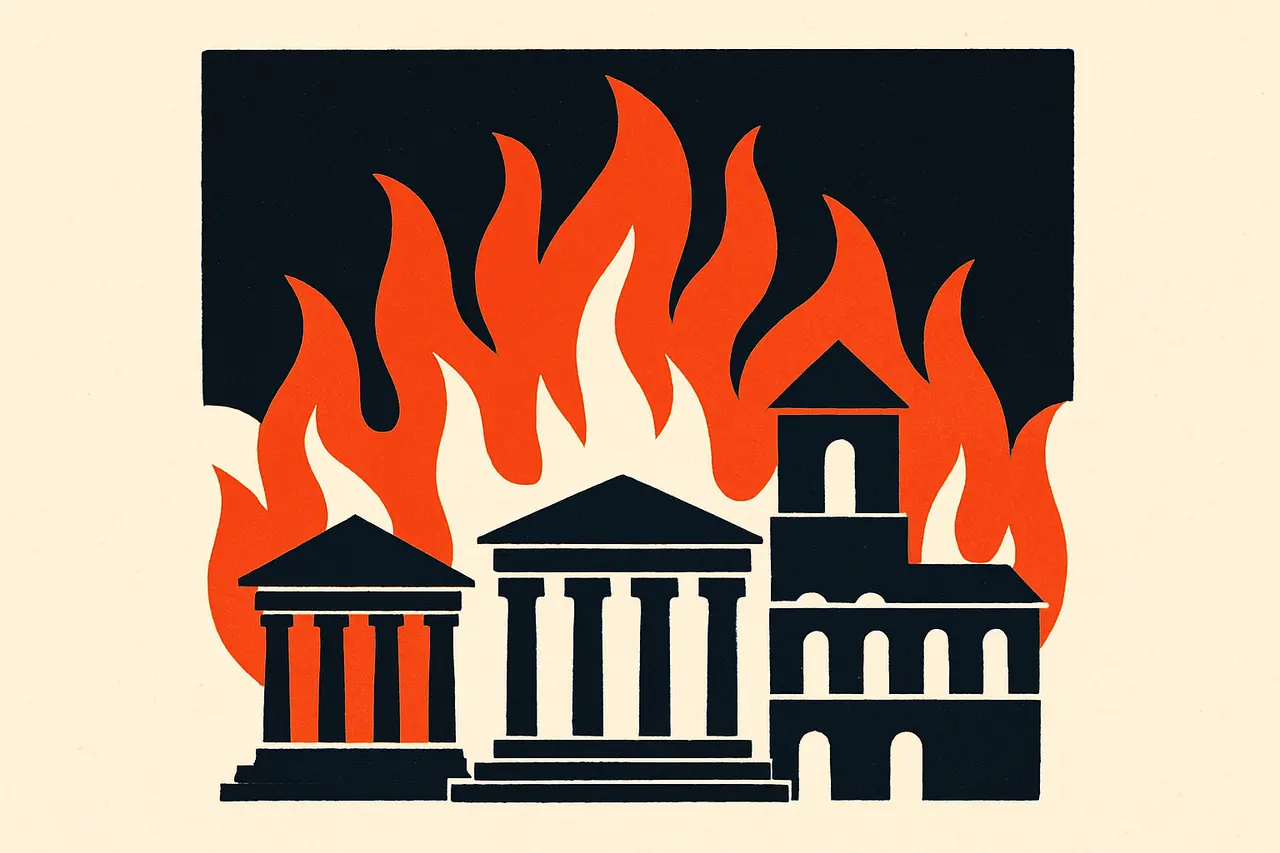
The Great Fire of AD 64 levelled three of Rome's 14 districts. The fiddle was not yet in use, and the singing story was a rumour.
The Great Fire of Rome broke out in July AD 64 among shops full of flammable goods at the end of the Circus Maximus. It burned for six days before being stopped at the foot of the Esquiline, then flared up again. Tacitus dates the first outbreak to 19 July; many modern accounts give the night of 18 to 19 July. He also gives the clearest tally of the damage. Of Rome’s 14 districts, 4 escaped untouched and 3 were levelled. In the other 7 only “a few dilapidated and half-burned relics of houses” survived.
Did Nero fiddle while Rome burned?
No. There was no fiddle to play: bowed string instruments did not become popular for about another thousand years. If Nero accompanied himself on anything, it would have been the cithara, a seven-stringed relative of the lyre. Tacitus does not say Nero performed at all. He reports a rumour that while the city burned, Nero climbed onto his private stage and sang of the fall of Troy. According to Tacitus, Nero was at his villa in Antium, on the coast south of Rome, when the fire started, and returned only as the flames neared his palace.
Did Nero start it?
Tacitus says it was uncertain whether the fire was “due to chance or to the malice of the sovereign”. The harshest version comes from Suetonius, who was born after the fire and loathed Nero. Many historians now think the men seen knocking down buildings were creating firebreaks, not carrying out an imperial building scheme.
Nero’s response looks better than his reputation. He opened the Campus Martius and his own gardens to the homeless and cut the price of grain to three sesterces. He then rebuilt with wider streets, height limits and stone instead of timber, rules much like those London adopted after its own Great Fire in 1666. Rumours of arson persisted all the same, so Nero blamed and executed the city’s Christians.
Sources & references
4 referencesWell-established. Corroborated by 3 independent sources.