The First Commercial Electric Telegraph Was Demonstrated
On this day · 25 July 1837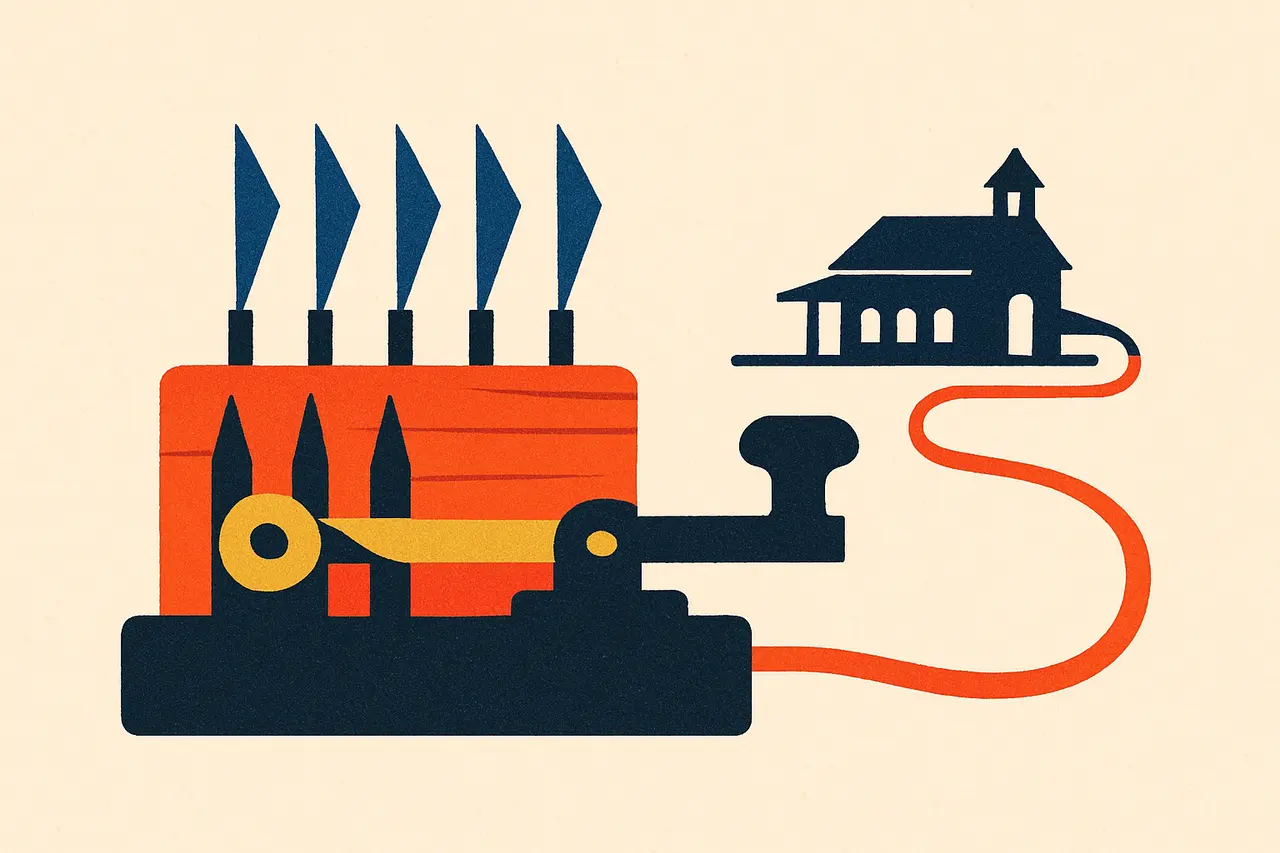
On a London railway line, two inventors flicked needles across nearly two kilometres and quietly ended the age of slow messages.
On 25 July 1837, inventors William Fothergill Cooke and Charles Wheatstone staged the first working demonstration of their commercial electric telegraph for directors of the London and Birmingham Railway. The trial ran along a temporary line strung between Euston and Camden Town, a distance of roughly 2.4 kilometres.
Their patented system used a board of swinging needles driven by electric current. By deflecting one or two needles at a time, an operator could point to letters of the alphabet, letting a message travel down the wire faster than any rider or signal flag could carry it.
A few twitching needles on a dial had just outrun the horse and the semaphore.
The railway directors did not adopt the system immediately. But the principle was proven, and in 1839 Cooke installed a working line beside the Great Western Railway from Paddington to West Drayton, launching the telegraph as a practical public technology and the foundation of modern electrical communication.
Sources & references
2 referencesWell-established. Corroborated by 2 independent sources.