The 1974 Arecibo message won't reach M13 for 25,000 years
On this day · 16 November 1974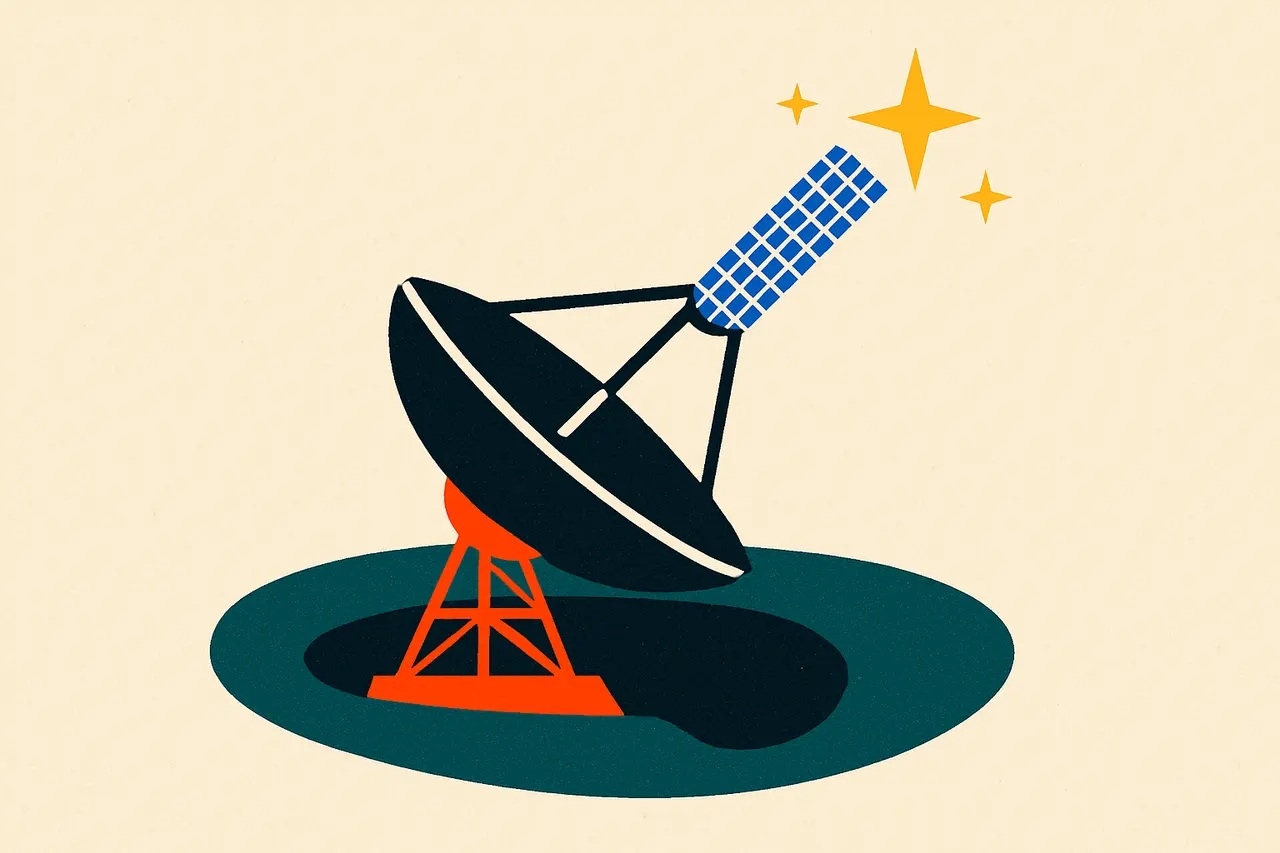
Arecibo's 1,679-bit broadcast of 16 November 1974 was a three-minute showcase for a new radar transmitter, aimed at a star cluster 25,000 light-years away.
The Arecibo message was a 1,679-bit radio transmission beamed from Puerto Rico’s Arecibo Observatory on 16 November 1974 toward M13, a globular cluster of about 300,000 stars some 25,000 light-years away, so it will not get there for roughly 25,000 years.
Cornell astronomer Frank Drake designed it as a grid of 23 by 73, the two primes whose product is 1,679, so a recipient could find the right shape. The bits sketch the chemistry of life, the structure of DNA, a human figure, the solar system and the telescope itself. Drake tested it on his friend Carl Sagan, who had not helped write it. The colourful version widely shared online is a later addition; colours were added to label the parts of what was plain binary.
It was never a serious attempt to start a conversation.
“It was strictly a symbolic event, to show that we could do it.” — Donald Campbell, Arecibo research associate in 1974
M13 was picked partly because it would be overhead during the ceremony; the dish, set in a sinkhole, could not be fully steered. Not everyone approved: some critics argued that announcing ourselves might attract hostile aliens.
The message’s timeline
- 16 November 1974: sent once, over about three minutes at 2,380 MHz, to mark the dedication of the upgraded 1,000-foot dish and its powerful new radar transmitter.
- 1 December 2020: the telescope’s instrument platform fell into the dish, so the instrument that sent it is gone.
- Half a century on: the message is about 50 light-years out, roughly 0.2% of the way.
- In about 25,000 years: it reaches M13. Most of the cluster’s stars will have drifted out of the beam by then, but a similar telescope in its path would find it 10 million times stronger than the Sun’s normal radio emission.
- Another 25,000 years later: the earliest any reply could come back.
Sources & references
4 referencesWell-established. Corroborated by 4 independent sources.