The gut's surface is about 30 m², not a tennis court
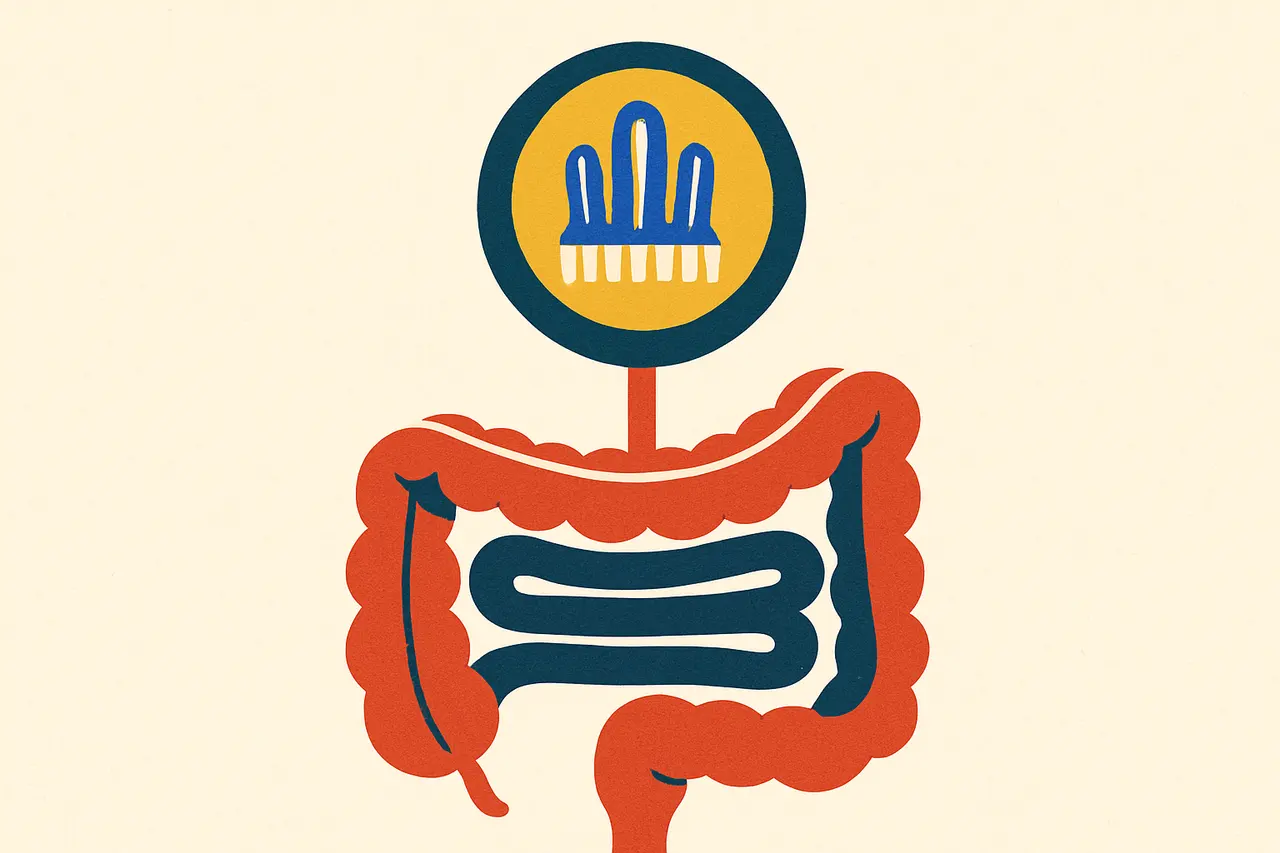
Three layers of folds give the small intestine about 30 square meters of lining — a studio apartment, not the tennis court of old textbooks.
The inner absorbing surface of the human small intestine covers about 30 square meters, roughly the floor space of a studio apartment, even though the tube itself is only about 2.5 centimeters wide. It gets there through three nested levels of folding.
- Circular folds (plicae circulares) ripple the lining and enlarge it by about 1.6 times.
- Villi, millions of finger-like projections on those folds, multiply the area about 6.5 times.
- Microvilli, microscopic bristles on every absorptive cell, add a further factor of about 13.
The tennis-court myth
For decades, medical textbooks said the gut’s lining would cover a tennis court, with estimates running from about 180 to 300 m². In 2014, Gothenburg researchers Herbert Helander and Lars Fändriks re-measured it and arrived at about 32 m² for the whole digestive tract, almost all of it (30 m²) in the small intestine and just 1.9 m² in the large intestine. Half a badminton court is a better picture.
The old figures were inflated by how they were obtained. Earlier measurements were made at post-mortem or during abdominal surgery, when the gut’s muscle tissue is relaxed. The Swedish team instead combined data from radiological examinations with their own microscope and endoscope studies of the lining. Helander argued that the smaller number also makes biological sense:
“From an anatomical point of view, the smaller area is quite logical since it means that the risk of effects from the intestinal contents is lower.”
Even corrected, the gut’s lining is about 15 times the area of your skin (around 2 m²), though still smaller than the lungs’ 50 m². That surface is where digested nutrients cross into the blood, which is why diseases that flatten the villi cause malnutrition even when a person eats normally.
Sources & references
4 referencesWell-established. Corroborated by 4 independent sources.