Several countries have no permanent rivers at all
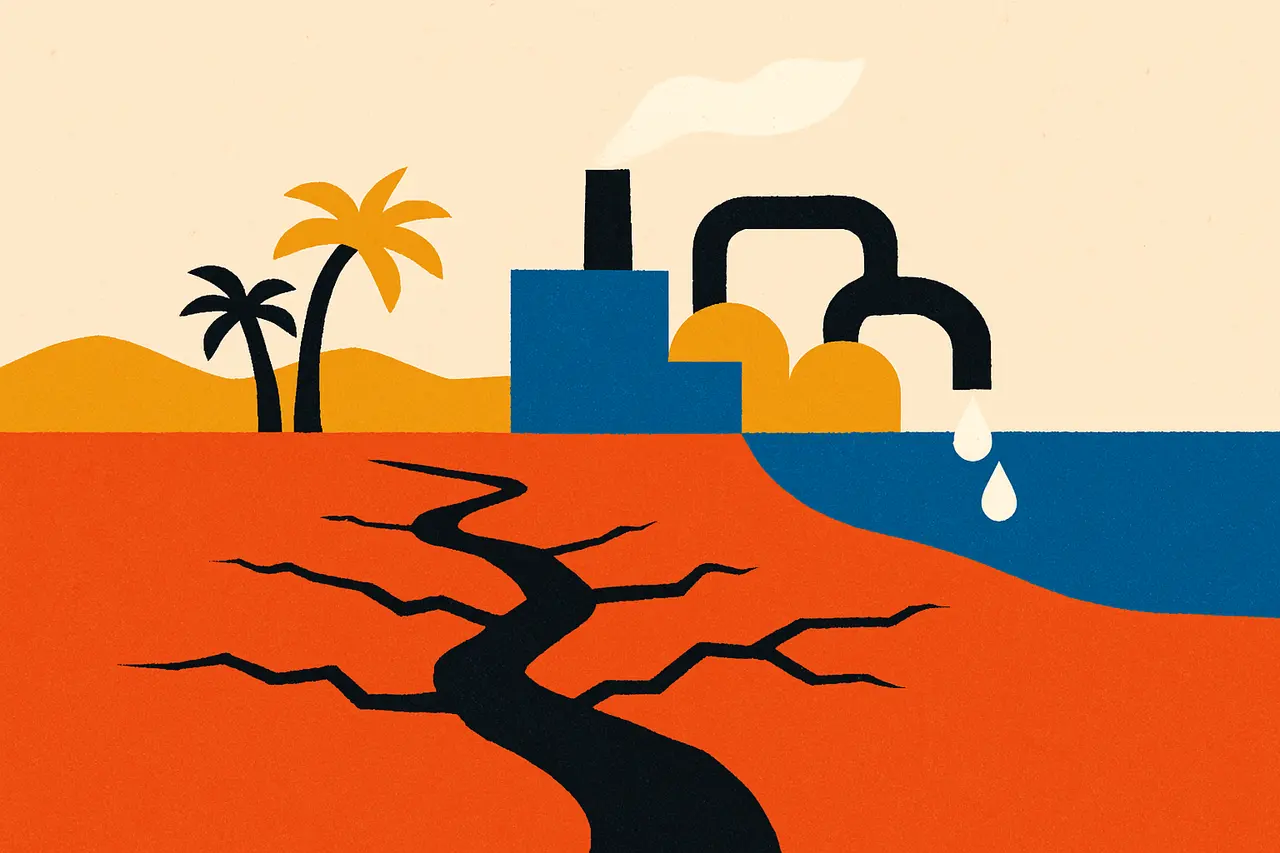
Roughly 19 nations — including Saudi Arabia, Qatar, Kuwait, the UAE, Bahrain, and the Maldives — have not a single permanent natural river.
We treat rivers as a default feature of a country, like a capital or a flag. Yet about 19 sovereign states have no permanent natural river anywhere inside their borders.
Most are clustered on the Arabian Peninsula — Saudi Arabia, Qatar, Kuwait, the United Arab Emirates, Bahrain, Oman, and Yemen — the largest region on Earth without a single perennial river. The reason is brutal arithmetic. Saudi Arabia, the largest country on the list, averages only about 50 millimeters of rainfall a year, and its desert heat evaporates standing water faster than it can collect. Any flow that does appear runs through wadis — dry channels that fill briefly after a rare storm, then vanish.
The rest of the riverless club are tiny by a different logic: low coral islands and atolls like the Maldives, Kiribati, Nauru, and Tuvalu, where rainwater simply soaks straight through porous ground before a river can form, plus micro-states such as Monaco and Vatican City.
No river does not mean no water — it means the water comes from somewhere harder.
These nations survive on engineered and hidden supplies: desalination plants turning seawater fresh, non-renewable “fossil” groundwater pumped from ancient aquifers, and harvested rain. In Saudi Arabia, desalination alone provides about two-thirds of municipal water. It is a vivid reminder that the map’s blue lines are a luxury, not a guarantee — and that some of the world’s wealthiest economies have built themselves on water they manufacture or mine.
Sources & references
2 referencesWell-established. Corroborated by 2 independent sources.