Roman hypocausts: underfloor heating 2,000 years ago
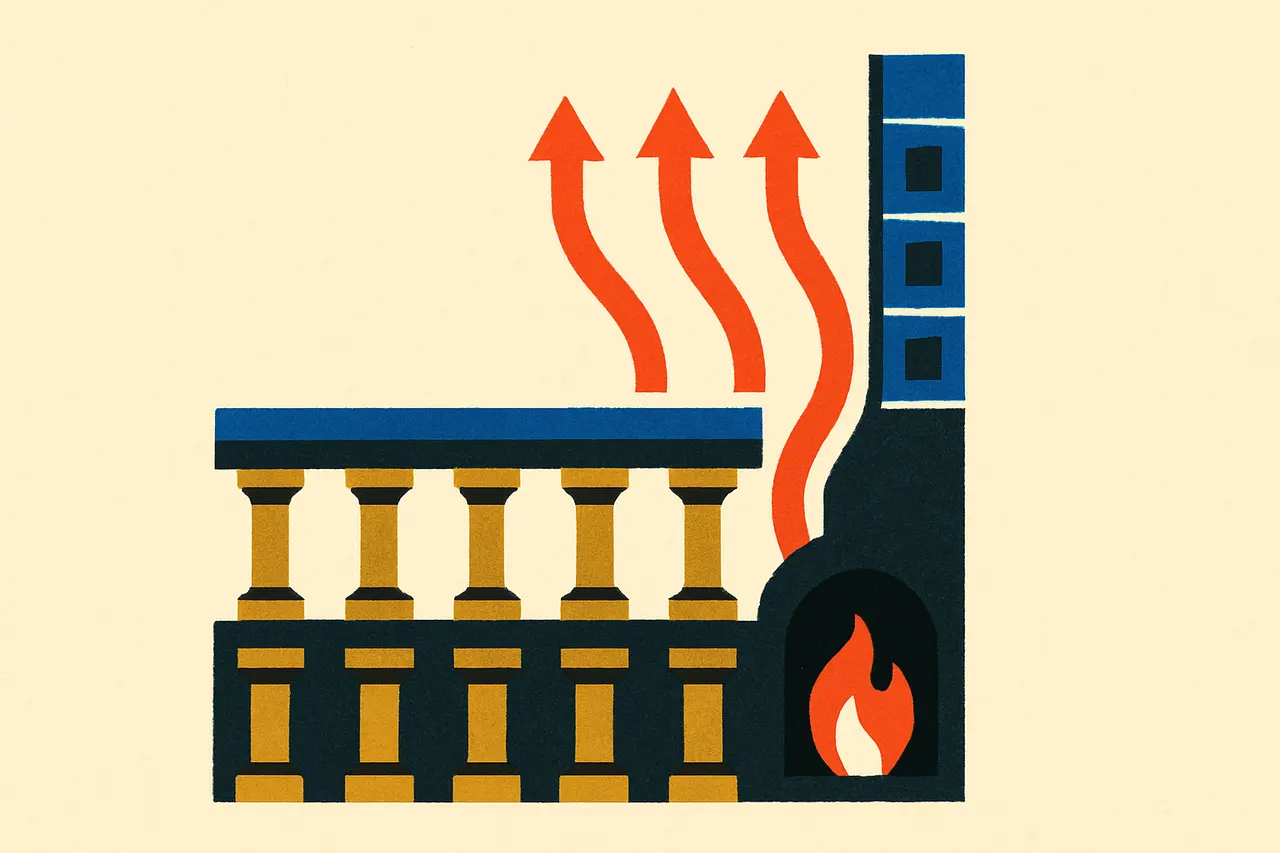
Roman baths were heated from below by furnace air under raised floors. Contrary to the usual story, the idea did not die with Rome.
The Romans heated bath-houses and the best rooms of wealthy homes with the hypocaust, a system of hot air under raised floors that was probably invented in the 1st century BC. The name means “heated from below”. The floor sat on short stacks of tile or stone called pilae. A furnace, the praefurnium, fed hot gases into the cavity underneath, and the heat then rose through hollow ceramic box tiles in the walls before escaping through the roof.
The architect Vitruvius, writing in the late 1st century BC, gives a builder’s specification. The sub-floor should be laid sloping towards the furnace, so that a ball thrown in would roll back to the furnace mouth and the flames would spread evenly underneath. Piers of eight-inch bricks were to stand two feet high, topped with two-foot tiles.
Baths were zoned by their distance from the fire:
| Room | Position | Typical heat |
|---|---|---|
| Caldarium (hot room) | Joined to the furnace | about 40°C |
| Tepidarium (warm room) | Further along the air path | about 30°C |
| Frigidarium (cold room) | Unheated | air temperature |
In the caldarium the floors and walls were too hot to touch, so bathers wore wooden sandals. The cost was fuel and the labour of stoking the furnace, which kept hypocausts a luxury of baths and rich houses.
The common claim that underfloor heating disappeared with the Western Empire for a thousand years is overstated. Public baths decayed, but hypocausts went on being built in early medieval monasteries, lived on in the Byzantine Empire and passed into Arab hammams. By the early 14th century, or possibly earlier, northern Europe had developed the heat-storage hypocaust: stones piled on the furnace vault soaked up heat and released it through floor vents long after the fire died. In 1822, engineers fired the 400-year-old system at Malbork Castle in Poland for three and a half hours. It raised the temperature of an 850-square-metre hall from 6°C to 22.5°C in 20 minutes.
Sources & references
7 referencesWell-established. Corroborated by 3 independent sources.