Radiocarbon dates aren't calendar dates until calibrated
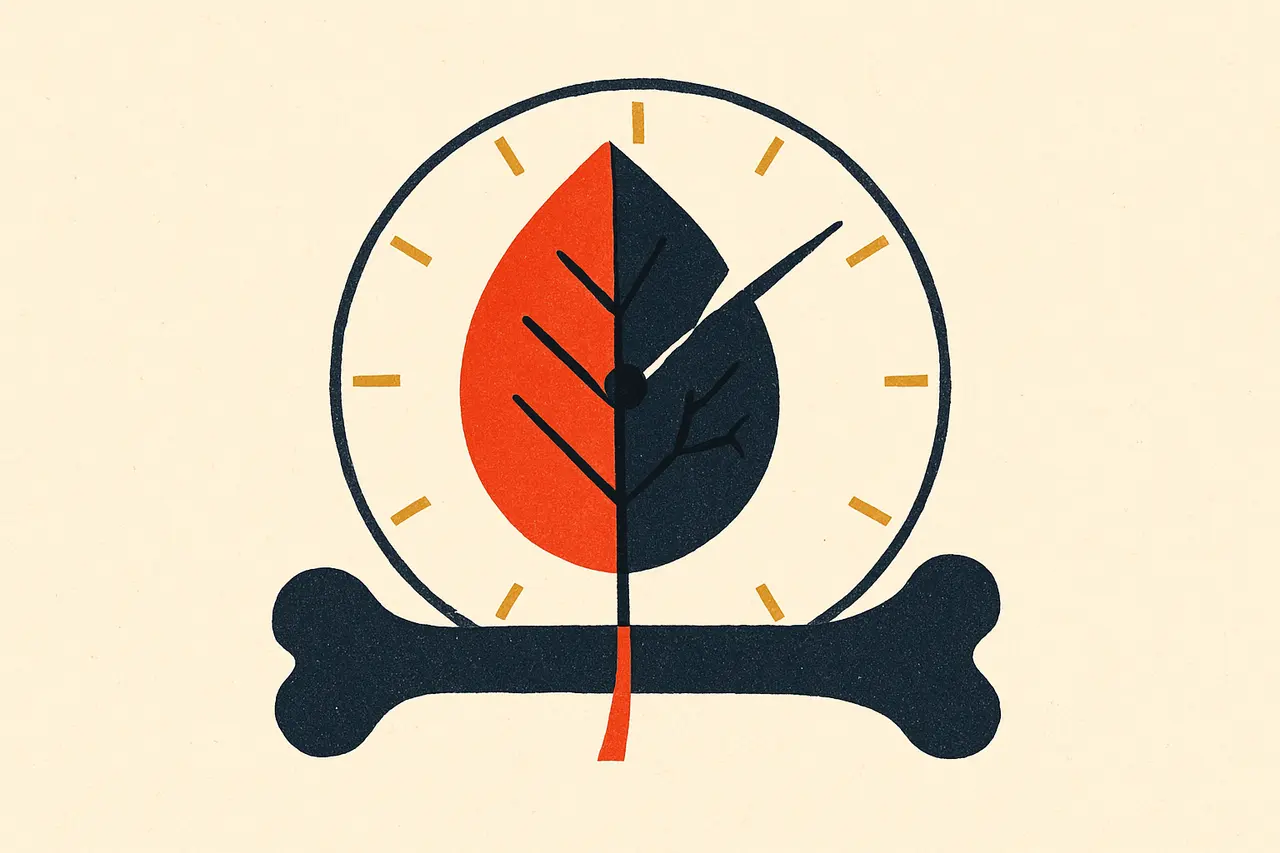
Carbon-14 dating, devised by Willard Libby in the 1940s, still uses his old half-life and needs tree-ring calibration to give true calendar ages.
Radiocarbon dating, developed by chemist Willard Libby at the University of Chicago in the late 1940s, estimates when a plant or animal died by measuring how much of its carbon-14 is left, and it reaches back about 50,000 years. Living things absorb carbon-14 from the air; at death the intake stops and the isotope decays, halving roughly every 5,730 years. Libby won the 1960 Nobel Prize in Chemistry for the method.
Is a radiocarbon date the same as a calendar date?
No. A raw lab result is a “radiocarbon age” in years BP, before present, with “present” fixed at 1950. It rests on two assumptions known to be wrong. Laboratories still calculate it with Libby’s original half-life of 5,568 years rather than the more accurate 5,730, to keep decades of results comparable. They also assume the atmosphere’s carbon-14 level never changed, which it did.
Calibration fixes both. The sample is matched against tree rings of known calendar age, compiled by the international IntCal group; overlapping sequences from pines, oaks and kauri now span over 14,000 years. Oxford’s radiocarbon unit gives a worked example: a measurement of 3000 ± 30 BP calibrates to between 1375 and 1129 cal BC at 95% confidence. The answer is a range, and older than simply subtracting 3,000 from 1950 would suggest.
The method also dates the organism, not the object. Stone, metal and pottery cannot usually be dated directly, and a date on a wooden beam records when that tree ring grew, not when the beam was cut.
What has radiocarbon changed?
Libby first tested artefacts of known age, including linen wrappings from the Dead Sea Scrolls and a deck plank from the tomb of Egypt’s Sesostris III. Then came surprises: wood buried by glaciers showed North America’s last Ice Age ended no later than about 11,000 years ago, not 25,000 as assumed. The technique later fixed Ötzi the Iceman at about 5,300 years old.
Humans have since altered the clock itself: 1950s and 1960s bomb tests spiked atmospheric carbon-14, a marker now used to date tissue formed in living people.
Sources & references
4 referencesWell-established. Corroborated by 3 independent sources.