Mariner 4's first Mars photos showed only 1% of the planet
On this day · 14 July 1965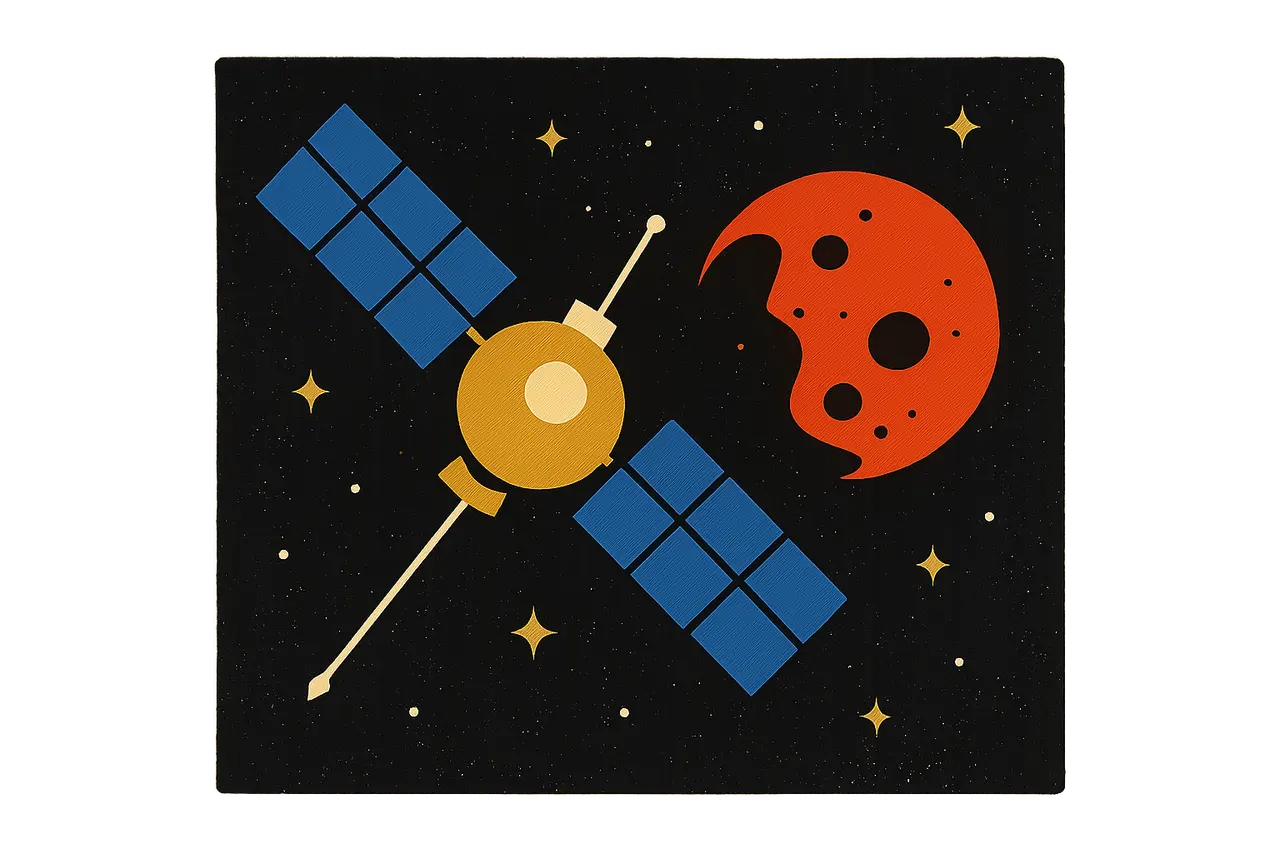
Mariner 4's 1965 photos made Mars look like a dead, Moon-like world. They also happened to capture some of its oldest ground.
NASA’s Mariner 4 took the first close-up pictures of Mars on 14 July 1965, flying past at 6,118 miles (9,846 km) and capturing 21 complete images, plus 22 lines of a 22nd. That is why sources variously say 21 or 22: the last frame was partial, and frames 20 to 22 were taken in darkness.
The data crawled home at 8⅓ bits per second, so each picture took about 10 hours to transmit. Too eager to wait for the computer, engineers at the Jet Propulsion Laboratory pinned printed strips of numbers side by side and hand-coloured them like a paint-by-numbers picture. The result was framed and given to JPL director William Pickering.
The pictures showed a heavily cratered, Moon-like surface, with no canals and no sign of life, and they ended a long run of speculation about Martian civilisations. A radio experiment, timed as the probe passed behind the planet, found a surface pressure of about 1% of Earth’s and suggested future landers would need retro-rockets as well as parachutes.
But it was a lucky, misleading sample. The images covered only about 1% of Mars, at a best resolution of just under a mile per pixel. By chance they fell on some of the planet’s oldest, most cratered terrain, missing its more varied, geologically younger features. Later orbiters, from Viking to Mars Reconnaissance Orbiter, have since photographed the same patch of ground in ever finer detail; today, NASA’s HiRISE camera sees it at 50 cm per pixel.
When the full set was released at the White House on 29 July 1965, President Lyndon Johnson said:
“This advance for mankind is awe-inspiring.”
Sources & references
5 referencesWell-established. Corroborated by 3 independent sources.