How the Inca ran a 24,000-mile road with knotted cords
The Qhapaq Ñan was built without wheels, iron or an alphabet — but not from scratch, and not quite without records.
The Inca road network, the Qhapaq Ñan, stretched some 24,000 miles (about 39,000 km) from southern Colombia to central Chile, and was built without wheels, iron tools or an alphabet. That is close to the distance around the Earth at the equator.
It was not all built from scratch. The American Society of Civil Engineers, which lists the road among its historic civil engineering landmarks, notes that it incorporated earlier routes of the Chavín, Tiwanaku, Wari and Chimú cultures, going back as far as 1000 BC. Inca rulers from Pachacuti onward extended and joined them into one imperial system, adding way stations at roughly 12-mile intervals, stairways on steep grades and culverts for drainage. Parts stayed in use into the 20th century, and the network invites comparison with Persia’s Royal Road and Rome’s highways.
How the empire kept records without writing
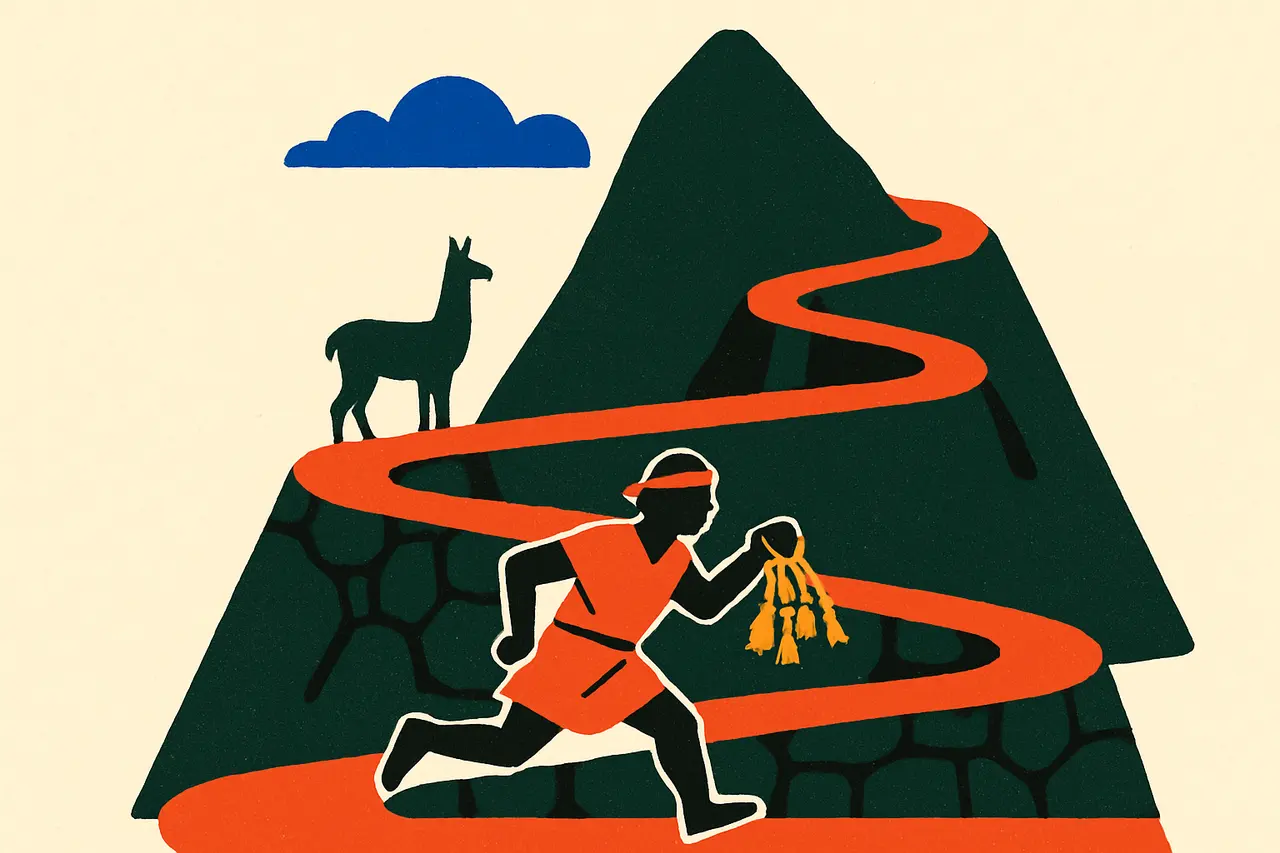
“Without writing” needs a footnote. The Inca recorded information on khipus: cords dyed in many colours, knotted and hung from a horizontal cord, which held both numerical and narrative information. Harvard anthropologist Gary Urton has studied some 600 of them. In 2017 he and undergraduate Manny Medrano matched six khipus to a Spanish census of 132 tributaries recorded in 1670, and showed that the way each cord was attached encoded villagers’ social groups — in their paper’s words, the first instance of “reading” information from khipu attachment knots. Like the first writing in Mesopotamia, the system was built for counting people and goods, and it is still only partly understood: that census match remains the only one found so far.
The road’s engineering also survives in living practice. Deep gorges were crossed on suspension bridges of braided natural fibre, and one, the Q’eswachaka over the Apurímac River in southern Peru, is still renewed every year by local Quechua communities using traditional Inca techniques and raw materials. The rebuild takes just three days, and UNESCO added it to its list of intangible cultural heritage in 2013.
Sources & references
3 referencesWell-established. Corroborated by 3 independent sources.