Philip IV arrested the Templars on Friday 13 October 1307
On this day · 13 October 1307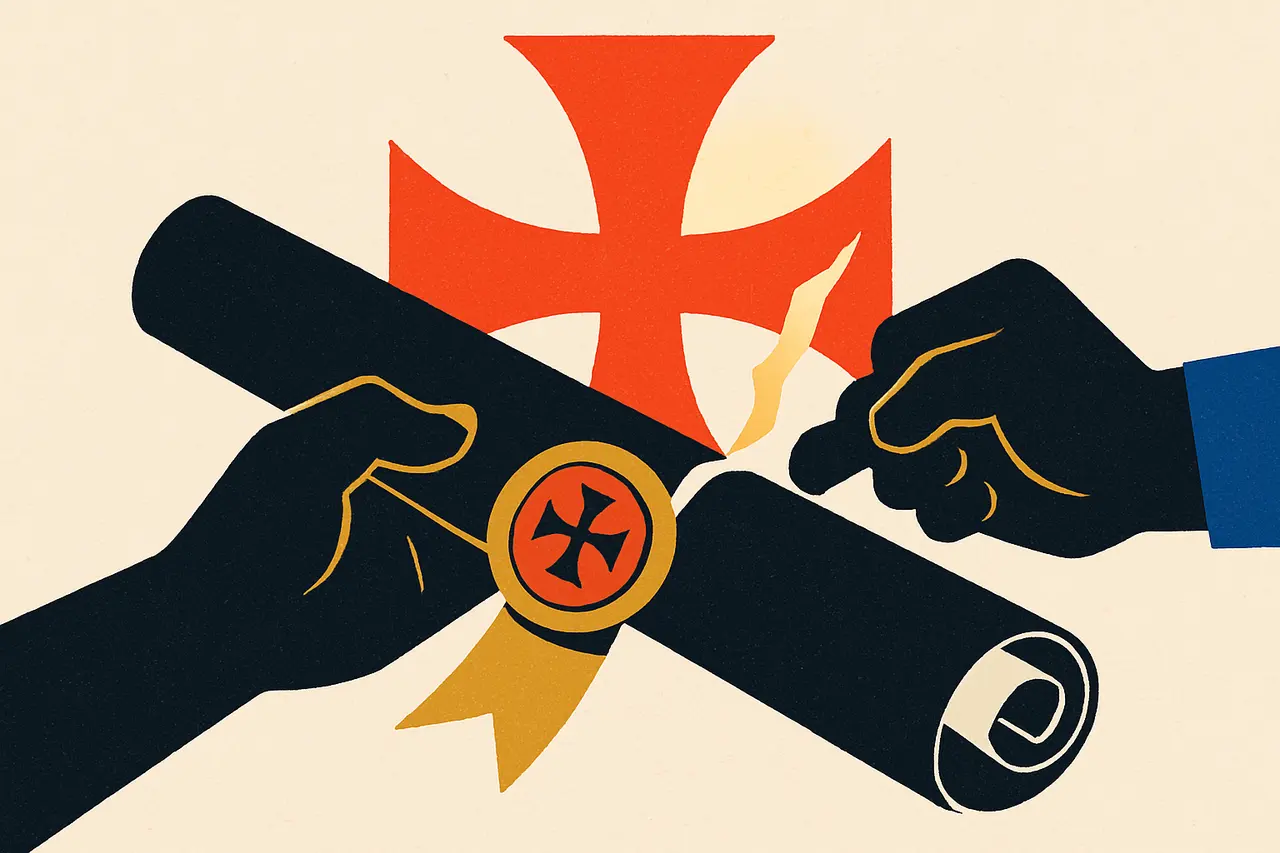
France's king seized hundreds of Templars in one dawn sweep. A 22-metre interrogation roll and a Vatican parchment show what happened next.
King Philip IV of France had the Knights Templar in his kingdom arrested in a single coordinated raid on Friday, 13 October 1307, seizing hundreds of brothers, including Grand Master Jacques de Molay, on charges of heresy. Orders had gone out weeks earlier so that royal officers everywhere could strike at once and catch the order by surprise.
Philip owed the Templars a great deal of money. Founded around 1119 as warrior-monks — the order won papal recognition a decade later — they had become bankers to Christendom, issuing notes of credit that let travellers draw funds abroad. Accusing his creditors of denying Christ and worshipping idols let the king wipe out his debts and seize their property.
How do we know what the prisoners said?
From a single extraordinary document. The French National Archives hold a roll 22 metres long, stitched from 44 parchment membranes made from the skins of 22 goats, recording the interrogation of the 138 Templars arrested in Paris, aged 16 to 80. They were questioned between 19 October and 24 November 1307, often under torture, and the confessions extracted there became the case against the whole order.
In 2001 the Italian scholar Barbara Frale recognised a second key record in the Vatican archives: the Chinon Parchment. It shows that papal envoys questioning the order’s leaders at Chinon in August 1308 absolved them and readmitted them to the Church. Pope Clement V still dissolved the order in 1312 under Philip’s pressure, and de Molay was burned in Paris in March 1314.
Is this why Friday the 13th is unlucky?
No. The link is a modern rationalisation, spread by novels such as The Da Vinci Code. Thirteen and Friday were each thought unlucky separately, but “Friday the 13th” as a combined superstition is not attested until centuries after the Templars; one theory credits a 1907 novel titled Friday, the Thirteenth. Medievalist Helen Nicholson’s verdict on the order itself is blunter: the evidence shows them to be “extremely boring Roman Catholics”.
Sources & references
3 referencesWell-established. Corroborated by 3 independent sources.