Humans share about 99.6% of their DNA, not 99.9%
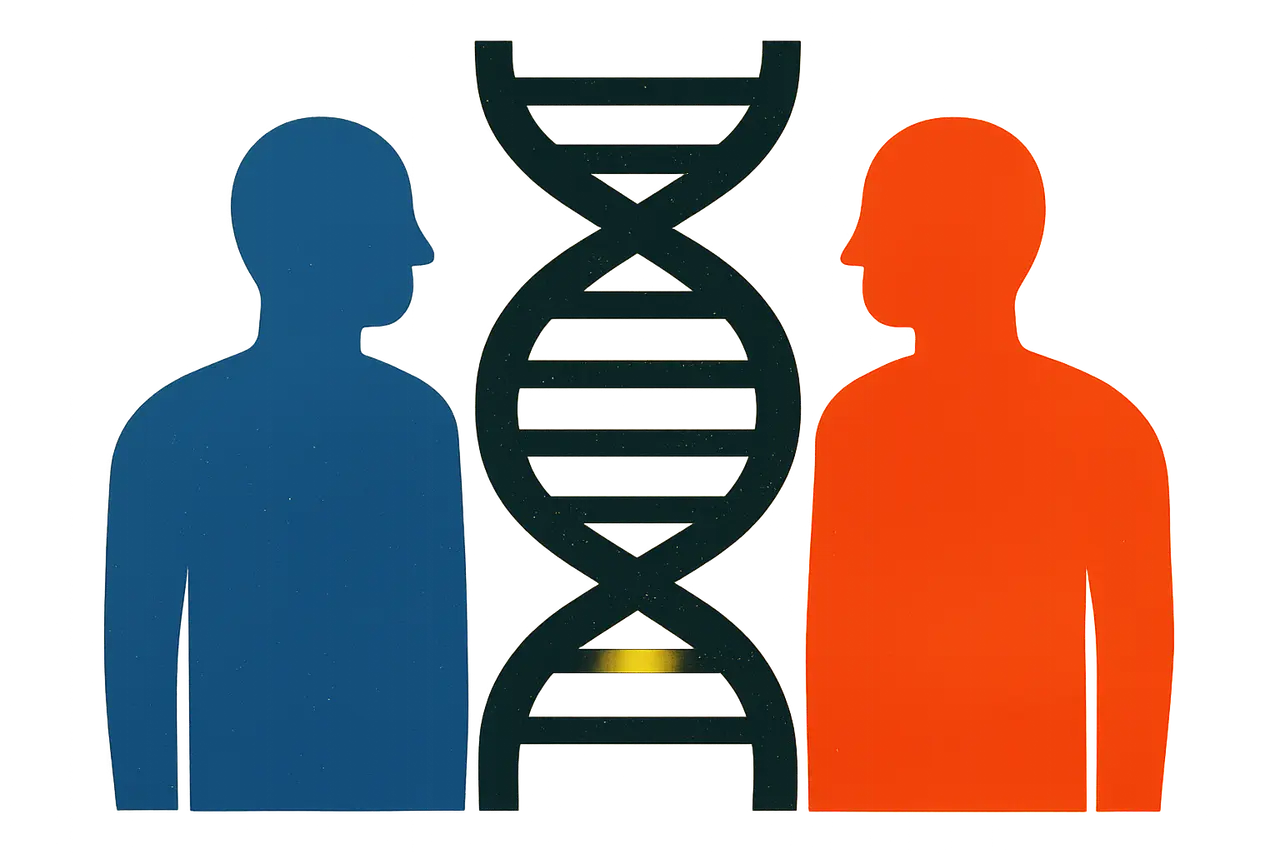
The famous 99.9% figure counts only single-letter differences. Add the bigger DNA changes and any two people are about 99.6% identical.
Any two people’s genomes are about 99.6% identical, according to the U.S. National Human Genome Research Institute (NHGRI) — not the 99.9% figure still repeated in textbooks and search results. The correction nearly quadruples the share of our DNA that varies from person to person.
Where does the 99.9% figure come from?
It counts only single-letter swaps. NHGRI says it rests on two people differing at one DNA letter roughly once every 1,300 nucleotides; NIH’s general medical sciences institute puts that 0.1% at about 3.2 million base pairs. NHGRI now calls that number “an over-simplification”, because it ignores variants that change many letters at once.
How much of our DNA really differs?
About 27 million positions, or ~0.4%. Compared with a reference genome, a typical person’s ~6-billion-letter genome carries roughly:
- 5 million single-letter variants, touching ~5 million letters
- 600,000 small insertions and deletions, touching ~2 million letters
- 25,000 structural variants, touching more than 20 million letters
Structural variants — stretches of 50 to thousands of letters that are inserted, deleted, inverted or moved — are the rarest kind of event, yet they account for most of the differing DNA. NHGRI cautions that these are current averages and will shift as more genomes are sequenced end to end.
Most single-letter differences are SNPs, variants shared by at least 1% of people. Each of us carries roughly 4 to 5 million, but researchers have catalogued more than 600 million across the world’s populations. That diversity is why a single reference genome represents some people poorly, and why scientists are now assembling a pangenome built from many individuals’ sequences.
Packed into that slim margin are differences that help shape how we respond to drugs and toxins and our risk of disease. Whichever figure you use, the visible variety of our species rides on well under 1% of our DNA.
Sources & references
4 referencesWell-established. Corroborated by 3 independent sources.