Carter wrote "Yes, it is wonderful", not "wonderful things"
On this day · 26 November 1922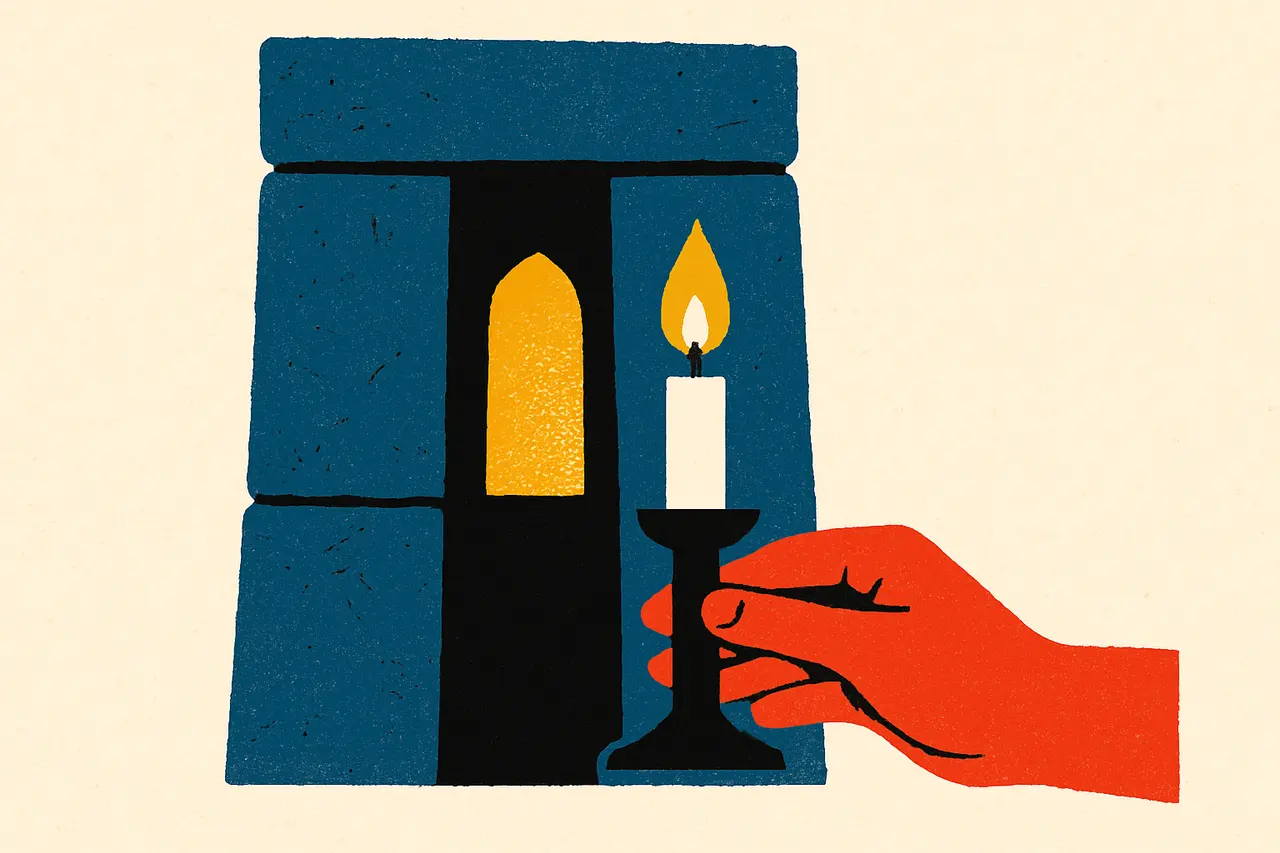
On 26 November 1922 Howard Carter first peered into Tutankhamun's tomb. His journal records a plainer line than the one he later published.
Howard Carter first looked into Tutankhamun’s tomb on the afternoon of 26 November 1922, holding a candle to a small hole in a sealed doorway. In his journal, his reply to Lord Carnarvon was “Yes, it is wonderful”, not the famous “wonderful things”.
That day his team had cleared 9 metres of rubble-filled passage below the stairway found earlier that month. They reached a second sealed doorway, stamped with the seals of Tutankhamun and the royal necropolis. Carter noticed the plaster had been opened and resealed more than once. While clearing the passage they had found broken jars and fragments of small objects mixed into the rubble, signs that he wrote “pointed towards plundering”. The tomb was nearly intact, but robbers had got in during ancient times.
Carter widened the breach and looked in. Carnarvon, his daughter Lady Evelyn Herbert, the engineer Arthur Callender and the Egyptian foremen (reises) waited behind him.
Did Carter really say “wonderful things”?
Probably not in those words. “Yes, wonderful things” is the version Carter printed in the first volume of The Tomb of Tut.ankh.Amen, written with Arthur Mace and published in 1923. His excavation journal, now in Oxford’s Griffith Institute, records the moment differently:
“Lord Carnarvon said to me ‘Can you see anything’. I replied to him Yes, it is wonderful.” — Howard Carter, excavation journal, 26 November 1922
The catalogue of the Bodleian’s 2022 centenary exhibition leans towards the journal version, because it was written close to the events. The printed line may simply have been polished for readers.
Was this the burial chamber?
No. The hole looked into the Antechamber. Once they had an electric torch, Carter could make out gilded couches, chests and two black, gold-sandalled statues of the king carrying a staff and mace. Those statues guarded another sealed wall. The burial chamber behind it was officially opened on 16 February 1923, almost three months later.
Sources & references
3 referencesWell-established. Corroborated by 3 independent sources.