Are 1 in 200 men descended from Genghis Khan? Probably not
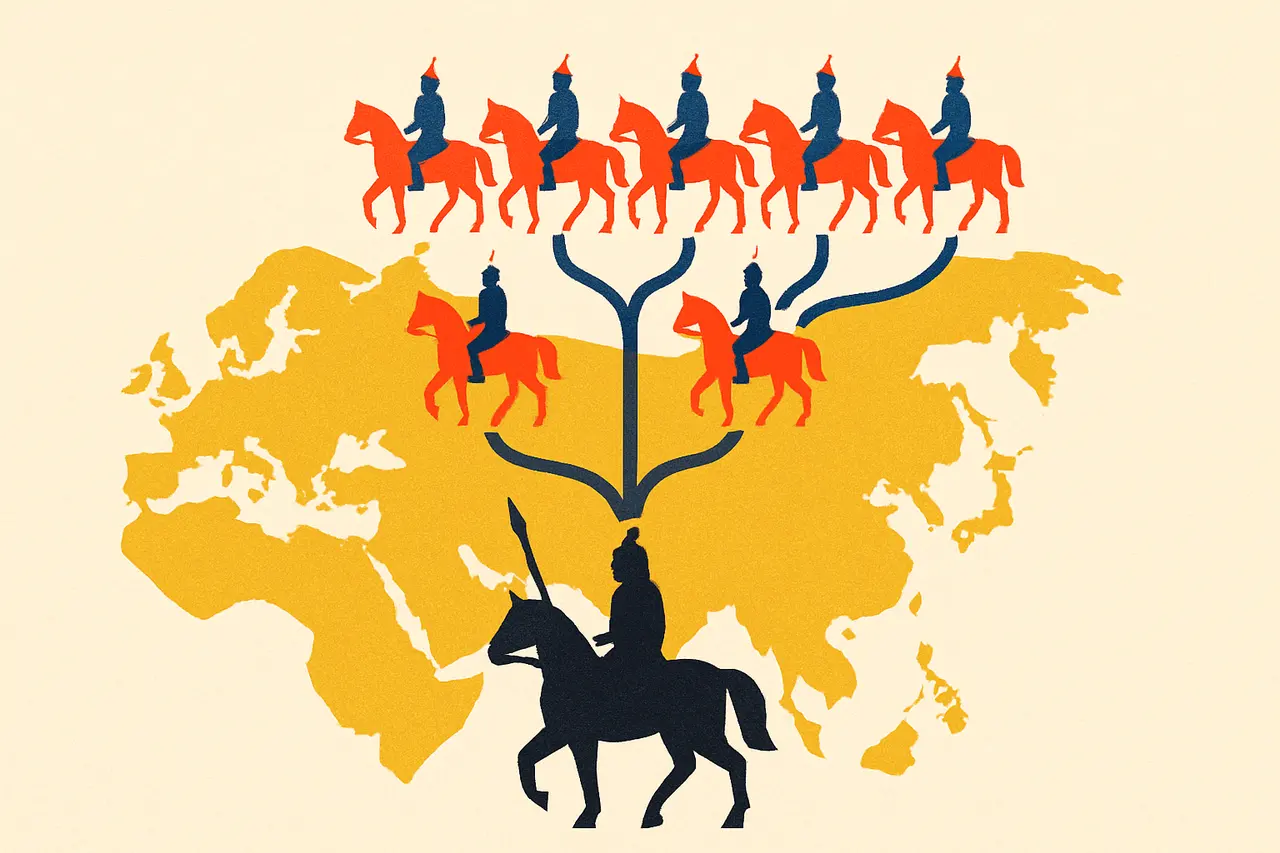
A 2003 study tied 16 million men to Genghis Khan. Newer genetics dates their shared lineage to well before he was born.
The claim that about 1 in 200 men alive today — roughly 16 million — descend from Genghis Khan comes from a single 2003 study, and later genetics has largely undercut it: the lineage in question now looks about 2,500 years old, far older than the Mongol conqueror, who died in 1227.
Where did the 1-in-200 figure come from?
In “The genetic legacy of the Mongols”, published in the American Journal of Human Genetics, a team led by Tatiana Zerjal found one Y-chromosome lineage in 16 populations stretching from the Pacific to the Caspian Sea. About 8% of men in that region carried it, roughly 0.5% of all men on Earth. Its variation suggested an origin in Mongolia about 1,000 years ago, a spread too fast for chance. The authors proposed “social selection”: Genghis Khan’s male-line descendants, ruling an empire and fathering many children, multiplied the lineage. It was always an inference; no DNA from Genghis Khan has ever been found, and his grave is unknown.
What do newer studies say?
In 2018, a team analysing 34 whole Y-chromosome sequences and data on 18,210 men from 292 populations re-dated the lineage’s most recent common ancestor to about 2,576 years ago (95% range 1,975–3,178). Its spread matches the diffusion of all Mongolic-speaking peoples rather than one ruler, and the authors concluded that direct evidence of a Genghis connection had yet to be discovered.
In February 2026, University of Wisconsin–Madison researchers led by Ayken Askapuli reported ancient DNA from men buried in Golden Horde mausoleums in Kazakhstan, the realm founded by Genghis Khan’s eldest son, Joshi. The elite men did carry a branch of the cluster — but one that is much rarer among modern men than the cluster’s common forms.
The defensible version is narrower: a large share of men across Central and East Asia share a paternal lineage that spread with Mongolic-speaking peoples, including during the Mongol Empire’s expansion. Whether Genghis Khan himself carried it cannot be settled until his burial place is found.
Sources & references
4 referencesWell-established. Corroborated by 4 independent sources.