Galileo recanted in 1633, likely without 'and yet it moves'
On this day · 22 June 1633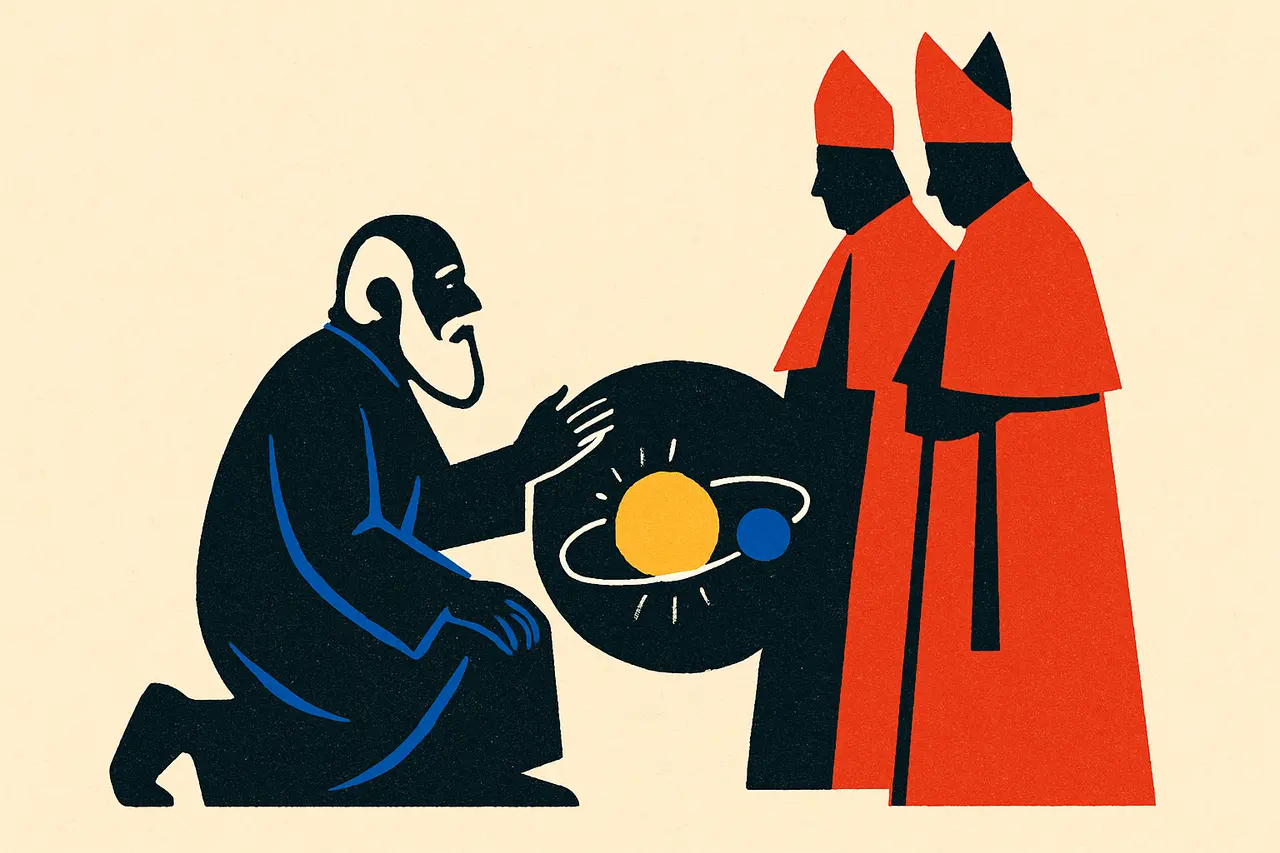
On 22 June 1633 Galileo knelt and abjured a moving Earth. The famous muttered retort first appears in print 124 years later.
Galileo Galilei recanted on 22 June 1633, kneeling in the convent of Santa Maria sopra Minerva in Rome while his sentence was read, then reciting and signing a formal abjuration of the idea that the Sun stands still and the Earth moves. The Roman Inquisition had found him “vehemently suspect of heresy” over his 1632 Dialogue Concerning the Two Chief World Systems.
The day before, at the last of four hearings in a trial that had begun in April, he was questioned about his true beliefs under a formal threat of torture and made to swear once more to tell the truth. Then came the ceremony:
“I abjure with a sincere heart and unfeigned faith, I curse and detest the said errors and heresies…” (Galileo’s abjuration, in the Shea and Artigas translation)
Did every inquisitor sign Galileo’s sentence?
No. According to the Galileo Project’s chronology, the sentence was signed by only seven of the ten cardinal-inquisitors, so the verdict was less united than the ritual suggests. His “formal imprisonment” was commuted to house arrest, first at the Tuscan embassy and the Archbishop of Siena’s palace and, from December 1633, at his villa in Arcetri near Florence, where he died in 1642.
Did he mutter “Eppur si muove”?
Probably not. The defiant “and yet it moves” is first documented in 1757, in Giuseppe Baretti’s The Italian Library, published in London more than a century after Galileo’s death, in a passage that also wrongly says he was tortured and held for six years.
A painting with the words written on a prison wall, said to date from 1643 or 1645, surfaced in Belgium in 1911 and briefly convinced some historians the phrase was genuine. Astrophysicist Mario Livio, investigating it for Scientific American, found that a near-identical canvas was painted in 1837 and that Murillo specialists doubted the old attribution. His verdict: the motto is most likely apocryphal.
Galileo’s formal rehabilitation by the Church came only in 1992, under Pope John Paul II.
Sources & references
5 referencesWell-established. Corroborated by 4 independent sources.