Galileo didn't invent the telescope; he sold it to Venice
On this day · 25 August 1609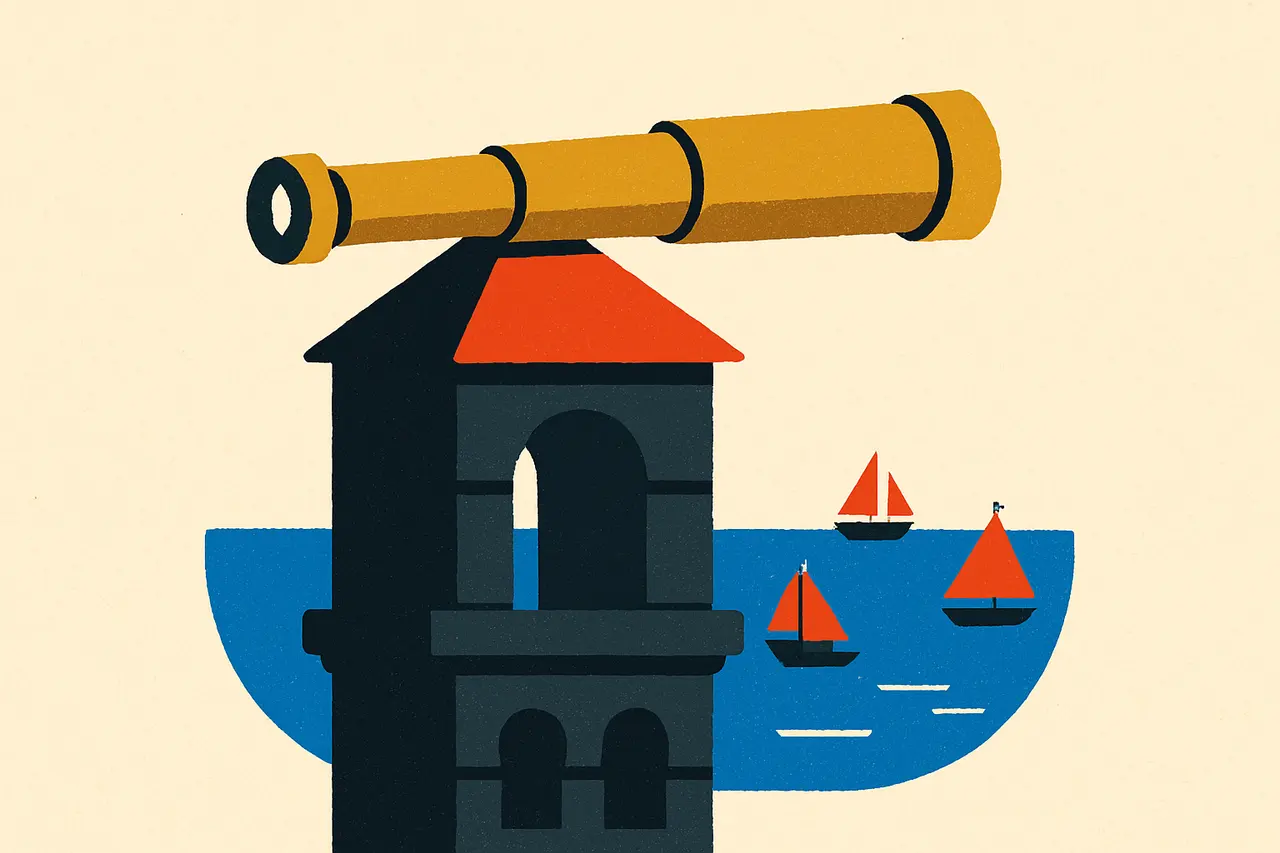
In August 1609 Galileo pitched an eight-powered spyglass to Venice's senators as a naval early-warning device, and won a life post at 1,000 florins.
In August 1609 Galileo Galilei showed an eight-powered telescope to the Doge and senators of Venice from the bell tower of St Mark’s, and the Senate rewarded him with a life appointment at the University of Padua at 1,000 florins a year, roughly double his salary.
Did Galileo invent the telescope?
No, though he is often credited with it. In October 1608 the Dutch States General in The Hague weighed patent applications from Hans Lipperhey of Middelburg and then Jacob Metius of Alkmaar for a tube holding a convex and a concave lens that magnified three or four times. The patent was refused as too easy to copy, and by April 1609 three-powered spyglasses were on sale in Paris shops. In England, Thomas Harriot drew the Moon through a six-powered instrument that summer.
Galileo’s edge was craft, not invention. Hearing rumours of the Dutch device, he made a three-powered copy in June or July 1609, then taught himself to grind his own lenses and reached eight times by August, far beyond what ordinary spectacle lenses allowed.
Why did Venice pay so much for a spyglass?
Because he sold it to a maritime republic as a military tool. Writing to his family afterwards, he boasted that senators had climbed the city’s highest towers to watch ships at sea that needed “two hours or more” to come into view without his spyglass. For a navy, that meant two hours’ warning of an approaching fleet. Accounts differ on the exact day: Museo Galileo places the bell-tower demonstration on 21 August, while anniversary histories such as Physics Today’s give 25 August. Either way the Senate acted within days, though Galileo was later disappointed by the fine print of the deal.
The real payoff came when he pointed the lenses upward. By November he had a twenty-powered instrument; in January 1610 he found four moons circling Jupiter, and Sidereus Nuncius followed in March 1610.
Sources & references
5 referencesWell-established. Corroborated by 4 independent sources.