Durian's Stench Is Written Into Its Genes
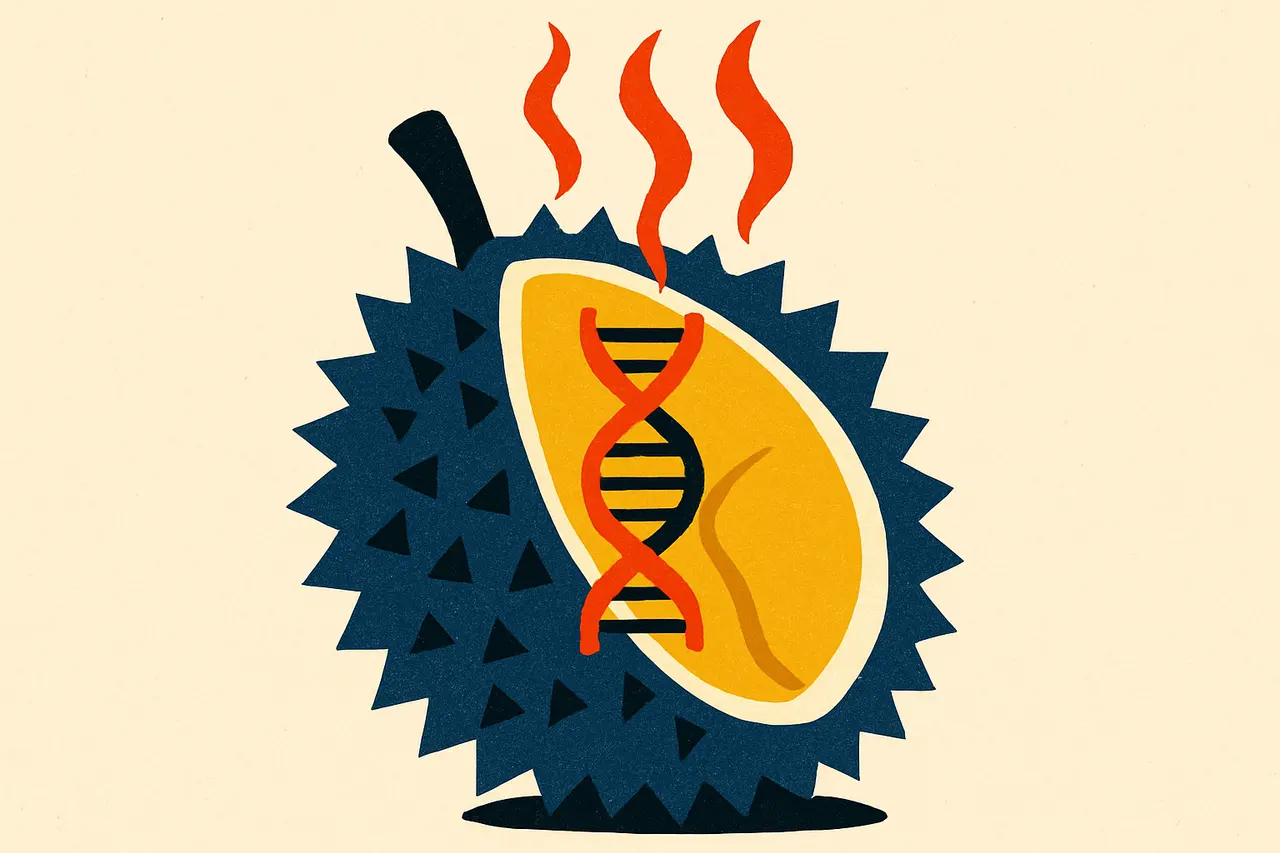
Scientists who sequenced the durian genome found the fruit hoards extra copies of sulfur-making genes, one switching on over 2,000 times in ripe pulp.
The durian is famous as the world’s smelliest fruit, banned from hotels and public transit across Southeast Asia. In 2017, researchers finally traced that infamous reek to its DNA. A team sequenced the genome of the Musang King variety (Durio zibethinus) and published the draft in Nature Genetics, counting roughly 46,000 genes — about double the human total.
The smell turned out to be hard-coded. Durian carries extra copies of MGL (methionine γ-lyase), a gene that drives production of volatile sulfur compounds, the same chemistry behind onions and skunk spray. Where relatives like cacao have a single copy, durian stacks up several.
In ripe fruit, one key sulfur-related gene was switched on over 2,000 times more strongly than elsewhere in the plant.
As the fruit ripens, MGL and ethylene-related genes fire together, flooding the pulp with pungent disulfides. Scientists think the funk evolved as a long-range advertisement, luring animals like elephants and bats to eat the fruit and scatter its seeds.
Sources & references
3 referencesWell-established. Corroborated by 2 independent sources.