Darwin's Beagle reached the Galapagos Islands
On this day · 15 September 1835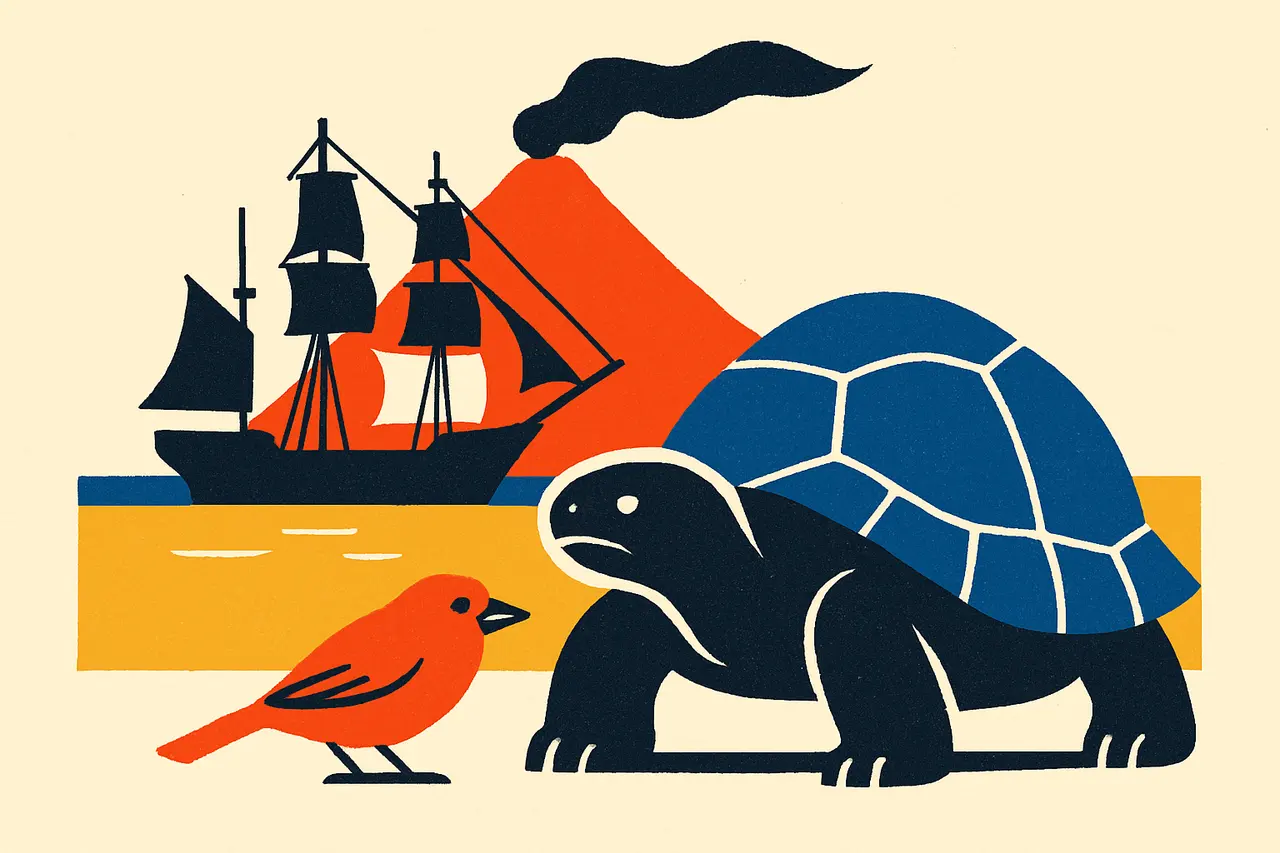
A volcanic archipelago of finches and tortoises planted the seed of evolution by natural selection.
On 15 September 1835, HMS Beagle dropped anchor off Chatham Island (now San Cristobal), the first stop on a five-week survey of the Galapagos. The ship’s young naturalist, Charles Darwin, was 26 and still thought of himself as a geologist.
Darwin spent his weeks ashore collecting birds, mocking the giant tortoises by riding them, and noting how species seemed to differ from one island to the next. He did not have a flash of insight on the spot; the famous finches were so casually labelled that he had to reconstruct which island each came from once home.
“It was this little world that would revolutionize scientific understanding of biology and lead to Darwin’s On the Origin of Species.”
Only later, sifting his specimens in England, did the pattern crystallize into the idea of evolution by natural selection, published in 1859. The islands’ isolation had, in miniature, made the workings of life unusually legible.
Sources & references
2 referencesWell-established. Corroborated by 2 independent sources.