Nearly all life shares the same genetic code
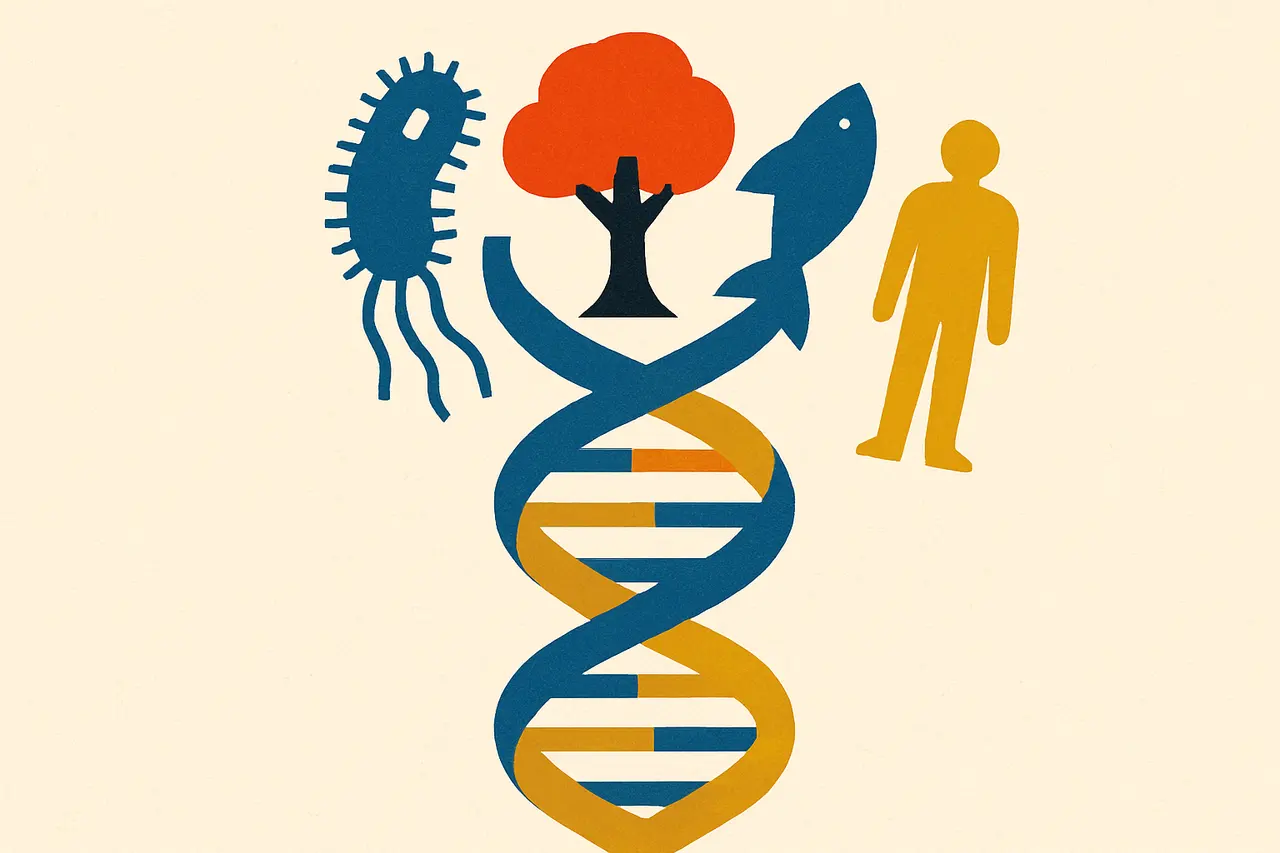
From bacteria to blue whales, life reads the same molecular instruction manual — strong evidence we all share one ancestor.
Every living thing stores its instructions in DNA, written with the same four chemical “letters” (A, C, G, T). Cells read these letters three at a time in units called codons, and each codon specifies one of the 20 amino acids that build proteins. With four letters in three slots there are 64 possible codons in all.
Why 64 codons for only 20 amino acids? Because the code is redundant, or degenerate: most amino acids are spelled by several different codons, and three codons are reserved as “stop” signals. Often the third base “wobbles” — it can change without changing the amino acid at all — building a margin of error into the system.
The striking thing is that this code is virtually identical in nearly every organism on Earth. The same triplet means the same amino acid whether you’re a bacterium, a fungus, an oak tree, or a human. There is no chemical law forcing AUG to mean methionine; countless other coding schemes are possible.
That near-universality is one of the most powerful pieces of evidence for common ancestry. Francis Crick called it a frozen accident: whichever arbitrary code the last universal common ancestor happened to use over 3.5 billion years ago got locked in, because any later reassignment would garble every protein in the cell at once — almost certainly fatal.
One code, written once, shared by everything alive.
The rare exceptions prove the rule. A handful of microbes and, notably, our own mitochondria have quietly reassigned a few codons — in mitochondria, UGA spells tryptophan instead of “stop.” The code can drift, but it almost never does.
Sources & references
2 referencesWell-established. Corroborated by 2 independent sources.