Mesopotamia's first writing was bookkeeping, not poetry
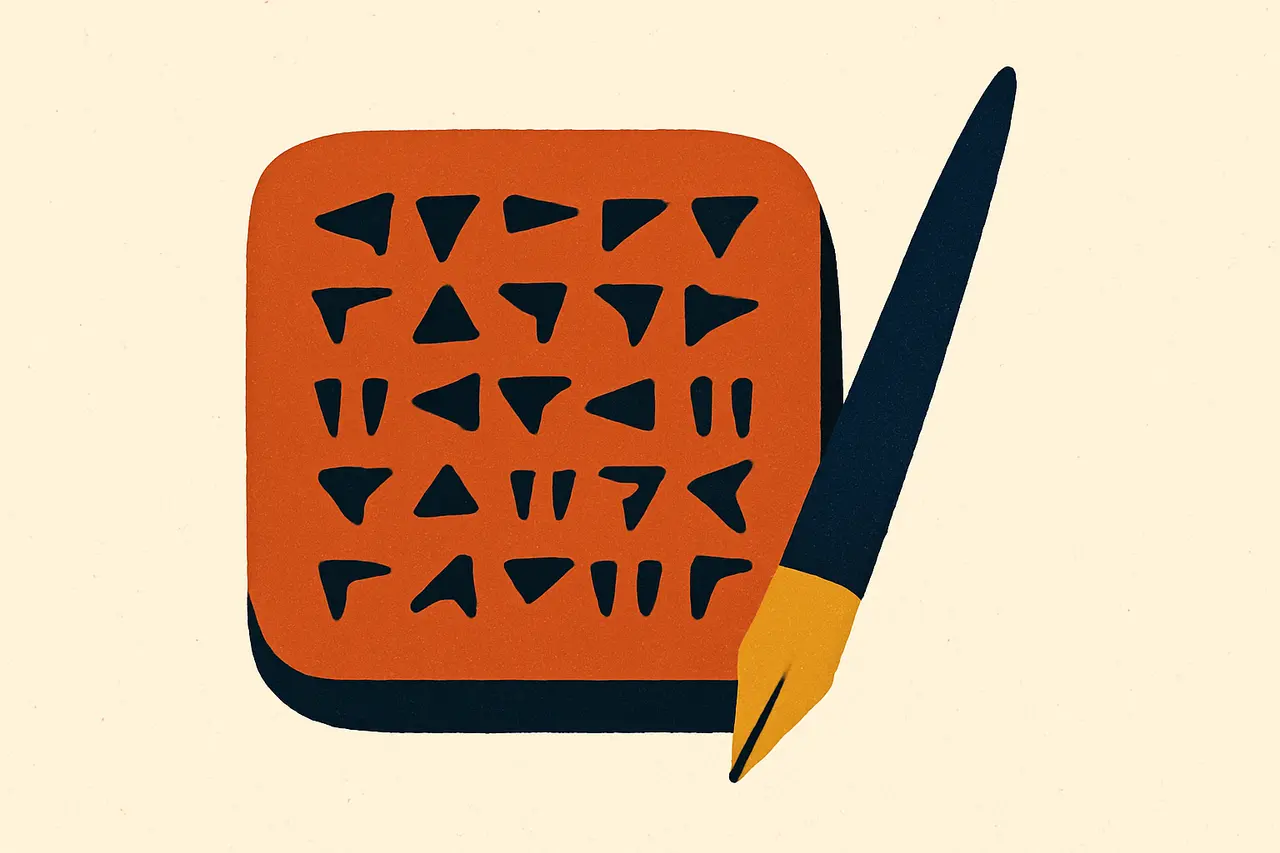
Cuneiform began around 3200 BC as ledgers of grain and livestock — and grew out of 5,000 years of counting with clay tokens.
Cuneiform, the wedge-shaped script of ancient Mesopotamia, was developed around 3200 BC by Sumerian scribes in the city of Uruk (in today’s Iraq) as a way of recording transactions: the earliest tablets are lists of goods, quantities and names, not stories, laws or prayers. Its name comes from the Latin cuneus, “wedge”, after the marks a cut reed leaves in wet clay.
The archaeologist Denise Schmandt-Besserat traced its roots to small clay counters. Her sequence, still debated in its details, runs like this:
- c. 7500 BC: Clay tokens appear across the Fertile Crescent, from Syria to Iran, as farming spreads. Each shape stands for a unit of one commodity — a cone for a measure of grain.
- c. 3500 BC: The token repertoire grows from about 12 shapes to some 350, as urban workshops add textiles, metal and other goods.
- c. 3300 BC: Accountants seal tokens inside hollow clay envelopes and press marks on the outside to show what is inside.
- c. 3200 BC: Envelopes give way to solid clay tablets bearing the same marks — the start of writing, which at Uruk became cuneiform.
One counter-intuitive result: abstract numbers came after writing. With tokens, every commodity had its own counters, so “three” meant nothing until it was three jars of oil or three measures of grain. Only once writing existed did numbers become independent of the thing counted.
Whether Mesopotamia was strictly first is less certain than many pages claim. The University of Chicago’s Oriental Institute counts four independent inventions of writing — Mesopotamia, Egypt, China and Mesoamerica — and dates Egyptian tags from the tombs of the first kings to about 3320 BC, at least as early as the Uruk tablets. The safe statement is that Mesopotamia and Egypt developed writing at about the same time.
Cuneiform went on to record law, literature and astronomy for some 3,000 years — and, still true to its roots, a furious complaint about bad copper. Inventing a script from scratch has stayed rare; one modern case is Sequoyah, who could not read.
Sources & references
3 referencesWell-established. Corroborated by 3 independent sources.