British troops burned Washington, D.C., on 24 August 1814
On this day · 24 August 1814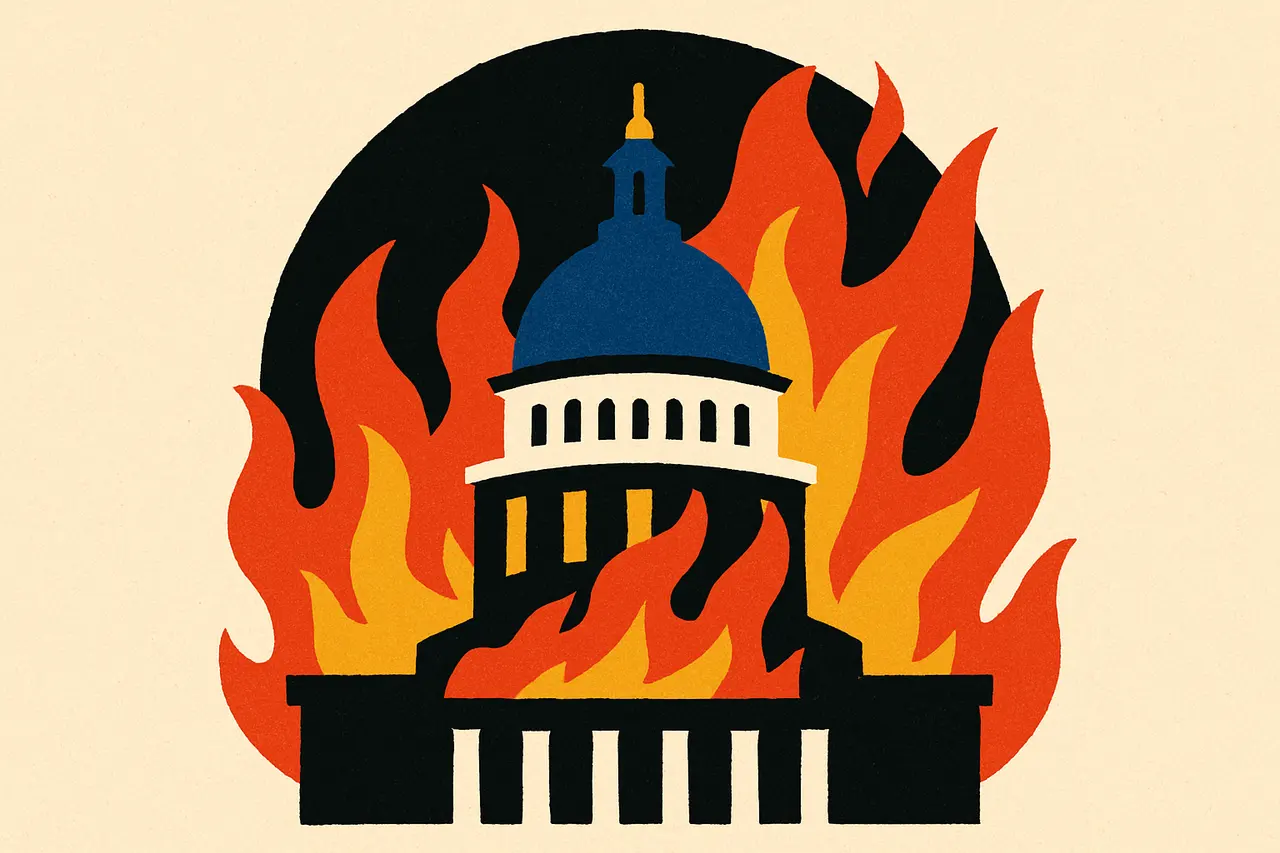
The fire gutted the Capitol and President's House — but it did not give the White House its name, and locals looted it first.
British troops burned Washington, D.C., on the night of 24 August 1814, setting fire to the Capitol, the President’s House and other public buildings hours after routing American militia at Bladensburg, Maryland. It remains the only time a foreign army has occupied the city.
Major General Robert Ross and Rear Admiral George Cockburn rode in at dusk. At the Capitol, Congreve rockets bounced off the Senate chamber’s sheet-metal roof, so soldiers piled furniture and curtains, sprinkled them with rocket powder and fired a rocket into the heap. By 11pm they were at the President’s House, and by morning it was a roofless shell. They also burned the buildings housing the State, War, Navy and Treasury departments, and a violent storm on 25 August completed the destruction.
Did the fire give the White House its name?
No. The building was first coated with lime-based whitewash in 1798, simply to protect its porous stone from frost. The nickname was already in use before the war: on 18 March 1812, Congressman Abijah Bigelow wrote of “much trouble at the White House, as we call it”. After the fire the house was repainted with white lead in 1818, and “White House” became its official name only in 1901, under Theodore Roosevelt.
Who actually looted the President’s House?
Not only the British. Paul Jennings, an enslaved servant of President James Madison, later wrote that “a rabble, taking advantage of the confusion, ran all over the White House, and stole lots of silver” before the troops arrived. British officers, for their part, ate the food left behind.
“Never was nectar more grateful to the palates of the gods than the crystal goblets of Madeira and water I quaffed off at Madison’s expense.” — British officer James Scott
Congress debated leaving the city, but voted to rebuild the Capitol, the White House and the public offices on their original sites. Weeks later the same force failed at Baltimore, and the war ended with the Treaty of Ghent, signed shortly before Andrew Jackson’s victory at New Orleans.
Sources & references
3 referencesWell-established. Corroborated by 3 independent sources.