Why your brain burns 20% of your energy at 2% of your weight
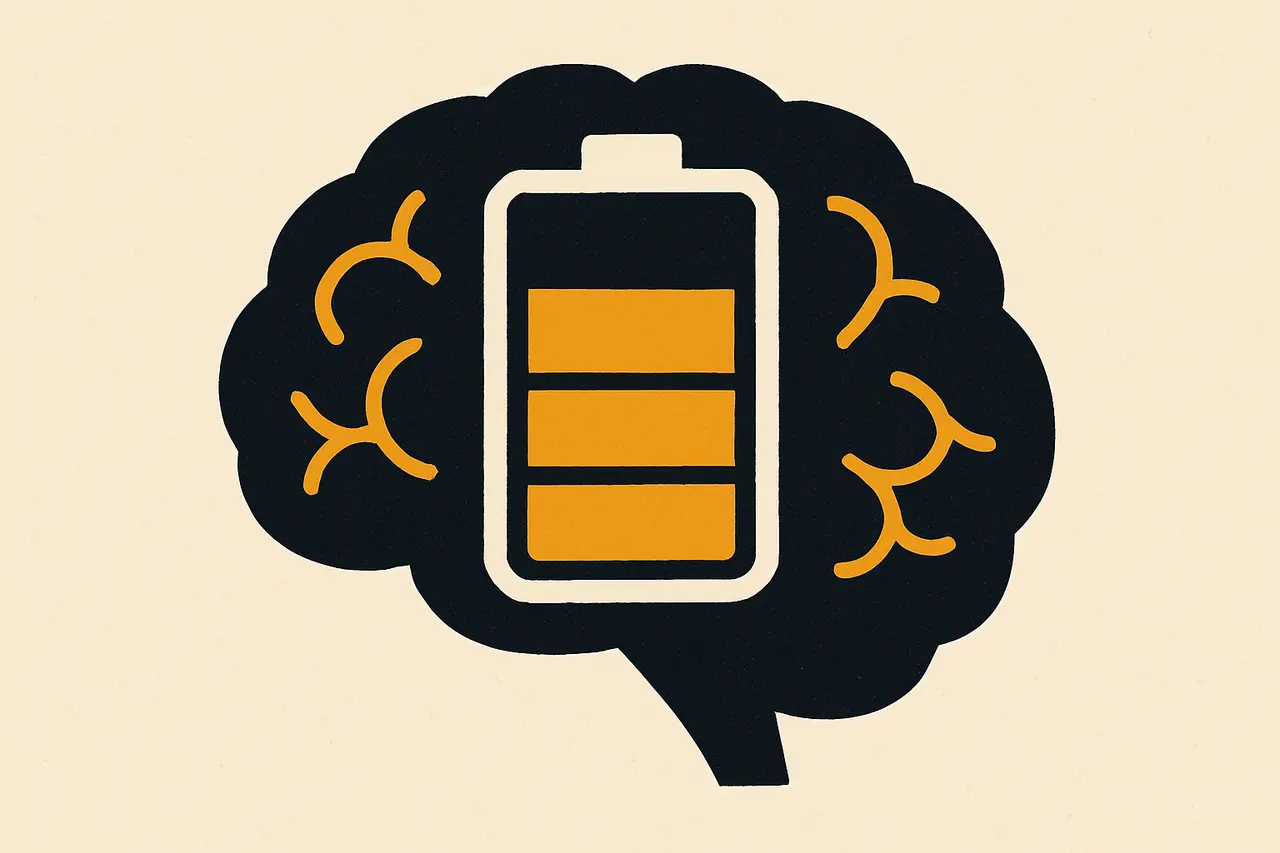
An adult brain runs on about 12 watts, a fifth of your resting energy, and a young child's brain takes far more.
The adult human brain makes up only about 2% of body weight but uses roughly 20% of the body’s resting energy, almost all of it delivered as glucose. On a resting budget of about 1,300 kcal a day, that is some 260 kcal, or a continuous 12 watts: a fifth of an old 60-watt light bulb.
By total energy use, the brain is the body’s third most expensive organ, behind only skeletal muscle and the liver.
Why does the brain use so much energy?
Because it holds so many neurons, around 86 billion, not because each one is unusually greedy. Neuroscientist Suzana Herculano-Houzel compared rodents and primates and found the glucose used per neuron is roughly constant, varying by only about 40% across six species. Most of each neuron’s budget goes on communication: one widely used estimate puts nearly 80% on glutamate signalling between cells.
That cost barely changes with what you are doing. Firing neurons do draw extra blood and glucose, but the local increases are tiny next to the brain’s constant baseline, so a hard exam burns little more than daydreaming. Even in deep sleep, the baseline stays high.
Does the brain use more energy in childhood?
Yes: the 20% figure is for adults, and the brain’s share peaks not at birth but in childhood. A 2014 study that combined PET and MRI scans put it at about 66% of resting metabolic rate and 43% of total daily energy, around ages 4 to 5.
Those are also the years when body growth slows to its minimum, which the authors argue is no coincidence: a growing brain may force the body to grow more slowly.
Sources & references
5 referencesWell-established. Corroborated by 5 independent sources.