What Apollo 13 actually said: 'Houston, we've had a problem'
On this day · 13 April 1970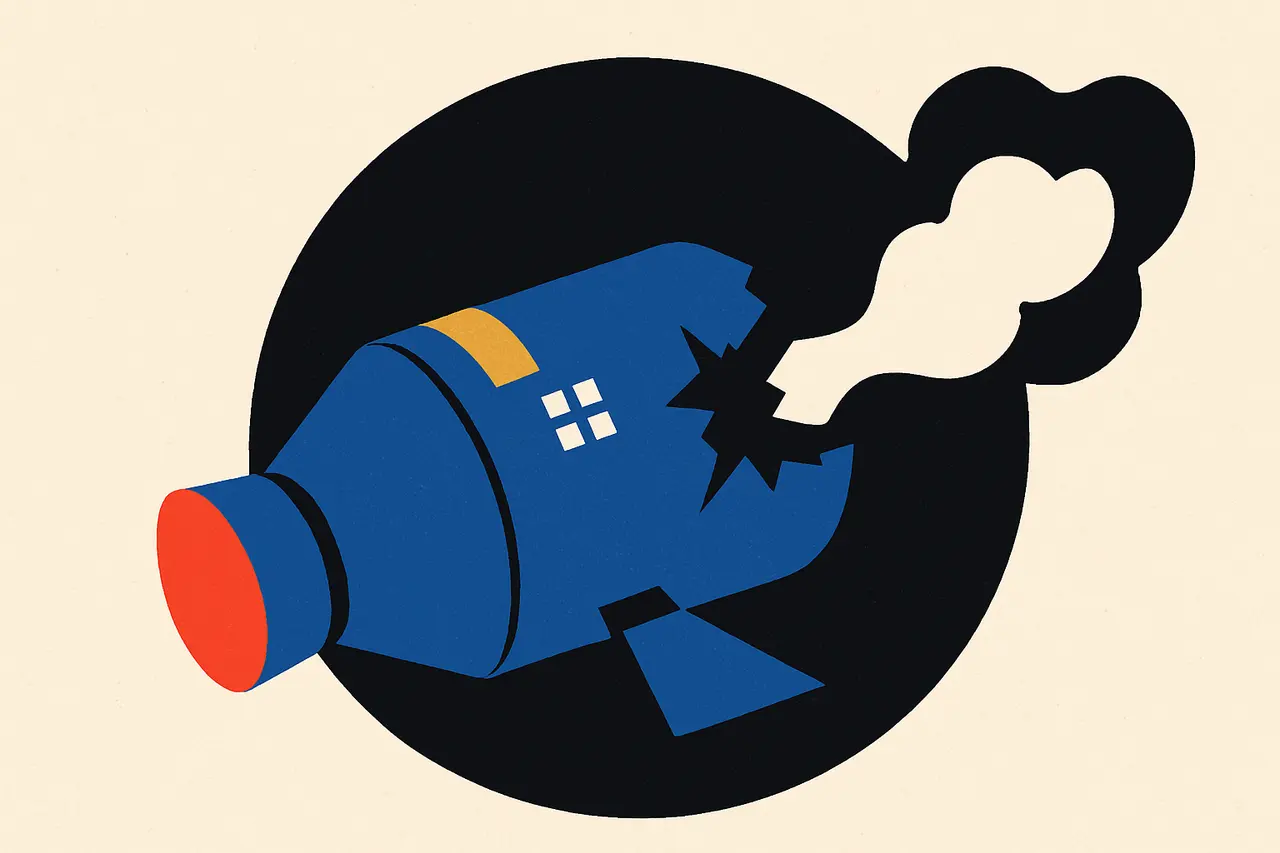
The famous line was past tense, and the oxygen tank that blew on April 13, 1970, had been quietly damaged on the launch pad weeks earlier.
The words after Apollo 13’s oxygen tank exploded on April 13, 1970, were “Okay, Houston, we’ve had a problem here”, radioed by Jack Swigert 55 hours, 55 minutes and 20 seconds into the flight. Commander Jim Lovell then repeated it when Houston asked: “Houston, we’ve had a problem. We’ve had a main B bus undervolt.”
The present-tense “Houston, we have a problem” comes from the 1995 film Apollo 13, whose writers knowingly used the line audiences expected. The real one was calmer and in the past tense, because by then the bang had already happened.
It started with routine housekeeping. At 55:52:58, CapCom Jack Lousma asked the crew to stir the cryogenic tanks. About a minute and a half later, damaged wiring inside oxygen tank No. 2 ignited, the tank failed, and a leak drained tank No. 1 too. Some 200,000 miles from Earth, the command module lost its normal supply of electricity, light and water, and the crew retreated to the lunar module.
The NASA review board traced the failure to a chain of ground mistakes:
- 1965: the spacecraft’s tank heaters were upgraded from 28 to 65 volts, but their thermostatic safety switches were not.
- Before Apollo 13: the same tank was removed from Apollo 10’s service module for modification and damaged in the process.
- March 27, 1970: it would not empty during a launch-pad test, so engineers boiled off the oxygen with its heater for eight hours at 65 volts. The switches were probably welded shut and nearby wiring reached about 1,000°F, degrading its Teflon insulation.
- April 13: switching on the tank’s fans sparked that wiring.
Using the lunar module as a lifeboat, the crew of Apollo 13 looped around the Moon and splashed down safely on April 17, a mission NASA classifies as a “successful failure”.
Sources & references
5 referencesWell-established. Corroborated by 3 independent sources.