Caral, Peru: America's oldest city predates the Great Pyramid
Radiocarbon dates put monumental building at Caral by 2627 BC, before Khufu's pyramid rose at Giza. But 'oldest city' needs a footnote.
Caral, in Peru’s Supe Valley, is usually named the oldest city in the Americas: radiocarbon dates published in Science in 2001 show monumental architecture, urban settlement and irrigation farming there by 2627 BC, a generation or two before Egypt’s Great Pyramid of Giza went up under King Khufu (2589–2566 BC).
The Science team, led by Peruvian archaeologist Ruth Shady Solís with Jonathan Haas and Winifred Creamer, dated organic samples from the site, which lies 23 km inland from the Pacific. Their range ran from 2627 to 1977 BC. Later fieldwork summarised by Popular Archaeology pushes Caral’s growth from village to city back further, to roughly 3500–3200 BC.
| Site or monument | Dated to |
|---|---|
| Aspero, at the mouth of the Supe | 3700–2500 BC |
| Caral (Shady’s later estimate) | 3500–2000 BC |
| Caral (2001 radiocarbon dates) | 2627–1977 BC |
| Djoser’s Step Pyramid, Egypt | c. 2670 BC |
| Great Pyramid of Giza | built 2589–2566 BC |
“Oldest city” needs a footnote. Caral was not a lone pioneer: it is one of 18 large preceramic sites in the Supe Valley alone, and the Field Museum’s Norte Chico project counts 24 major Late Archaic centres across four valleys, none with pottery. Coastal Aspero may be older, but Caral is by far the largest and most complex, which is why it gets the title. The claim is also a different test from Old World contenders such as Damascus, which rest on continuous habitation.
Even Caral’s size depends on what you measure. The 2001 paper gives 65 hectares for its central zone of monumental and residential buildings; the Field Museum gives 110 hectares for the whole site, with six major platform mounds and three sunken circular plazas. The largest structure, the Great Pyramid, measures about 171 by 151 metres at its base.
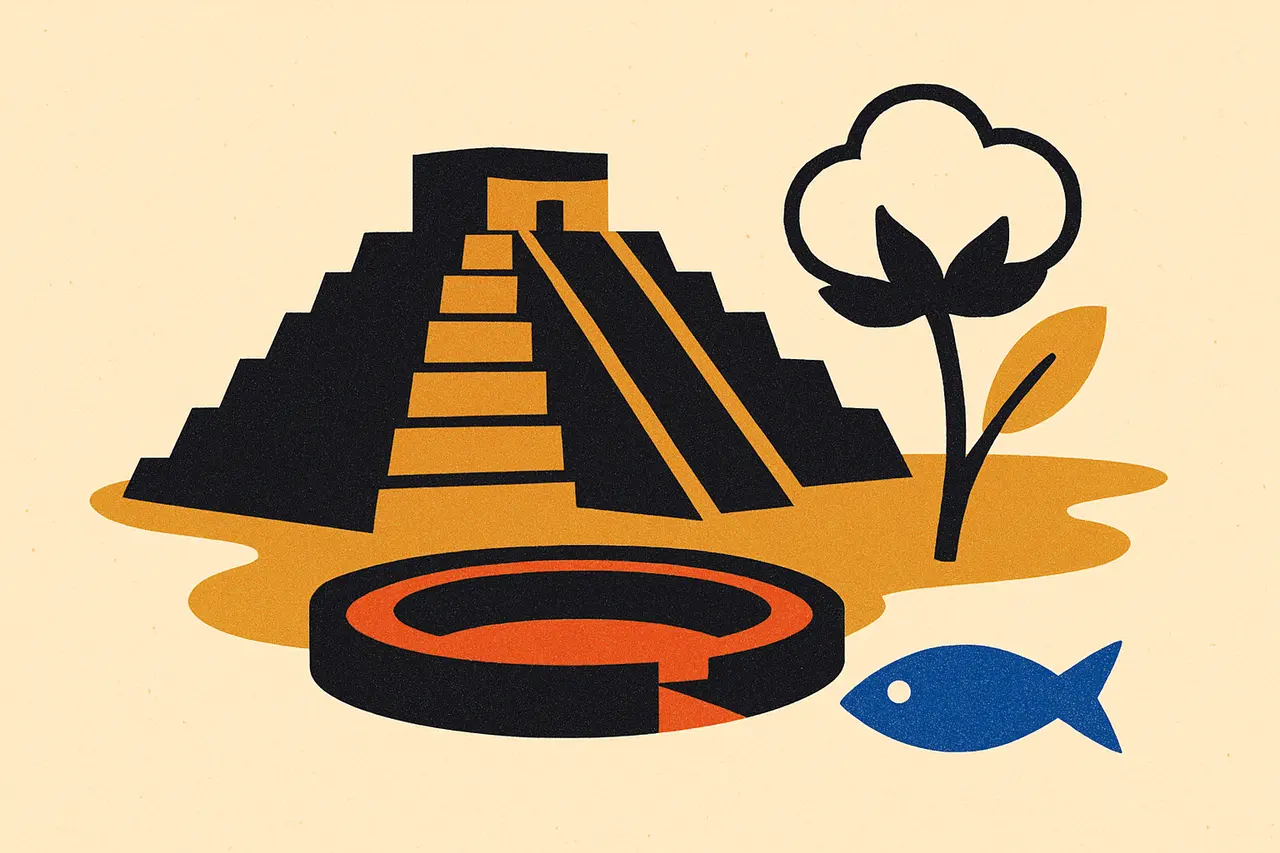
The city is often described as peaceful, built on cotton, fishing and trade rather than conquest. But it was not gentle: Shady’s team found a man of about 20, killed by blows to the face and head, buried in the stones of an old temple atrium before a new one was built over him, apparently as an offering.
Sources & references
4 referencesWell-established. Corroborated by 4 independent sources.