Halley predicted the 1715 eclipse to within four minutes
On this day · 3 May 1715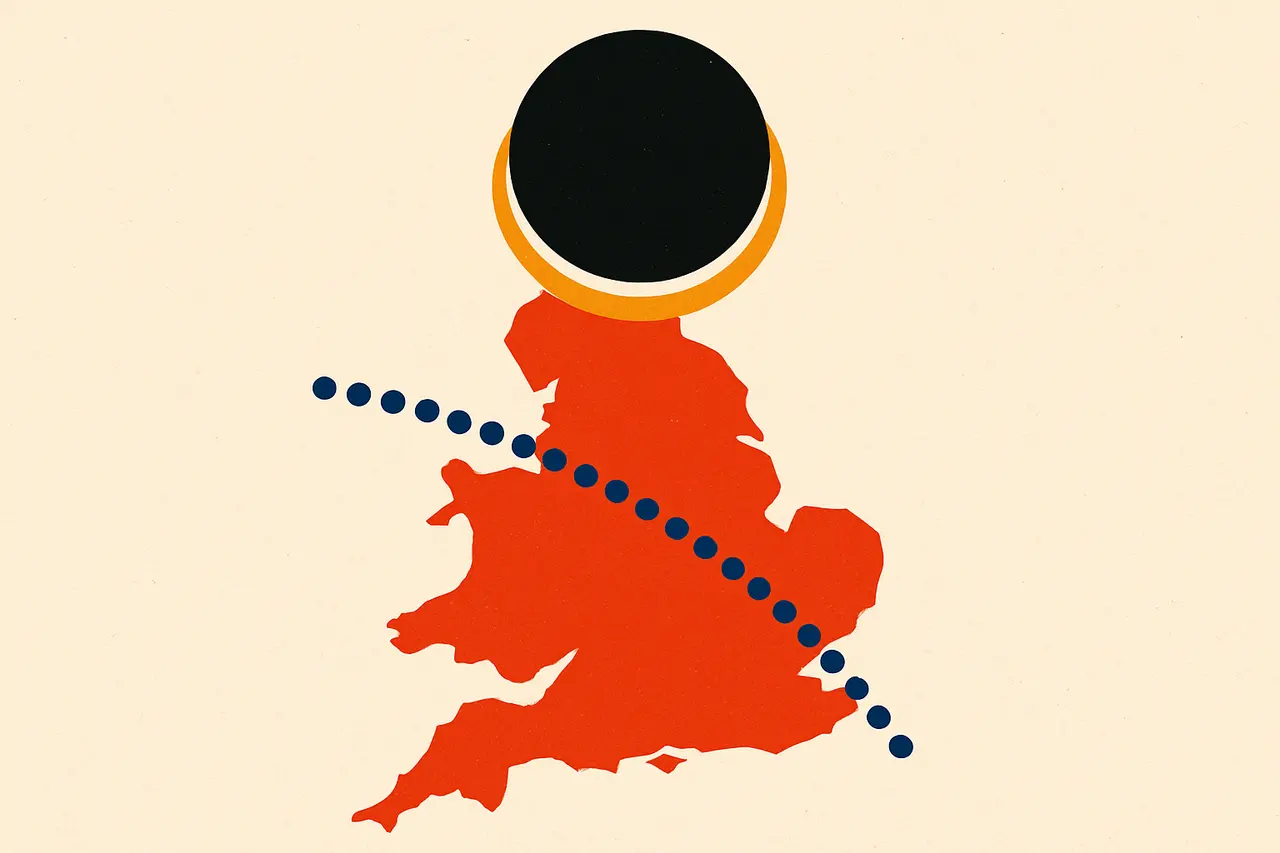
Edmond Halley mapped the 1715 eclipse in advance, asked the public to time it, then redrew his map from their reports.
A total solar eclipse crossed England on 3 May 1715 (22 April by the Julian calendar England still used), and Edmond Halley had predicted it: his timings proved accurate to within about four minutes. Working from Newton’s theory of gravitation, he published a broadsheet map of the Moon’s shadow days before the event.
The rarity was the hook. Halley wrote that he could find no total eclipse seen at London since 20 March 1140, a gap of some 575 years. He watched from the Royal Society’s house in Crane Court and timed 3 minutes 33 seconds of totality; the shadow was up to 295 km wide, and greatest totality lasted 4 minutes 14 seconds.
The map also turned the eclipse into a crowdsourced experiment. It carried an appeal to “the Curious” to observe the eclipse and, above all, to time the total darkness, a job needing nothing more than a household pendulum clock. Better measurements, Halley argued, would make future predictions more certain. England also had a freshly crowned king and a rebellion brewing, so an eclipse announced in advance lost much of its power as an omen.
Reports poured in. An observer at Barton, Northamptonshire, timed totality at 3 min 53 s, another at King’s Walden near Hitchin at 3 min 52 s, while at Cranbrook in Kent the Sun was extinguished only for a moment, placing the shadow’s edge directly over the town.
“Nor has this Advertisement failed of the desired Effect.” (Edmond Halley, reporting to the Royal Society)
Those observations showed that his predicted track had been off by about 20 miles along its northern edge. Later in 1715 Halley published a second map, A description of the passage of the shadow of the Moon over England as it was observed, redrawing the path from the public’s reports: a prediction, tested and then corrected by the public’s own observations.
Sources & references
5 referencesWell-established. Corroborated by 5 independent sources.