Yellowstone is a supervolcano whose last giant eruption ejected 1,000 cubic km of rock
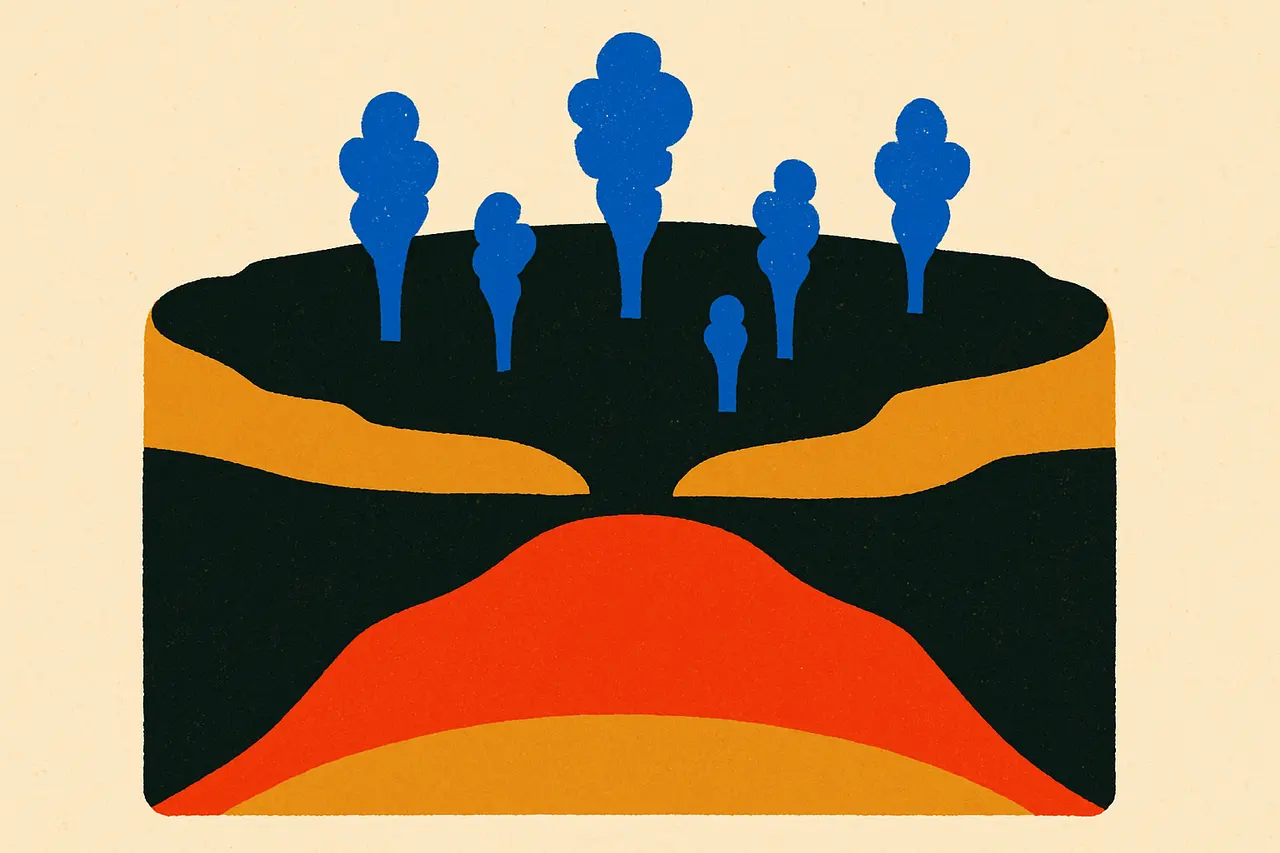
A supervolcano is defined by a VEI 8 eruption — and Yellowstone has produced three, the most recent about 640,000 years ago.
Beneath the geysers and hot springs of Yellowstone sits one of the planet’s best-known supervolcanoes. The label is not loose: a supervolcano is one capable of a VEI 8 eruption — the top of the Volcanic Explosivity Index — ejecting more than 1,000 cubic kilometers of material. Yellowstone has done exactly that three times, roughly 2.1 million, 1.3 million, and 640,000 years ago. The most recent, the Lava Creek eruption, blasted out about 1,000 cubic kilometers of rock and ash and left behind the vast Yellowstone Caldera, a basin some 45 by 30 miles across.
The heat source isn’t a fixed crack in the crust. The North American plate is slowly sliding southwest over a stationary mantle hotspot, so the plume effectively burns a track eastward through the rock. That track is written across the Snake River Plain as a chain of older, extinct calderas, with Yellowstone simply the youngest scar at the leading edge.
A full supereruption would be continental in scale — ash blanketing much of the country, crippling agriculture across the breadbasket, and cooling the global climate for years as sulfate aerosols dim the sun. But that scenario is also the least likely thing to happen here. The far more probable hazards are localized: hydrothermal explosions from flashing groundwater, and lava flows of the kind that have resurfaced the caldera many times since the last big blast.
Which is why scientists stress Yellowstone is not “overdue.” The Yellowstone Volcano Observatory records constant ground deformation and frequent earthquake swarms — thousands a year — yet this churn is routine for a living caldera, not a countdown.
Caldera unrest is what an active volcano does between eruptions; it is not, by itself, a signal that one is coming.
Sources & references
2 referencesWell-established. Corroborated by 2 independent sources.