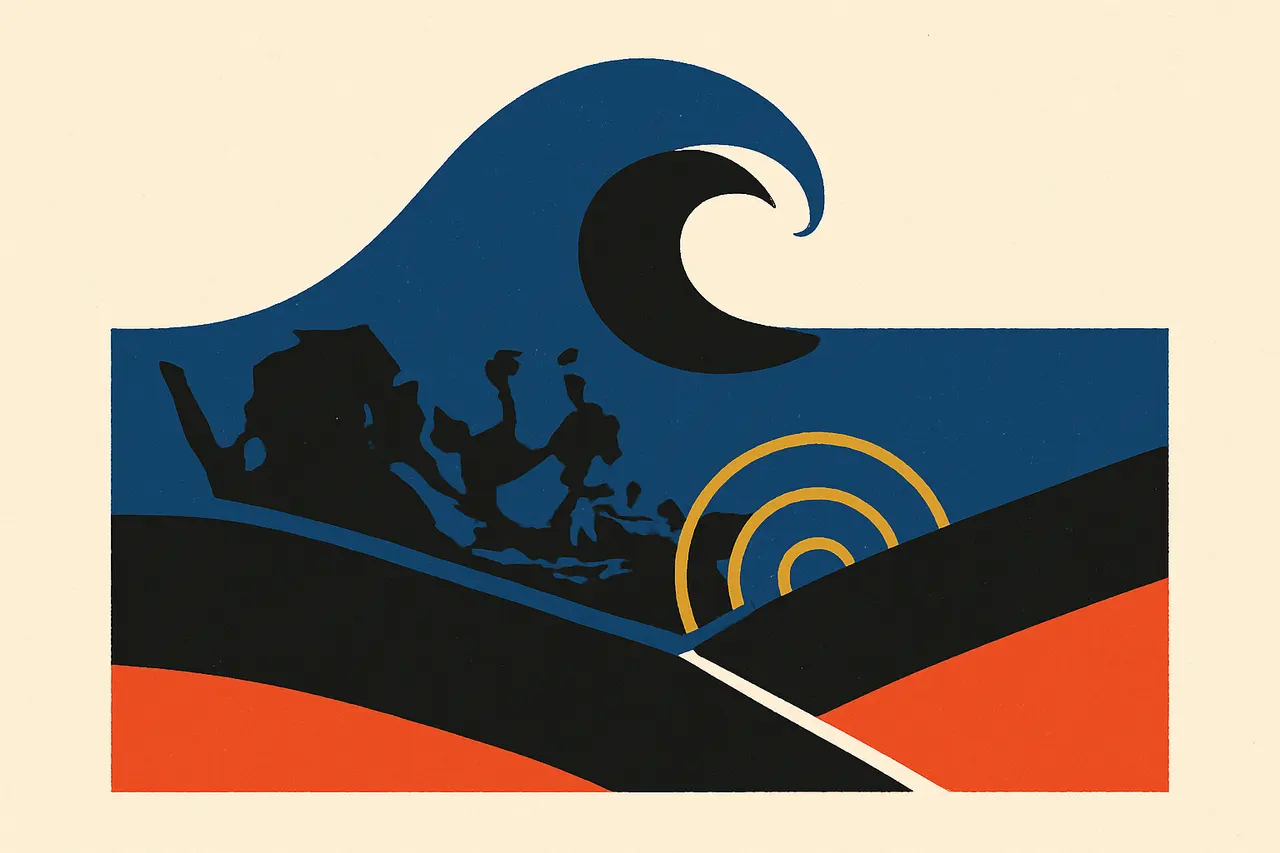
In deep water a tsunami races along as fast as a jet airliner

Out at sea a tsunami is only inches high and easy to miss—yet it's travelling around 500 miles an hour.
A tsunami is born when the seafloor moves suddenly—usually a large undersea earthquake that lifts or drops a huge slab of ocean floor, shoving the entire water column above it. That displaced water spreads outward as a train of very long waves.
In the deep open ocean those waves travel astonishingly fast—on the order of 500 to 600 mph (around 800 km/h), comparable to a commercial jet. The speed is set by the water’s depth: the deeper the ocean, the faster the wave.
What makes a tsunami so dangerous is how it hides. In deep water its crest may be only a few feet high but its wavelength stretches for hundreds of miles, so a ship can pass over one and never notice.
Near shore the shallowing seabed forces the wave to slow down and pile up. That trapped energy converts into towering height—turning an invisible swell into a wall of water.
Sources & references
2 referencesWell-established. Corroborated by 2 independent sources.