Tiktaalik: the "fishapod" caught mid-step onto land
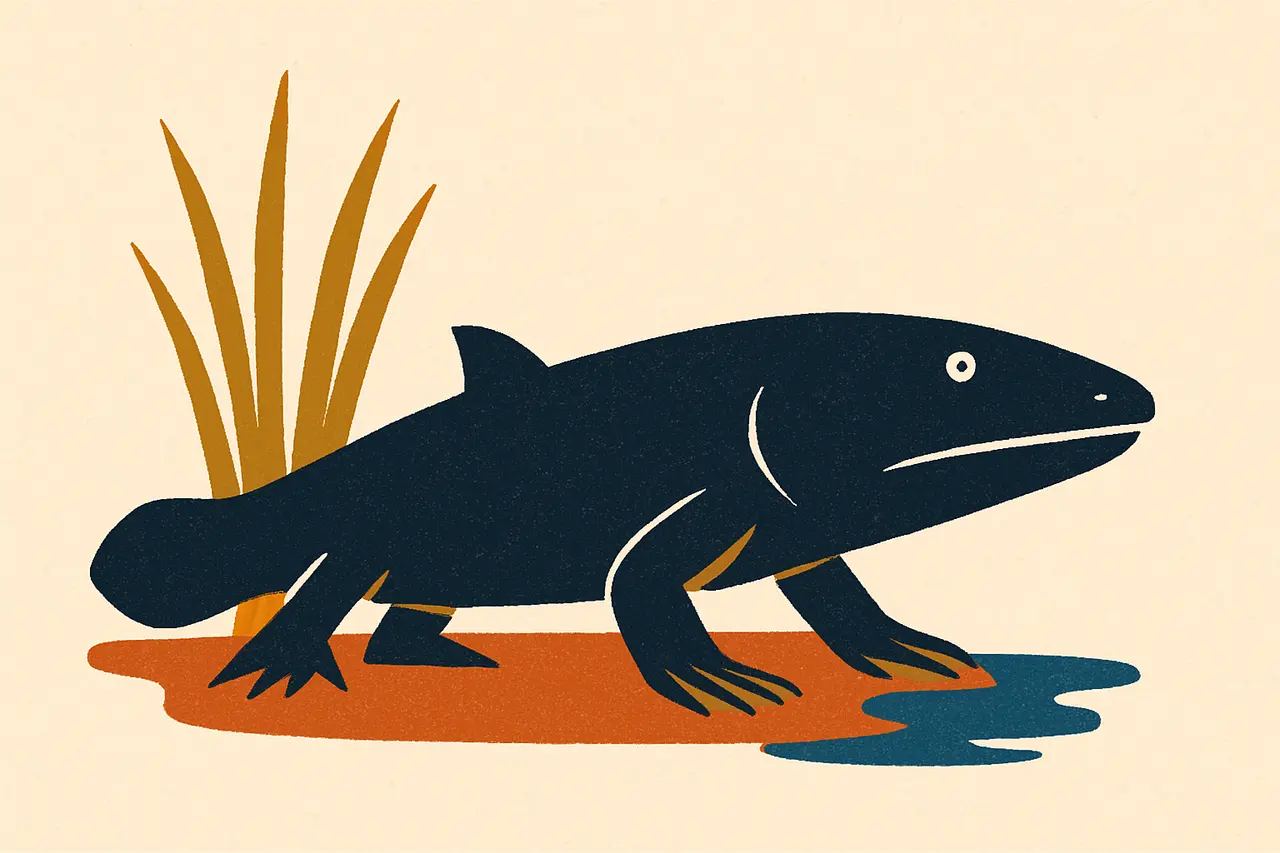
A 375-million-year-old fossil bridges the gap between swimming fish and the first animals to walk on land.
In 2004, on Ellesmere Island in the Canadian Arctic, paleontologists led by Neil Shubin and Ted Daeschler uncovered one of the most celebrated transitional fossils ever found: Tiktaalik roseae, a creature about 375 million years old from the Devonian period.
What makes the find extraordinary is that it was predicted. Knowing the fish-to-tetrapod transition happened in the Devonian, the team reasoned that the right animal would lie in 375-million-year-old freshwater deposits exposed at the surface. That logic pointed them to Ellesmere Island, and they searched the barren rock for years before the snouts began to emerge — evolutionary theory cashed out as a precise prospecting tool.
Tiktaalik is a near-perfect intermediate. Like a fish, it had scales, gills, and fins. But inside those front fins sat bones answering to a humerus, radius, and ulna — an upper arm, forearm, and the beginnings of a wrist. It also carried a spiracle and a mobile neck, plus robust ribs, hinting that it gulped air and could prop itself up in shallow water. Shubin nicknamed it the “fishapod,” and the point is personal: our own wrists and weight-bearing arms trace back to fins built like these.
Tiktaalik is to land vertebrates what Archaeopteryx is to birds — a snapshot of evolution caught mid-transition.
The story gained a twist in 2014, when Shubin’s team finally described the animal’s rear half and found a surprisingly large, robust pelvis. That suggested hind-limb-driven locomotion may have begun earlier than anyone assumed — that walking, in some form, started in the water.
Sources & references
2 referencesWell-established. Corroborated by 2 independent sources.