Earth's 3 trillion trees likely outnumber Milky Way stars
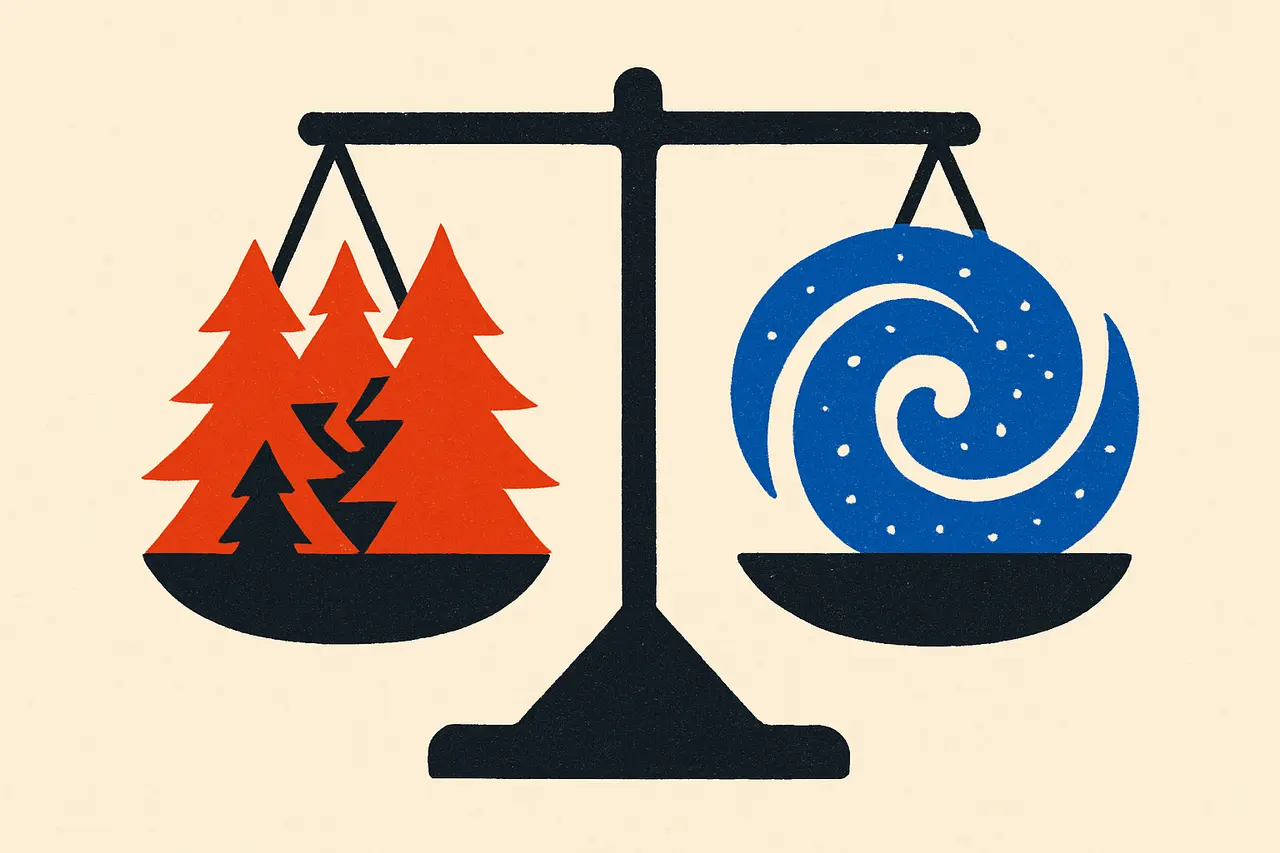
A 2015 ground-truthed count found about 3 trillion trees, more than the galaxy's 100 to 400 billion stars. Before that, it was roughly a tie.
Earth almost certainly has more trees than the Milky Way has stars: a 2015 study in Nature estimated about 3.04 trillion trees, while astronomers usually put our galaxy at 100 billion to 400 billion stars, so trees win by a factor of roughly 8 to 30.
The tree count, led by ecologist Thomas Crowther at Yale, combined tree-density measurements from more than 400,000 forest plots with satellite data on climate, terrain and land use. It works out to about 422 trees per person. About 43% grow in the tropics; the densest stands are in the boreal forests of Russia, Scandinavia and North America, which hold 24%, with another 22% in temperate zones.
| Count | Estimate |
|---|---|
| Trees on Earth (2015 Nature study) | 3.04 trillion |
| Trees on Earth (estimate before 2015) | just over 400 billion |
| Milky Way stars (most common range, NASA Goddard) | 100 to 400 billion |
| Milky Way stars (ESA upper limit) | about a trillion (10¹²) |
| Stars in the whole universe (ESA) | 10²² to 10²⁴ |
The old tree figure, about 61 per person, came from satellite images of forest area with no counts on the ground. It sat at the very top of the Milky Way’s star range, so by the old numbers the contest was close to a tie; ground-truthing raised the tree total by an order of magnitude.
The star side is the shakier number. Nobody counts the galaxy’s stars one by one: astronomers estimate the Milky Way’s mass and divide by the mass of an average star, and the answer swings with how many faint red dwarfs are assumed. Even the generous ceiling allowed by the ESA falls short of 3 trillion trees.
The comparison does not stretch to the whole universe, though, where stars outnumber every tree on Earth billions of times over. And the tree total is shrinking. People cut down more than 15 billion trees a year, and the global number has fallen by about 46% since the start of human civilization.
Sources & references
5 referencesWell-established. Corroborated by 4 independent sources.