The universe has no center: the Big Bang happened everywhere
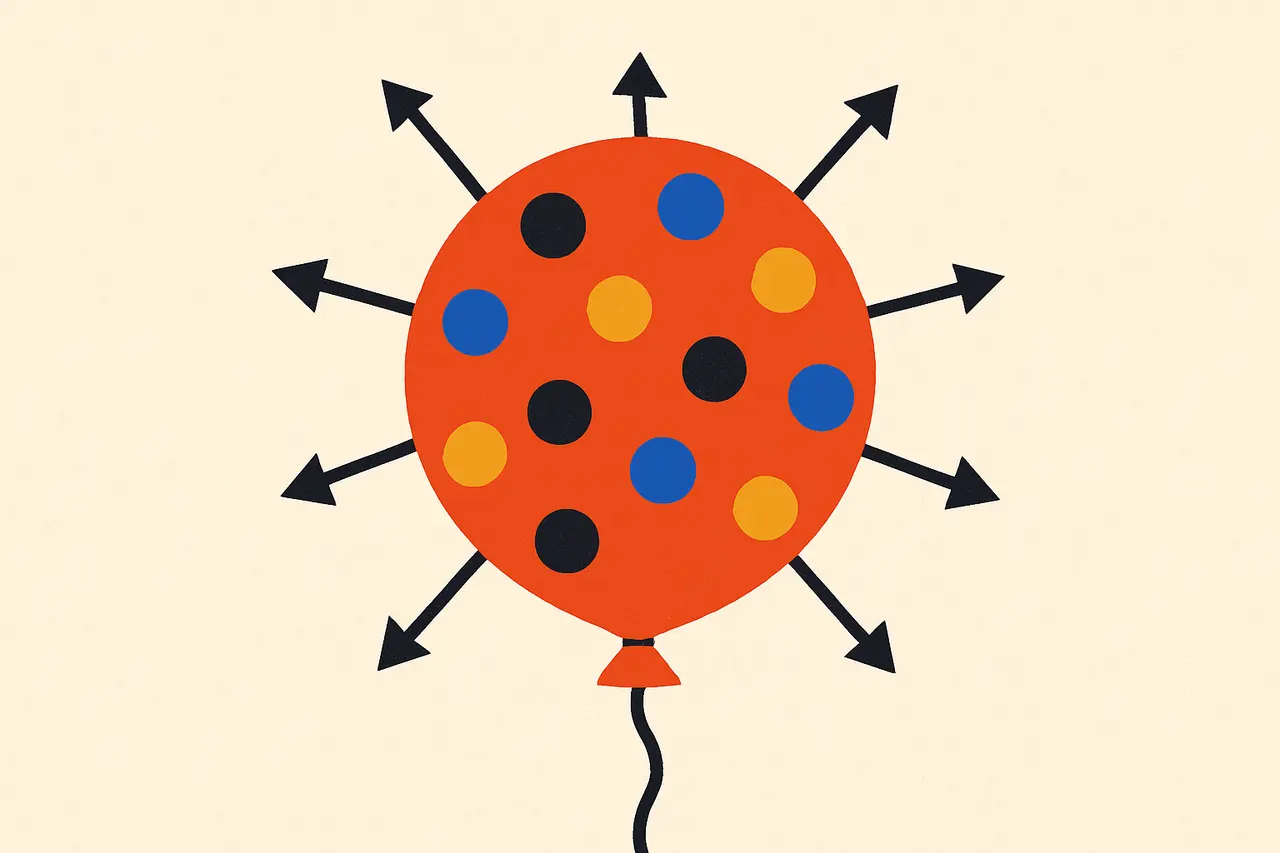
Every galaxy sees the others fleeing as if it were the middle, because the Big Bang expanded space itself rather than exploding in it.
The universe has no center and, as far as anyone can tell, no edge, because the Big Bang was not an explosion at one point in space but the start of an expansion of space itself that happened everywhere at once. There is no spot you could point to as ground zero.
The clue that fools people is Hubble’s law: the farther away a galaxy is, the faster it recedes, which seems to put us in the middle. But uniform expansion looks the same from anywhere. Suppose we see galaxy B receding at 10,000 km/s and galaxy C, twice as far in the same direction, at 20,000 km/s. Now move to B:
| Watching from | Galaxy watched | Seen receding at |
|---|---|---|
| Us | B | 10,000 km/s |
| Us | C, twice as far | 20,000 km/s |
| B | Us, one way | 10,000 km/s |
| B | C, the other way | 10,000 km/s |
Every galaxy sees itself as the center, which is another way of saying none is.
The standard picture, dots on an inflating balloon, goes back to Arthur Eddington in 1933. It works only if the balloon’s surface stands for all of space: every dot moves away from every other, and the surface has no center and no edge. The trap is the balloon’s middle and the air around it. Neither corresponds to anything physical, and the universe is not expanding into anything we can detect. Fred Hoyle, who used it in the 1960 edition of his popular book, warned about it himself:
“There are several important respects in which it is definitely misleading.” — Fred Hoyle, The Nature of the Universe
If the Big Bang had been an ordinary explosion in pre-existing space, we would see its expanding edge with emptiness beyond. Instead, in every direction we see the same faint cosmic microwave background, uniform to about 1 part in 100,000.
One honest caveat: all of this describes the region we can observe. Standard models fit every observation, but physicists cannot rule out lumpier structure, even a center of sorts, far beyond our horizon.
Sources & references
4 referencesWell-established. Corroborated by 4 independent sources.