Huygens is still the only landing in the outer solar system
On this day · 14 January 2005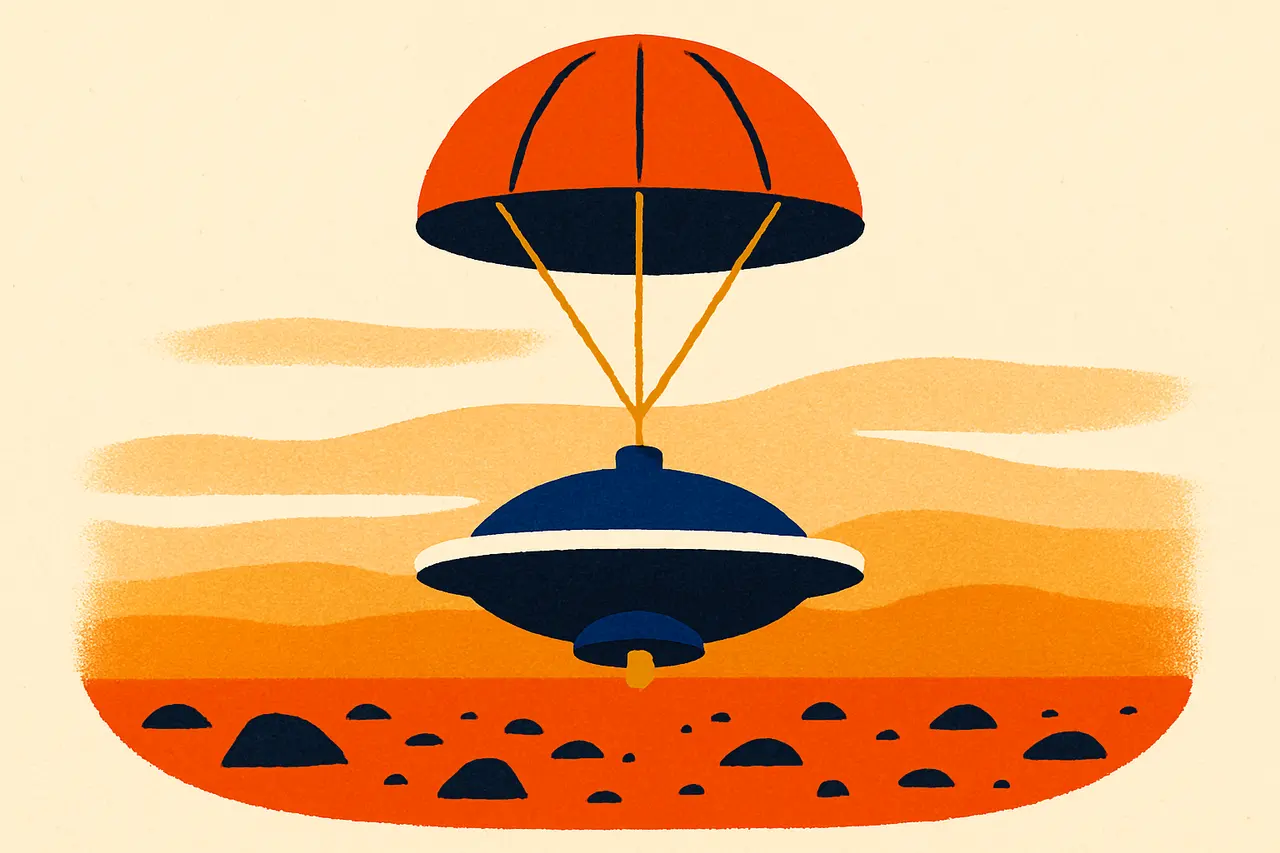
On 14 January 2005 ESA's Huygens parachuted onto Titan and kept talking for 72 minutes — far longer than its designers dared hope.
The European Space Agency’s Huygens probe landed on Titan, Saturn’s largest moon, on 14 January 2005 after a parachute descent of 2 hours 27 minutes, then kept transmitting from the surface for another 72 minutes. It remains the first and only landing in the outer solar system, and the most distant landing ever made from Earth.
Huygens was carried to Saturn by NASA’s Cassini orbiter. Its mission was built around the descent: scientists hoped for a few minutes of data from the ground at most, unsure whether the probe would survive impact or what kind of terrain it would meet. It came down at about 18 km/h onto ground with the consistency of loose wet sand, strewn with pebbles of dirty water ice, at a temperature colder than minus 170 °C.
How we heard it
Huygens relayed its data to Cassini in real time, but Earth listened in directly too. The Green Bank Telescope in West Virginia picked up the probe’s faint 3.5-watt signal from 1.4 billion kilometres away, and radio telescopes around the world kept tracking it through the descent and its long survival on the surface.
That eavesdropping turned out to matter. A configuration problem with one of Cassini’s receivers meant the probe’s Doppler wind experiment could not be done from orbit, so the global network of radio telescopes measured Titan’s winds instead.
Then and next
- 2005: the pictures show what the camera’s principal investigator called “drainage channels”, possibly cut by liquid methane rather than water, and the instruments confirm complex organic compounds in both gas and solid form.
- No earlier than July 2028: NASA’s Dragonfly rotorcraft is due to launch.
- Late 2034: Dragonfly is due to arrive, then fly several miles at a time between sites during a planned 3.3-year mission.
Sources & references
4 referencesWell-established. Corroborated by 3 independent sources.