Sunlight's energy takes about 170,000 years to leave the Sun
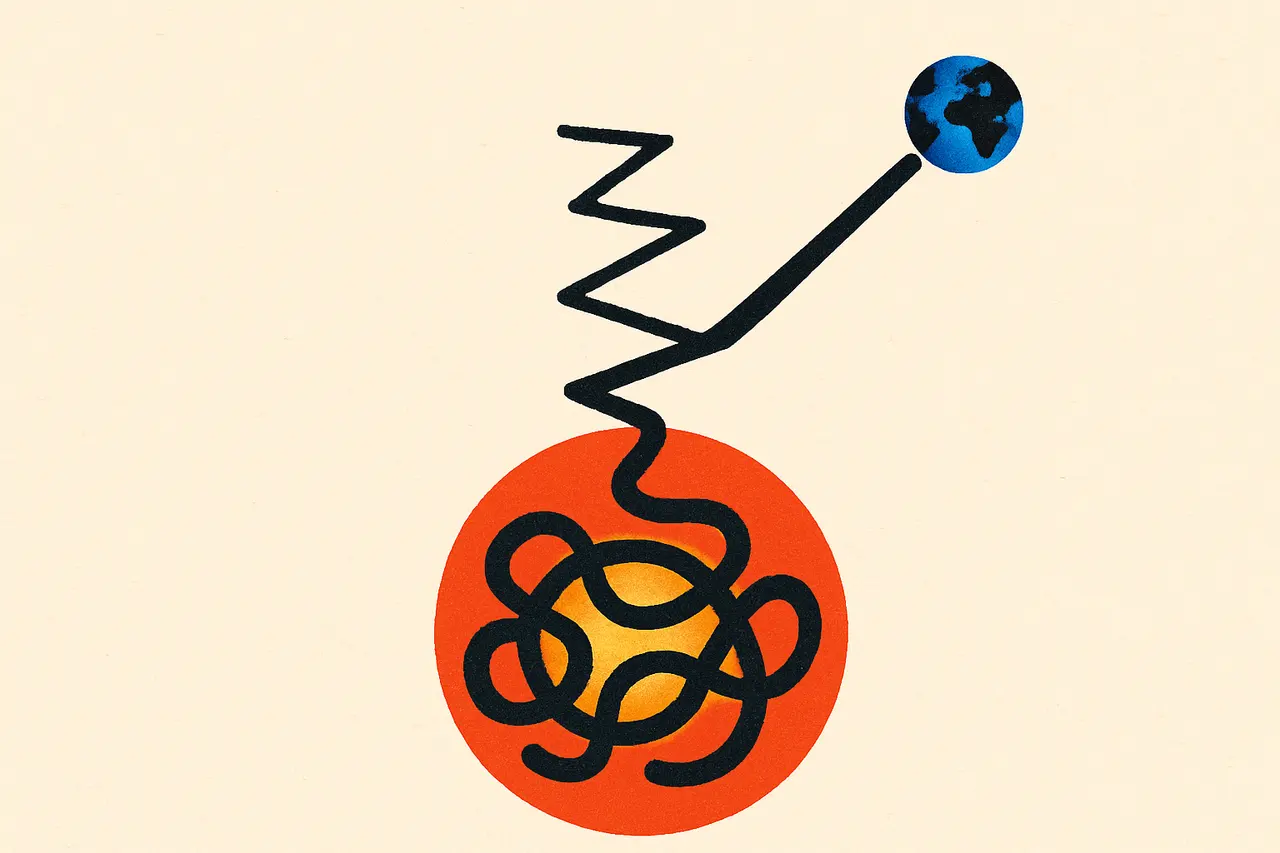
Sunlight reaches us in eight minutes, but its energy spent some 170,000 years escaping the Sun's interior; neutrinos show the Sun has barely changed since.
The energy in today’s sunlight was released by fusion in the Sun’s core long before it reached you: NASA estimates radiation takes about 170,000 years to work its way from the core to the top of the convection zone, while the final trip to Earth takes only about eight minutes.
That last leg is the easy part. Light travels at about 300,000 kilometres per second, and with the Sun roughly 150 million kilometres away, the crossing takes about 500 seconds.
The slow part happens inside. Fusion releases energy as gamma rays, but the plasma of the radiative zone is so dense that light travels only a tiny distance before being absorbed and re-emitted in a random direction. This drunkard’s walk makes painfully slow net progress, and the light that finally escapes is not the photon that set out.
Published figures vary widely. NASA’s Sun facts page gives 170,000 years, NASA Marshall’s solar-interior page says an individual photon needs about a million years just to reach the base of the convection zone, and the Paris Observatory puts the energy’s journey at one to two hundred thousand years. The spread reflects different solar models and whether one tracks a single photon or the overall flow of energy.
How do we know the Sun hasn’t changed since that light set off? Fusion also makes neutrinos, which barely interact with matter. They cross the solar plasma in a few seconds and reach Earth about eight minutes later, a live feed from the core. In 2014 the Borexino detector, deep under Italy’s Gran Sasso mountain, measured neutrinos from the Sun’s main fusion reaction for the first time. Their flux implied a solar power of 3.98 × 10²⁶ watts, close to the 3.84 × 10²⁶ watts carried by today’s sunlight. Because one figure describes the core now and the other energy released over 100,000 years ago, the Sun’s output has barely changed in all that time.
Sources & references
4 referencesWell-established. Corroborated by 3 independent sources.