Enterprise first flew in 1977, riding on a 747's back
On this day · 18 February 1977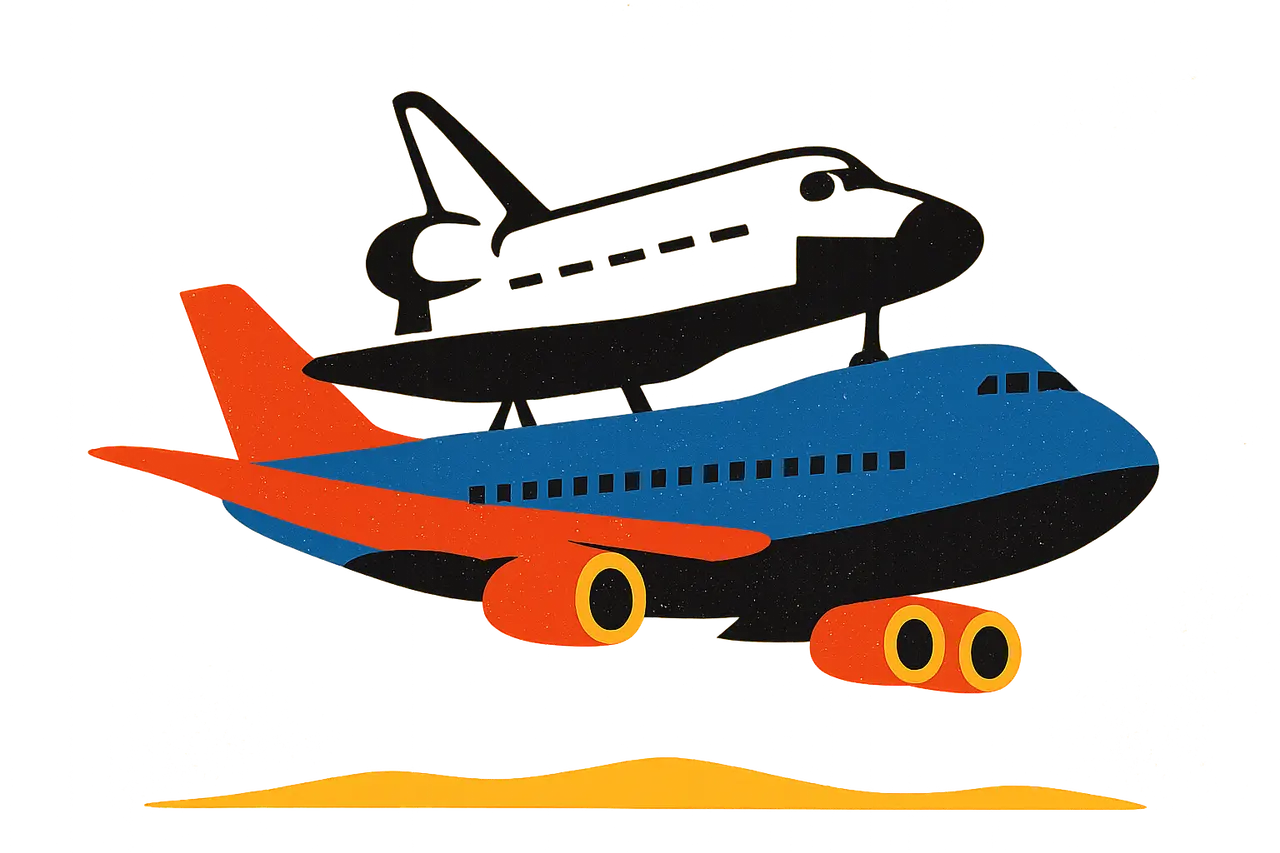
The shuttle Enterprise's 'first flight' has three dates in 1977: a piggyback ride in February, a crewed one in June, and a free glide in August.
The space shuttle prototype Enterprise first flew on February 18, 1977, bolted to the back of a modified Boeing 747, the Shuttle Carrier Aircraft NASA 905, over Edwards, California. Nobody was aboard the orbiter, which was powered down; the jet’s crew flew the pair for 2 hours 5 minutes, reaching 16,000 feet and 287 mph.
Sources date Enterprise’s first flight differently because its Approach and Landing Tests came in stages:
- February 18, 1977: first captive flight, inert and uncrewed, after taxi tests on February 15.
- June 18, 1977: first crewed, active captive flight, with astronauts aboard Enterprise.
- August 12, 1977: first free flight. Fred Haise fired the explosive bolts at 24,100 feet, and he and Gordon Fullerton glided to Rogers Dry Lake, watched by an estimated 65,000 people.
- October 26, 1977: the last of 16 test missions flown since February 15.
The carrier had its own history. NASA 905 began as an American Airlines 747, bought by NASA in 1974 for wake-vortex research, and kept the airline’s red, white and blue stripes into the early 1980s.
Enterprise itself never reached space. It had no engines and no real heat shield, only polyurethane stand-in tiles. NASA planned to refit it for spaceflight, but design changes made on Columbia would have made the conversion far more extensive, so Enterprise was retired in October 1979. Space Center Houston notes that without its tests the program could not have launched STS-1 in April 1981.
Since July 19, 2012, Enterprise has been on public display at the Intrepid Museum in New York, after a last piggyback flight from Washington to JFK Airport.
Sources & references
5 referencesWell-established. Corroborated by 4 independent sources.