Mir launched in 1986; its backup core still flies on the ISS
On this day · 20 February 1986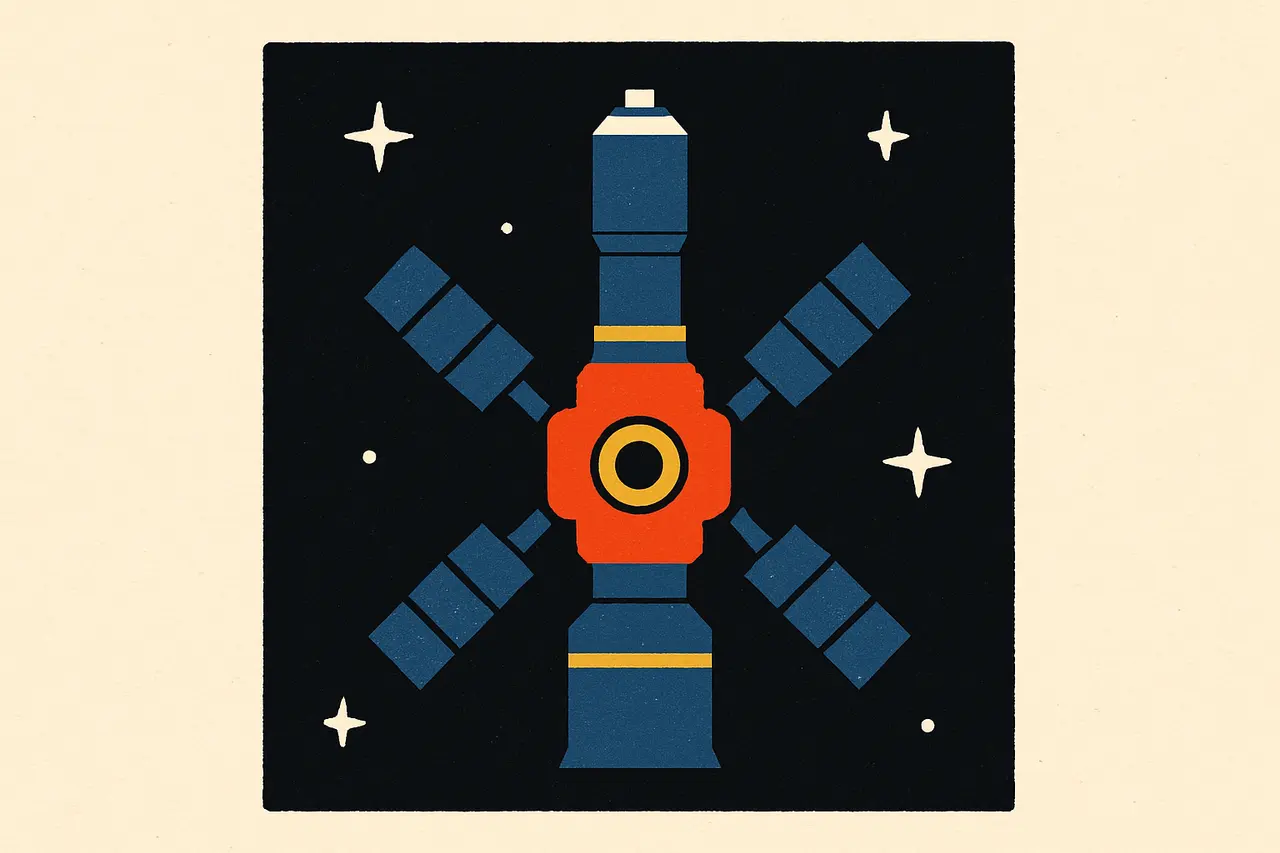
Mir's core module reached orbit in February 1986, grew into a 130-tonne complex, and lives on: its flight backup became the ISS's Zvezda module.
The core module of the Soviet Mir space station was launched on February 20, 1986, Moscow time, atop a Proton rocket from the Baikonur Cosmodrome in Kazakhstan. NASA dates it February 19 because liftoff fell late that evening in UTC; both dates describe the same launch.
The 45,000-pound base block held the crew quarters, life support and command systems. Its key innovation was a forward docking hub, with four radial ports for large research modules and one axial port, plus a sixth port at the rear. Five research modules followed between 1987 and 1996, and the finished complex weighed about 285,900 pounds, more than six times the core and the largest spacecraft ever assembled up to that point.
The first crew, Leonid Kizim and Vladimir Solovyov, docked in March 1986. In May they took their Soyuz to the older Salyut 7 station, about 3,800 miles away, worked there for 50 days, and returned to Mir with 880 pounds of equipment, including a guitar. It remains the only station-to-station crew transfer ever made.
Mir hosted 125 people from 12 countries and was occupied without a break from September 1989 to August 1999, a decade-long run the International Space Station did not surpass until October 2010. It was steered into the South Pacific on March 23, 2001.
Yet Mir’s core is, in a sense, still up there. The ISS Zvezda service module, the heart of the station’s Russian segment, was built as the Mir base block’s flight backup, updated with newer technology. Zarya, the first ISS module launched, shares its heritage with Mir’s research modules, and China’s Tiangong station also derives from Mir module designs. A near-twin of the 1986 core is still in orbit as part of the ISS.
Sources & references
3 referencesWell-established. Corroborated by 3 independent sources.