Soyuz 4 and 5 made the first docking of two crewed ships
On this day · 16 January 1969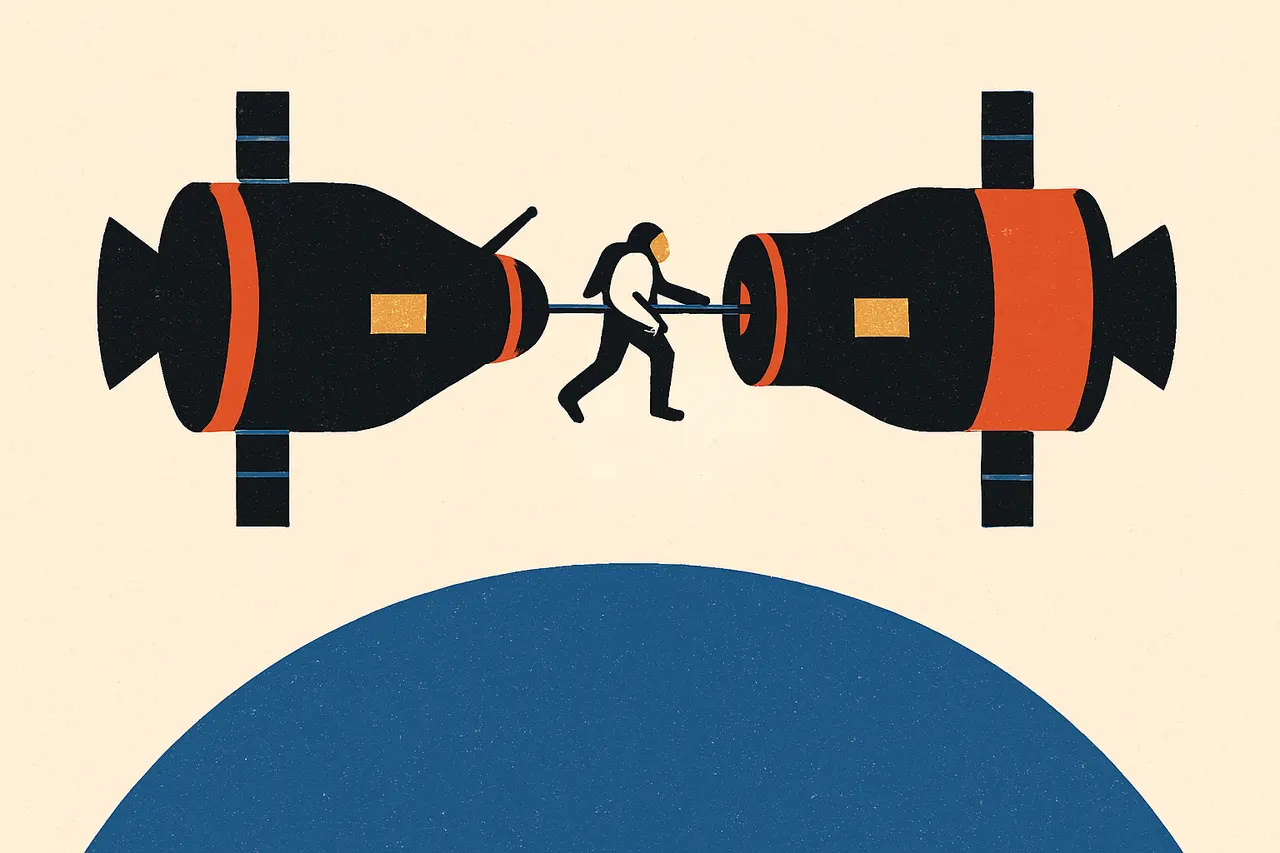
In January 1969 two Soviet capsules made the first crew-to-crew docking — not the first docking in space — and one pilot barely survived the trip home.
Soyuz 4 and Soyuz 5 made the first docking of two crewed spacecraft on January 16, 1969, linking up in Earth orbit with four Soviet cosmonauts aboard. Vladimir Shatalov flew Soyuz 4 alone and steered it in by hand over the final 100 meters; Soyuz 5 carried Boris Volynov, Aleksei Yeliseyev and Yevgeny Khrunov.
It was not the first docking in space, a point many summaries blur. That came on March 16, 1966, when Neil Armstrong and David Scott docked Gemini VIII with an uncrewed Agena target vehicle, and uncrewed Soyuz craft had already docked under fully automatic control in 1967 and 1968. What Soyuz 4 and 5 added was a crew on both sides, and a transfer between them.
For the transfer, Yeliseyev and Khrunov put on Yastreb suits and spent about 37 minutes climbing along the outside from Soyuz 5 to Soyuz 4. The ships stayed joined for about four and a half hours, and the two spacewalkers landed with Shatalov on January 17, the first people to come home in a different spacecraft from the one they launched in.
The man left behind had the hardest ride. Volynov, alone in Soyuz 5, nearly died coming home on January 18. After the braking burn, the ship’s instrument module failed to separate, and the stack plunged into the atmosphere nose first, with the lightly protected entry hatch facing the heat instead of the main heat shield. He could smell the hatch sealant burning and began recording notes for investigators on a fire-resistant wire recorder.
The module finally broke away, but the capsule fell on a ballistic path at up to 9 g, its parachute lines twisted, and the hard landing, roughly 600 kilometers short of target on a −38°C steppe, broke the roots of his upper teeth. Secrecy had kept him from even describing the problem over the radio, and Volynov could tell the full story publicly only decades later.
Sources & references
4 referencesWell-established. Corroborated by 3 independent sources.