Ordinary matter is only 5% of the universe — mostly unseen
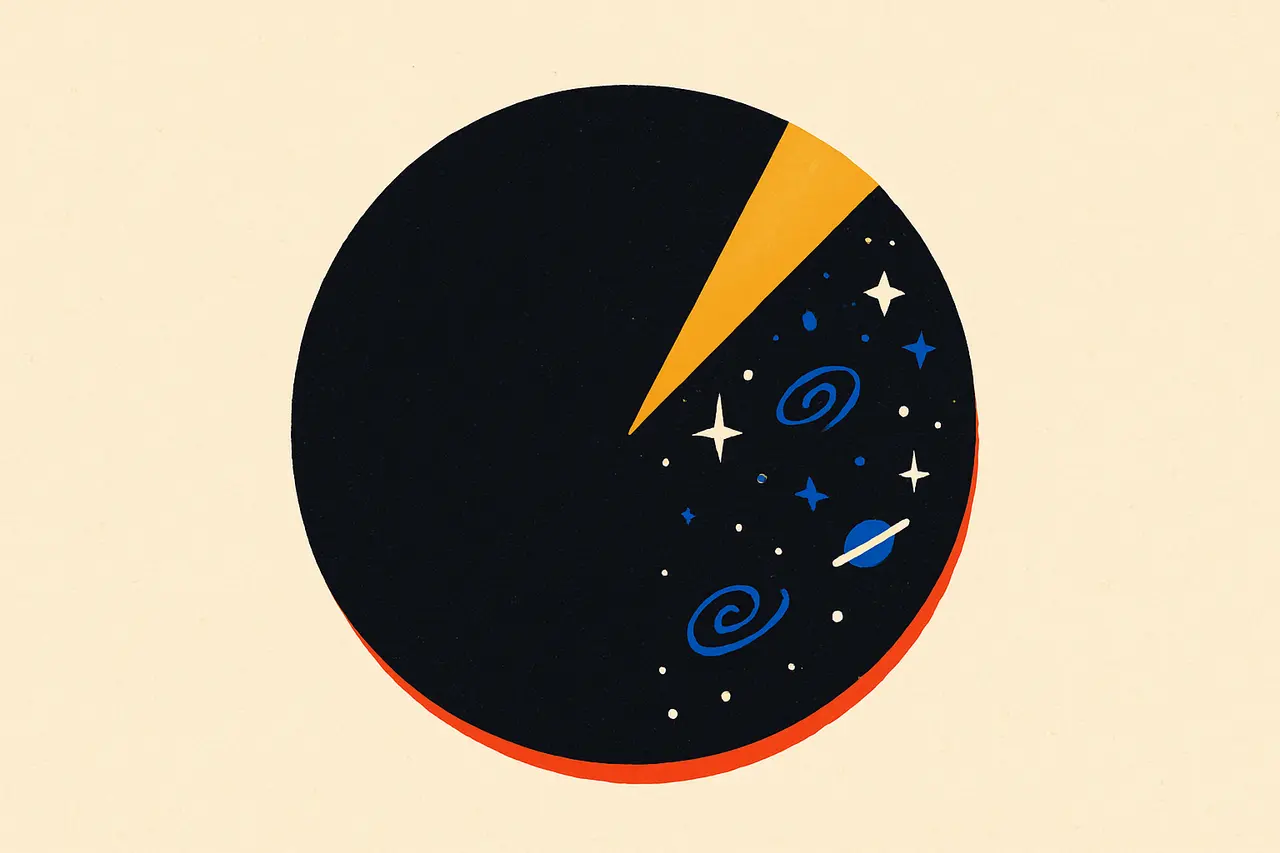
Atoms make up about 5% of the cosmos, and a 2025 radio-burst study found most of those atoms drifting as faint gas between galaxies.
Ordinary matter, every atom in every star, planet, gas cloud and person, makes up only about 5% of the universe’s total mass and energy. About 27% is dark matter, which has gravity but neither emits nor absorbs light, and roughly 68% is dark energy, the unknown something accelerating cosmic expansion.
The recipe comes from the cosmic microwave background. In 2013 ESA’s Planck satellite produced the sharpest map yet of that ancient light and extracted the most refined values to date: 4.9% ordinary matter and 26.8% dark matter, nearly a fifth more dark matter than the previous estimate. NASA puts dark energy at about 68.3 to 70%.
5% or 16%?
You will also see ordinary matter described as about 16% of the universe. Both numbers are right; they answer different questions. Sixteen percent is its share of matter alone, since dark matter outweighs it by roughly six to one, as CERN puts it. Five percent is its share of everything once dark energy is counted too.
Even the 5% is mostly not “what we can see”. Because much of it is spread thinly, roughly half of all ordinary matter went unaccounted for until 2025, when astronomers at Caltech and the Harvard–Smithsonian Center for Astrophysics used 69 fast radio bursts as backlights. Measuring how intervening gas delayed each flash let them weigh it: 76% of ordinary matter lies in the space between galaxies, about 15% in haloes around galaxies, and only the remainder sits inside galaxies as stars and cold gas. On those numbers, stars, planets and people are well under 1% of the universe.
“It’s like we’re seeing the shadow of all the baryons, with FRBs as the backlight.” — Vikram Ravi, Caltech, 2025
Sources & references
5 referencesWell-established. Corroborated by 4 independent sources.