Luna 9 proved the Moon wasn't a sea of dust in 1966
On this day · 3 February 1966
The first soft landing on another world, by a 99 kg Soviet ball on airbags, settled whether the lunar surface could hold a spacecraft.
The Soviet probe Luna 9 made the first soft landing on the Moon on 3 February 1966, touching down in the Ocean of Storms and proving the lunar surface was firm enough to carry a spacecraft. Until then, some experts feared that anything landing there would sink into a deep layer of dust; ESA describes the mission as removing doubts that the surface was “unsafe quicksand”.
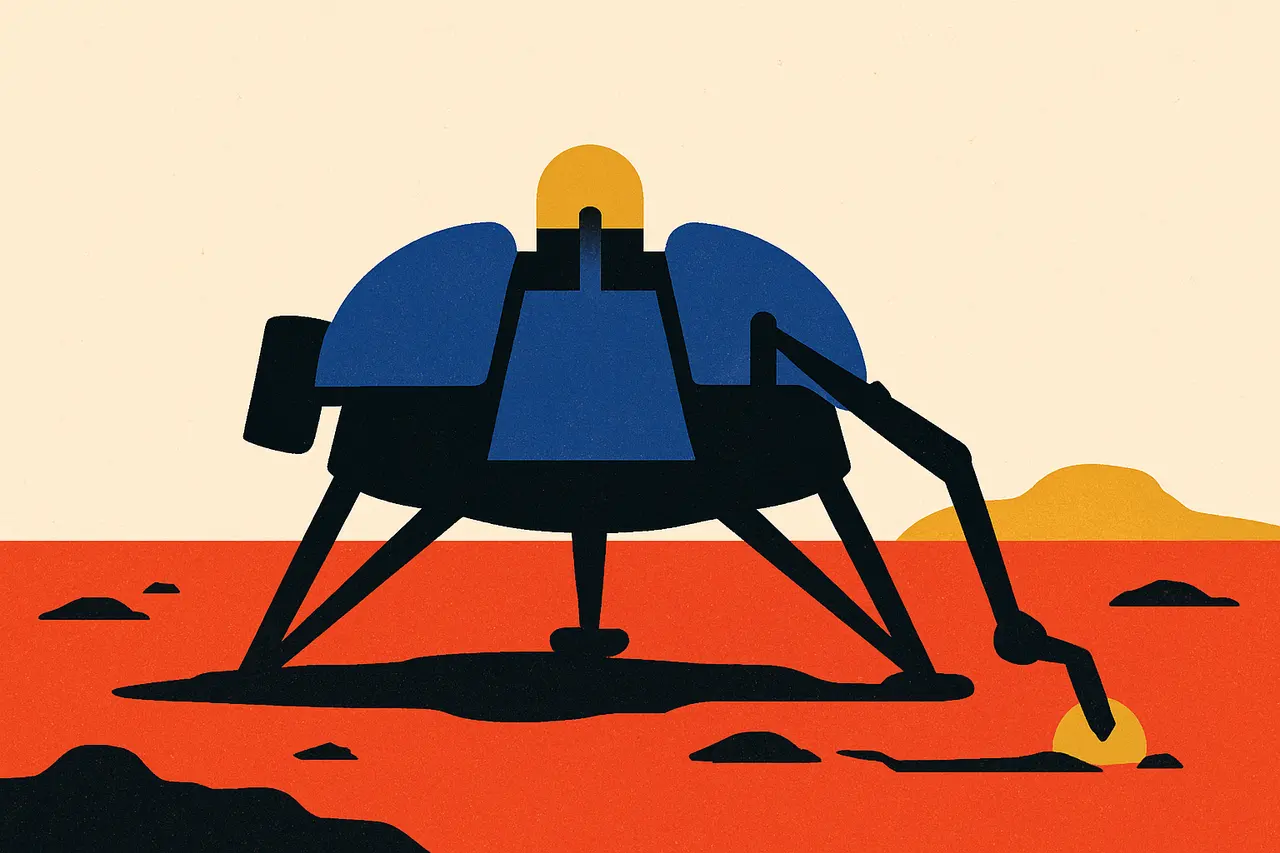
Landing gently was harder than hitting. Soviet and American probes had already crashed into the Moon, some deliberately, but a soft landing needed precise braking, protection from the final drop and a reliable radio link. In Luna 9’s case, about 5 metres above the ground, the descending craft ejected a sealed ball roughly 1.5 m across and weighing about 99 kg. Cushioned by airbags, it bounced several times before coming to rest. Some 250 seconds after landing, four spring-loaded petals opened to steady it upright, and the camera began scanning the scene with a rotating mirror.
The first test image was faint because the Sun stood only about 3 degrees above the horizon. Over seven radio sessions totalling 8 hours 5 minutes, Luna 9 sent three series of pictures that assembled into four panoramas of nearby rocks and a crater about 25 metres wide nearby.
The pictures held a quiet clue about the soil. The lander first sat at a 15-degree tilt, then shifted to 22.5 degrees as the ground settled beneath it: soft enough to move, but strong enough to bear weight.
Transmissions continued until 6 February, when the batteries ran out. In July 1969, three and a half years later, Apollo 11 astronauts walked on that same kind of ground.
Sources & references
5 referencesWell-established. Corroborated by 3 independent sources.