The Sun and Jupiter orbit a point outside the Sun
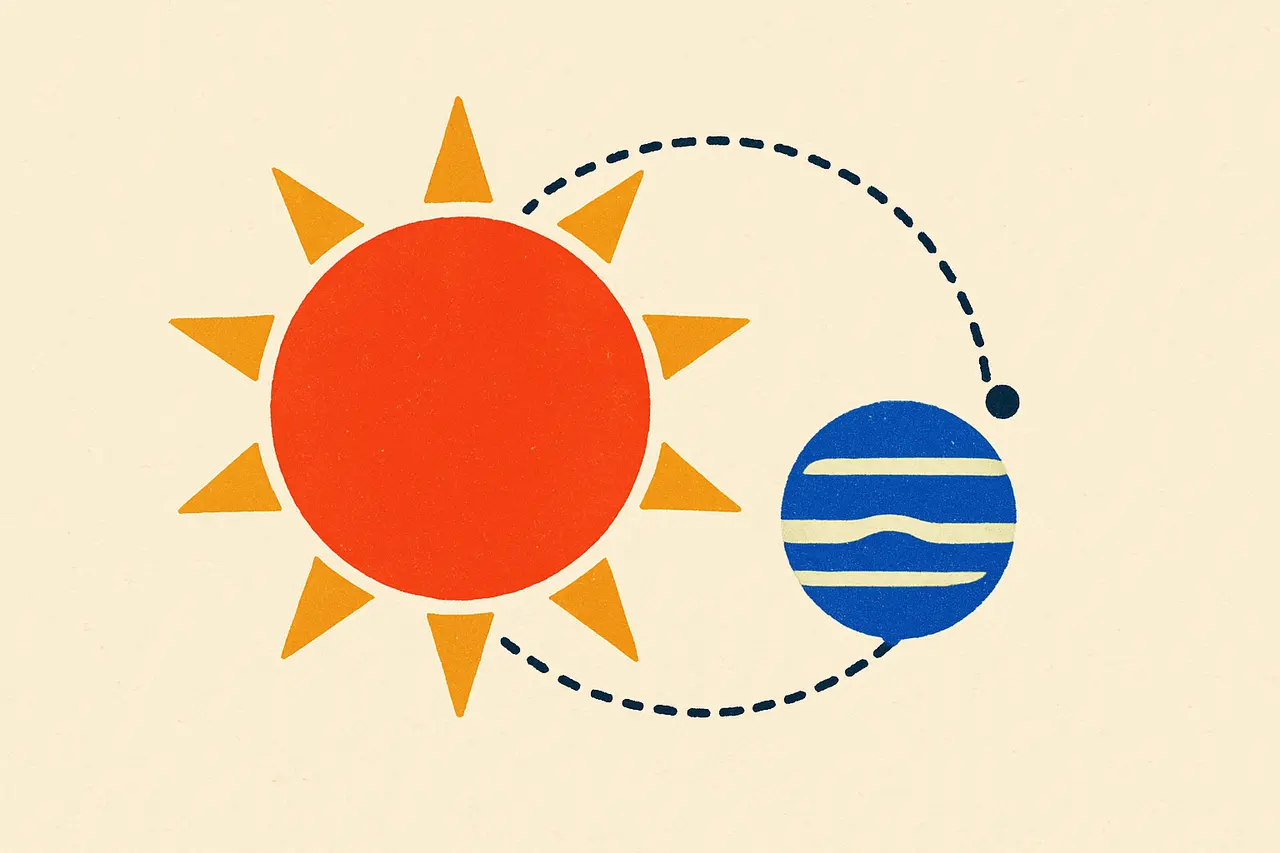
Jupiter is heavy enough to drag the Sun–Jupiter balance point just past the solar surface, so our star wobbles around a spot in empty space.
The Sun does not sit still at the centre of Jupiter’s orbit: the two bodies circle a shared centre of mass, or barycenter, that lies just outside the Sun’s surface. Every planet tugs on the Sun this way, but Jupiter is the one that drags the balance point clear of the star.
The reason is mass plus leverage. Jupiter carries 318 times Earth’s mass, more than twice the material of all the solar system’s other bodies apart from the Sun combined, and it orbits far out. Over each of its roughly 12-year orbits, the Sun traces a small matching loop around that external point.
Other pairs balance in other places. For the Sun and Earth, the point sits very close to the Sun’s centre. For Earth and the Moon it lies inside Earth, even though Earth is only about 81 times the Moon’s mass. Pluto and Charon balance outside Pluto, which is only about 8 times Charon’s mass, making them a binary dwarf planet.
Claims that “Jupiter doesn’t orbit the Sun” go too far. The Sun–Jupiter pair is only part of the picture: the barycenter of the whole solar system shifts constantly as the planets move, ranging from near the Sun’s centre to beyond its surface. Everything, Sun included, orbits that wandering point, which never strays far from the Sun.
The same wobble is how astronomers found many planets around other stars. The first planet discovered orbiting a Sun-like star, 51 Pegasi b, in 1995, raced around its star in four days and tugged it so hard that the wobble was obvious to telescopes once astronomers knew what to look for. Earth is a far gentler partner: ESA notes it moves the Sun at only about 0.1 metres per second, one reason a true Earth twin is so hard to catch this way.
Sources & references
5 referencesWell-established. Corroborated by 4 independent sources.