The oldest piece of Earth is a crystal older than the rocks around it
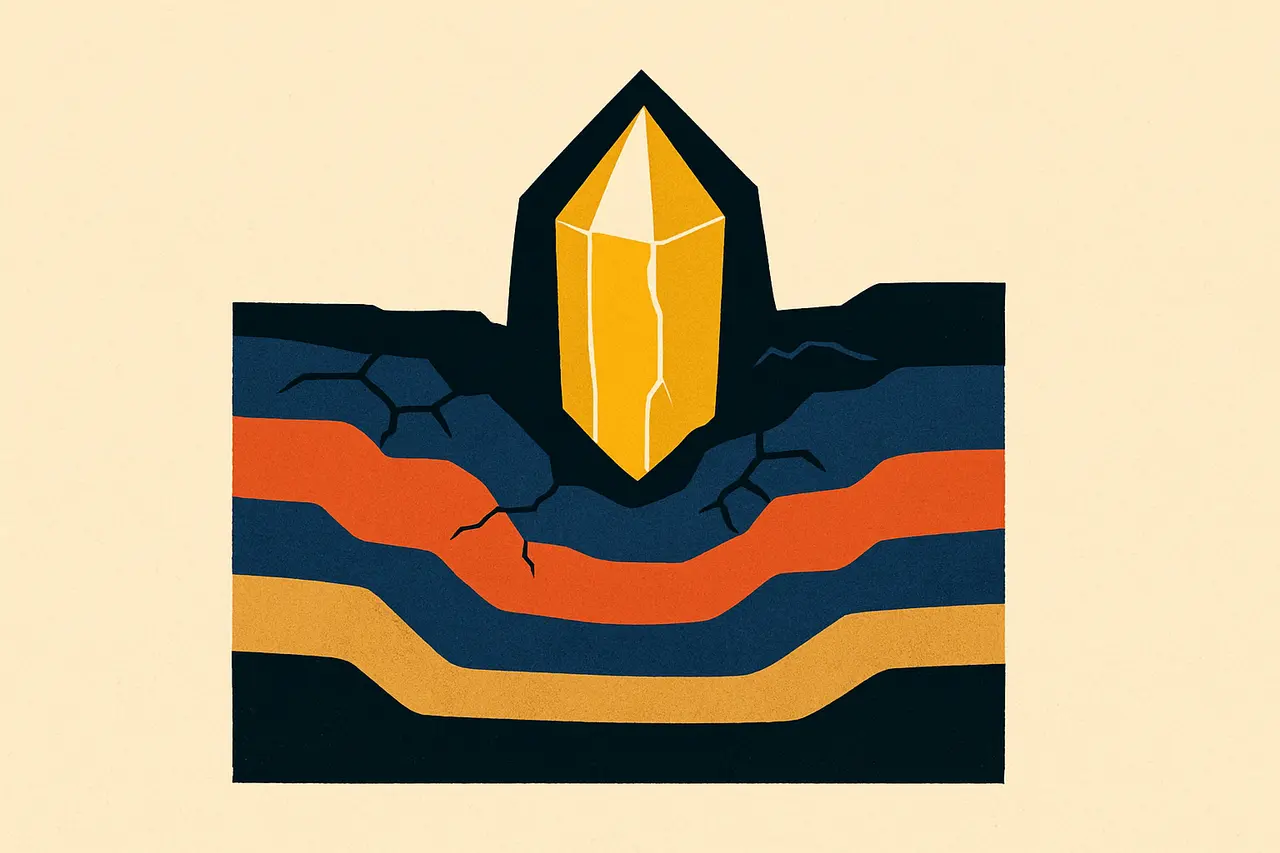
A speck of zircon from Australia has survived 4.4 billion years — almost as old as the planet itself.
In the Jack Hills of Western Australia, geologists found a grain of zircon measuring only about 200 by 400 microns — roughly twice the width of a human hair. Its age comes from a clock built into the crystal itself: when zircon forms, it traps uranium but rejects lead, so any lead inside must come from uranium slowly decaying at a known rate. By measuring that uranium-to-lead ratio grain by grain with an ion microprobe, researchers dated the crystal to about 4.4 billion years ago, just 150 million years after Earth coalesced. That makes it the oldest known material formed on Earth.
Zircon endures because it is extraordinarily tough, surviving cycles of weathering, transport and burial long after its parent rock has crumbled to nothing.
The crystal is older than any surviving rock — a relic from a world we otherwise cannot see.
What the grain revealed was as startling as its age. The textbook picture of the Hadean eon was a hellish, all-molten planet, its surface an ocean of magma. But oxygen-isotope ratios locked in the zircon point to its having interacted with liquid water at the surface — water cool enough to weather and recycle rock. That evidence underwrites the idea of a “cool early Earth,” a planet that had calmed, grown a crust, and possibly hosted oceans hundreds of millions of years sooner than once believed — and that may have been habitable far earlier than anyone expected.
Sources & references
3 referencesWell-established. Corroborated by 3 independent sources.