Gravitational waves were first detected on 14 September 2015
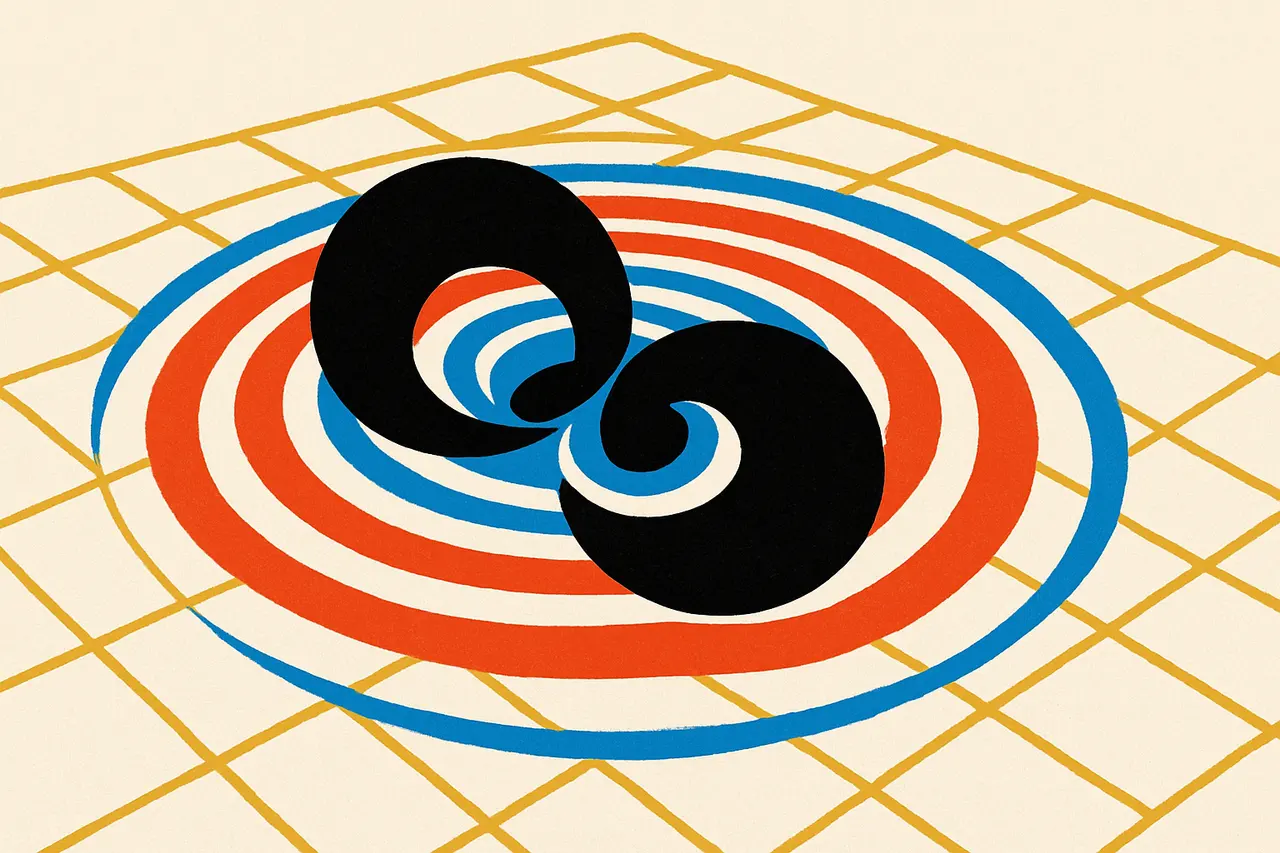
LIGO's first signal came from two black holes that merged 1.3 billion years ago; a decade later it hears such collisions every few days.
The first direct detection of gravitational waves was made on 14 September 2015, when both LIGO detectors in the US recorded a signal, later named GW150914, from two black holes of about 29 and 36 solar masses that merged some 1.3 billion years ago.
It was not the first evidence that the waves exist. In 1974 Russell Hulse and Joseph Taylor found a pulsar orbiting a neutron star, and in 1982 Taylor and Joel Weisberg showed its orbit shrinking as energy drained away in gravitational waves, work that won the 1993 Nobel Prize. LIGO’s feat was catching the ripples themselves, something Einstein had not expected anyone to manage.
“Einstein thought gravitational waves were too weak to detect, and didn’t believe in black holes. But I don’t think he’d have minded being wrong!” — Bruce Allen, Max Planck Institute for Gravitational Physics, 2016
| GW150914 | Figure |
|---|---|
| Black holes that merged | 29 and 36 solar masses |
| Mass converted into gravitational waves | about 3 solar masses |
| Peak power vs the whole visible universe | roughly 50 times |
| Gap between Livingston and Hanford | 7 milliseconds |
| Change in LIGO’s 4-kilometre arms | about 4 × 10⁻¹⁸ metres |
The mass was converted in a fraction of a second, the 7-millisecond lead at Livingston placed the source in the southern sky, and the change in arm length was roughly 1/200th of a proton’s width. The discovery earned Rainer Weiss, Barry Barish and Kip Thorne the 2017 Nobel Prize in Physics.
Ten years on, detections are routine. The LIGO–Virgo–KAGRA network has captured about 300 black-hole mergers, and LIGO now picks up roughly one every three days. In January 2025 it recorded GW250114, a near-twin of the first event in distance and mass but heard far more clearly, which gave the best evidence yet for Stephen Hawking’s 1971 area theorem: when black holes merge, their total surface area cannot shrink.
Sources & references
4 referencesWell-established. Corroborated by 3 independent sources.