The CMB was found by accident in 1964 — and missed in 1941
Two Bell Labs radio astronomers stumbled on the Big Bang's afterglow while chasing antenna hiss, decades after it was predicted and unknowingly measured.
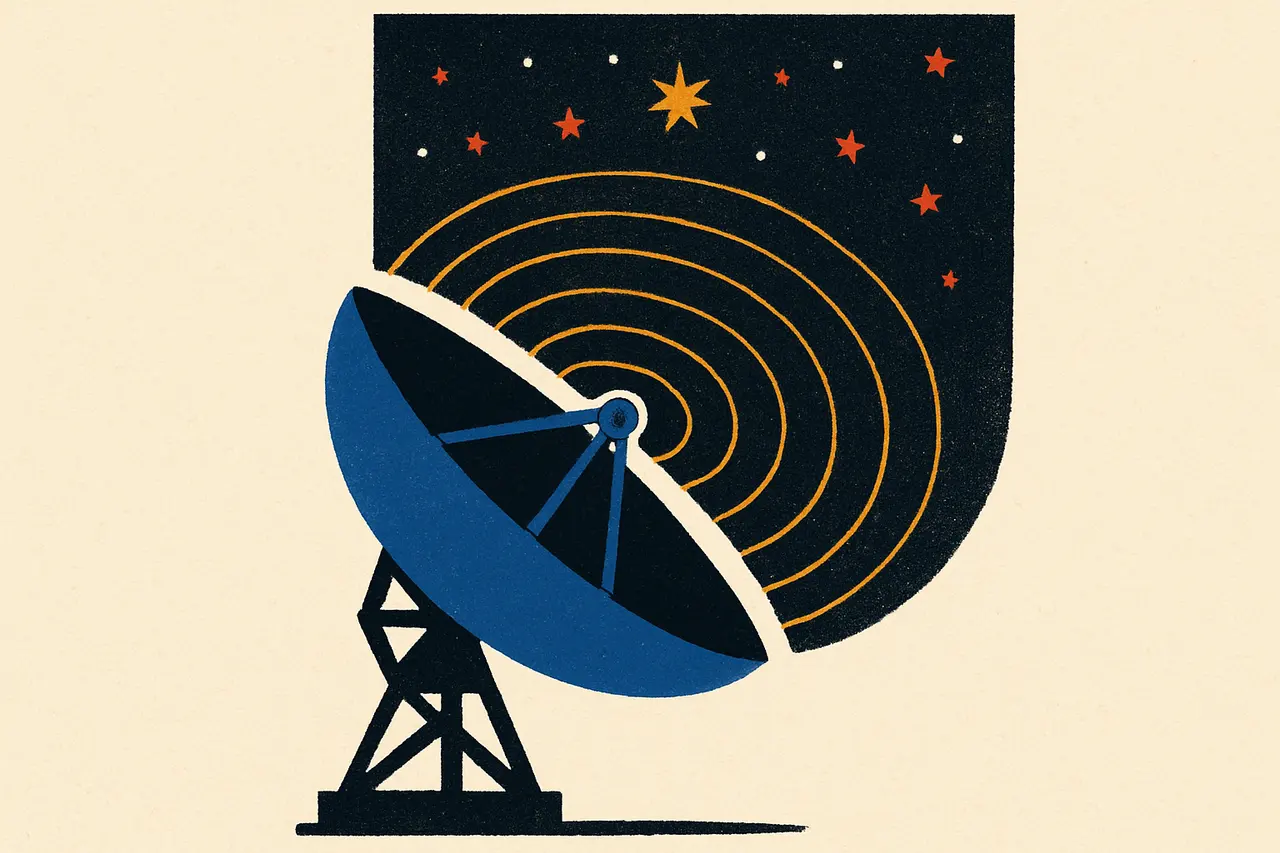
The cosmic microwave background (CMB), the afterglow of the Big Bang, was discovered by accident in 1964 by Arno Penzias and Robert Wilson, Bell Labs radio astronomers trying to get rid of a stubborn hiss in a horn antenna at Holmdel, New Jersey. Their result appeared in 1965, which is why both dates circulate.
The noise was faint, steady and the same in every direction. The pair spent a year eliminating suspects, from radio signals drifting in from nearby cities to pigeons nesting inside the horn, before concluding that the microwaves filled the universe. They had little idea what it was. The explanation came from Robert Dicke at Princeton, whose group was preparing to search for exactly this kind of faint, cold afterglow of a hot Big Bang.
The signal was not entirely new to science. It had been predicted, and even measured, long before anyone recognised it:
| Year | Who | Predicted or measured temperature |
|---|---|---|
| 1941 | Andrew McKellar | Measured: interstellar cyanogen bathed in something about 271 °C below zero |
| Late 1940s | George Gamow, Ralph Alpher, Robert Herman | Predicted: leftover radiation from a hot early universe, at no more than about 5 K |
| 1964 | Penzias and Wilson | Measured: microwaves from every direction, about 3 degrees above absolute zero |
| Today | Modern measurements | Measured: 2.7 K |
McKellar, a Canadian astronomer, read his number from the spectrum of interstellar cyanogen molecules, close to the modern CMB value. Nobody connected it to the Big Bang. The spectroscopist Gerhard Herzberg wrote off the reading:
“From the intensity ratio of the [CN] lines … a rotational temperature of 2.3 K follows, which has of course a very restricted meaning.” — Gerhard Herzberg
The radiation is light released about 380,000 years after the Big Bang, now stretched to microwaves, with roughly 400 photons in every cubic centimetre of space. Penzias and Wilson shared the 1978 Nobel Prize in Physics; McKellar had died in 1960.
Sources & references
5 referencesWell-established. Corroborated by 5 independent sources.