Boustrophedon: ancient Greeks wrote alternating lines in opposite directions
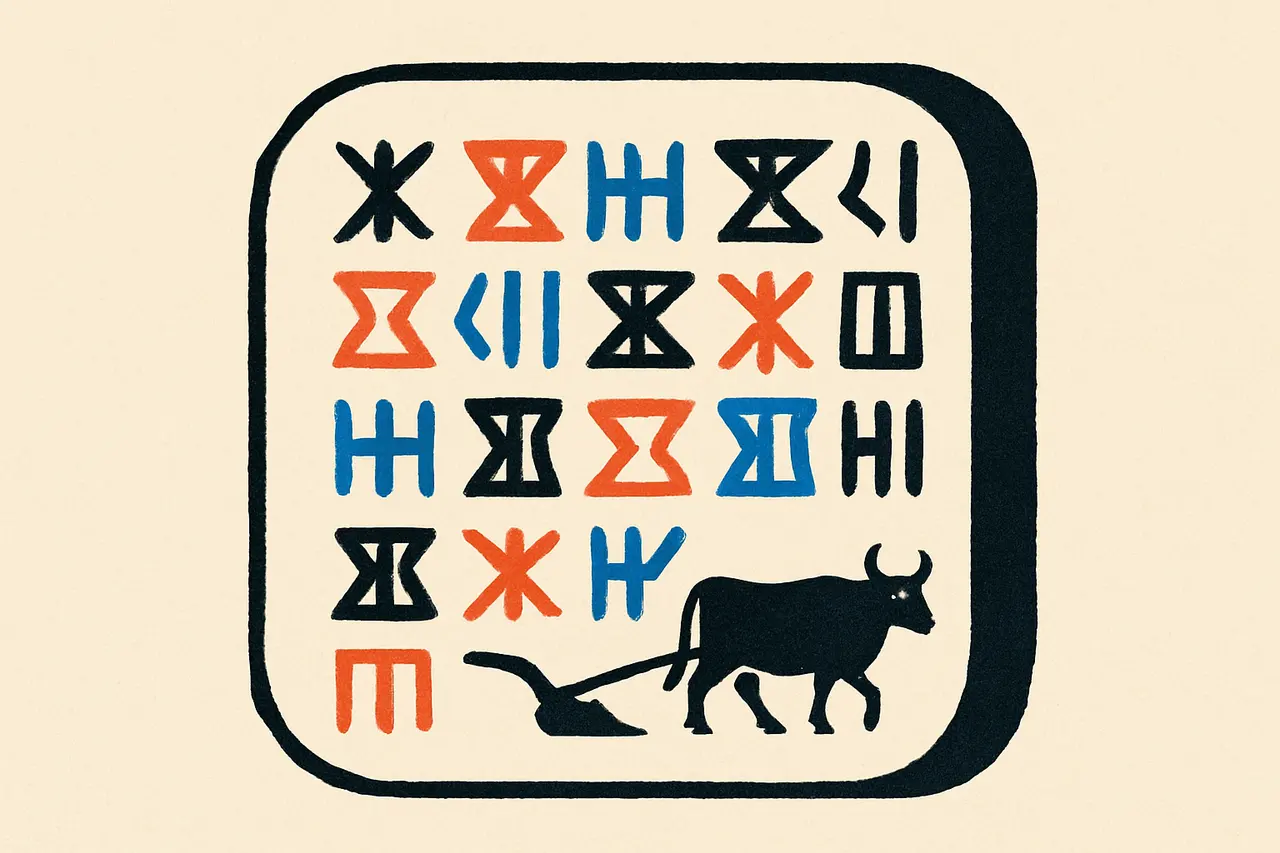
Early Greek inscriptions snaked left-to-right, then right-to-left — flipping the letters too — in a style named after a plowing ox.
Reading a modern page is monotonous in the best way: every line runs the same direction. Some of the earliest Greek inscriptions were not so tidy. They were written boustrophedon — the first line left-to-right, the next right-to-left, the next reversed again, weaving back and forth down the stone.
The name says it all. From Greek bous (“ox”) and strephein (“to turn”), boustrophedon means writing that “turns like oxen” plowing a field — the scribe’s hand doubling back at each row’s end, just as a plow team turns to cut the next furrow.
Picture an ox plowing: down one row, turn, back up the next. That’s the page.
And it wasn’t only the line order that flipped. In true boustrophedon, the individual letters were mirror-reversed on the right-to-left lines, so non-symmetrical characters faced whichever way the reading went. The text was, quite literally, a mirror image of itself every other row.
The style appears in Greek and Etruscan writing around the 6th century BCE. It faded as the left-to-right convention won out, helped along by the spread of writing on papyrus. Boustrophedon survives today mostly as a wonderfully specific vocabulary word — and, fittingly, as the path a dot-matrix printer head still traces.
Sources & references
2 referencesWell-established. Corroborated by 2 independent sources.