Time runs slower near a black hole, and we've measured it
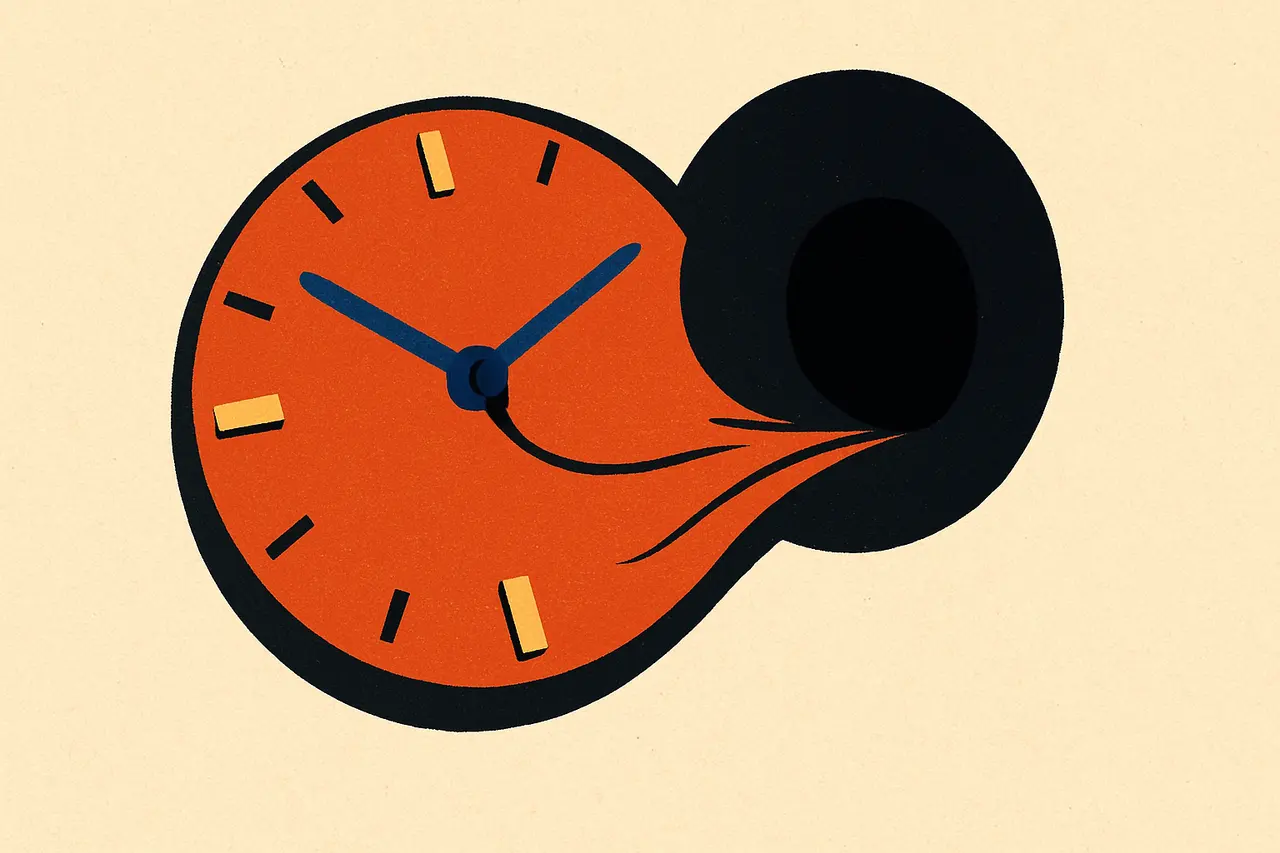
Gravity slows clocks. Near a black hole the effect is extreme, and in 2018 astronomers caught it in starlight from the Milky Way's central black hole.
Time runs slower near a black hole. General relativity says mass warps time as well as space, so the deeper a clock sits in a gravitational well, the slower it ticks compared with one farther out. Close to a black hole’s event horizon, the boundary beyond which not even light can escape, the effect becomes extreme.
The same physics works, very gently, on Earth. In 2010, NIST physicists compared two aluminium atomic clocks and showed that one raised just 33 centimetres ticks faster than the one below. The gap is tiny, about 90 billionths of a second over a 79-year lifetime, but it is the same effect a black hole magnifies.
We know it happens near a black hole thanks to the Milky Way’s central one, Sagittarius A*, which packs around four million Suns into a region no larger than our solar system. In May 2018, astronomers using ESO’s Very Large Telescope tracked the star S2 as it swung within 20 billion kilometres of it at almost 3% of the speed of light. Its light arrived stretched to longer wavelengths, a gravitational redshift, by exactly the amount Einstein’s theory predicts. That stretching is time dilation seen from outside: the star’s light, like a clock, is slowed by the black hole’s gravity.
It was the first time this departure from Newton’s simpler theory of gravity had been seen in a star orbiting a supermassive black hole. Reinhard Genzel and Andrea Ghez, who led the two teams that spent decades tracking those stars, shared the 2020 Nobel Prize in Physics.
A common misreading is that time “stops” at the horizon. That is how things look from far away: to a distant observer, an object falling toward the horizon appears to slow down until it seems completely frozen. The falling object, by contrast, notices nothing odd about its own clock.
Sources & references
4 referencesWell-established. Corroborated by 4 independent sources.