Birds are living dinosaurs
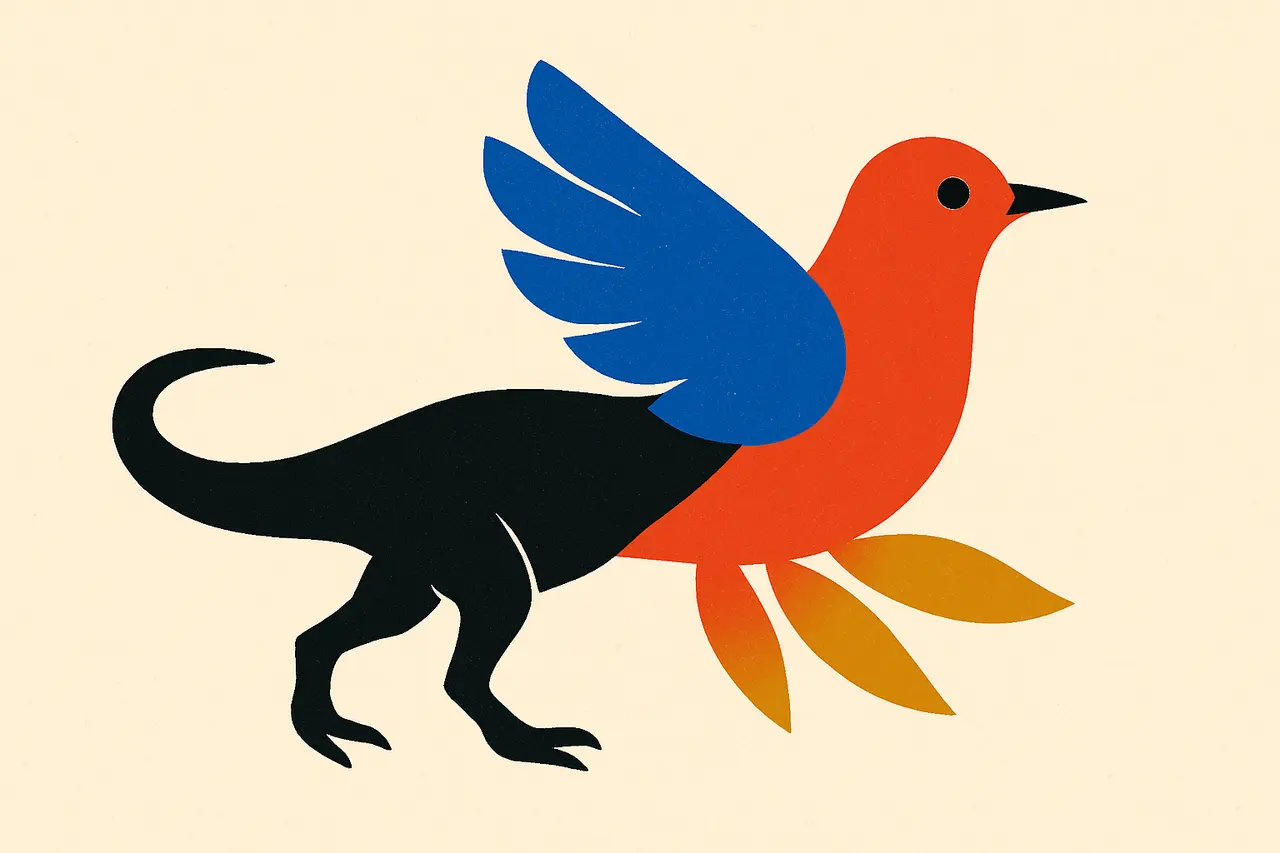
The dinosaurs never fully died out — about 13,000 species of them are still flying around today.
Modern birds are not merely related to dinosaurs; biologically, they are dinosaurs. In the language of cladistics, birds nest deep inside the dinosaur family tree — within the theropods, then Coelurosauria, then Maniraptora, the same branch as Velociraptor. Because a group always contains all the descendants of its ancestor, birds don’t just descend from dinosaurs; by definition they are a kind of theropod dinosaur, a living twig on that branch.
The evidence began with Archaeopteryx, a feathered, raven-sized animal from about 150 million years ago that mixed bird and dinosaur traits: wings and feathers, but also sharp teeth, a long bony tail, and clawed fingers. The case was sealed in the 1990s, when the lake beds of Liaoning, China yielded exquisitely preserved feathered dinosaurs like Sinosauropteryx and the four-winged Microraptor — proof that feathers evolved for warmth and display long before flight.
The shared traits run far deeper than plumage. Birds and their dinosaur kin have hollow, air-filled (pneumatized) bones, a wishbone, lungs ventilated by air sacs, and three-fingered hands. They brood their eggs in open nests, and egg-laying females of both lay down a special calcium store called medullary bone — the very tissue that helped identify a pregnant Tyrannosaurus.
“The birds are simply a twig on the dinosaurs’ branch of the tree of life.” — UC Berkeley, Understanding Evolution
So the dinosaurs never fully vanished. As the American Museum of Natural History puts it, they are still among us, represented by at least 13,000 living bird species — singing, nesting, and flying overhead today.
Sources & references
2 referencesWell-established. Corroborated by 2 independent sources.