The axolotl regrows limbs, heart, and even brain
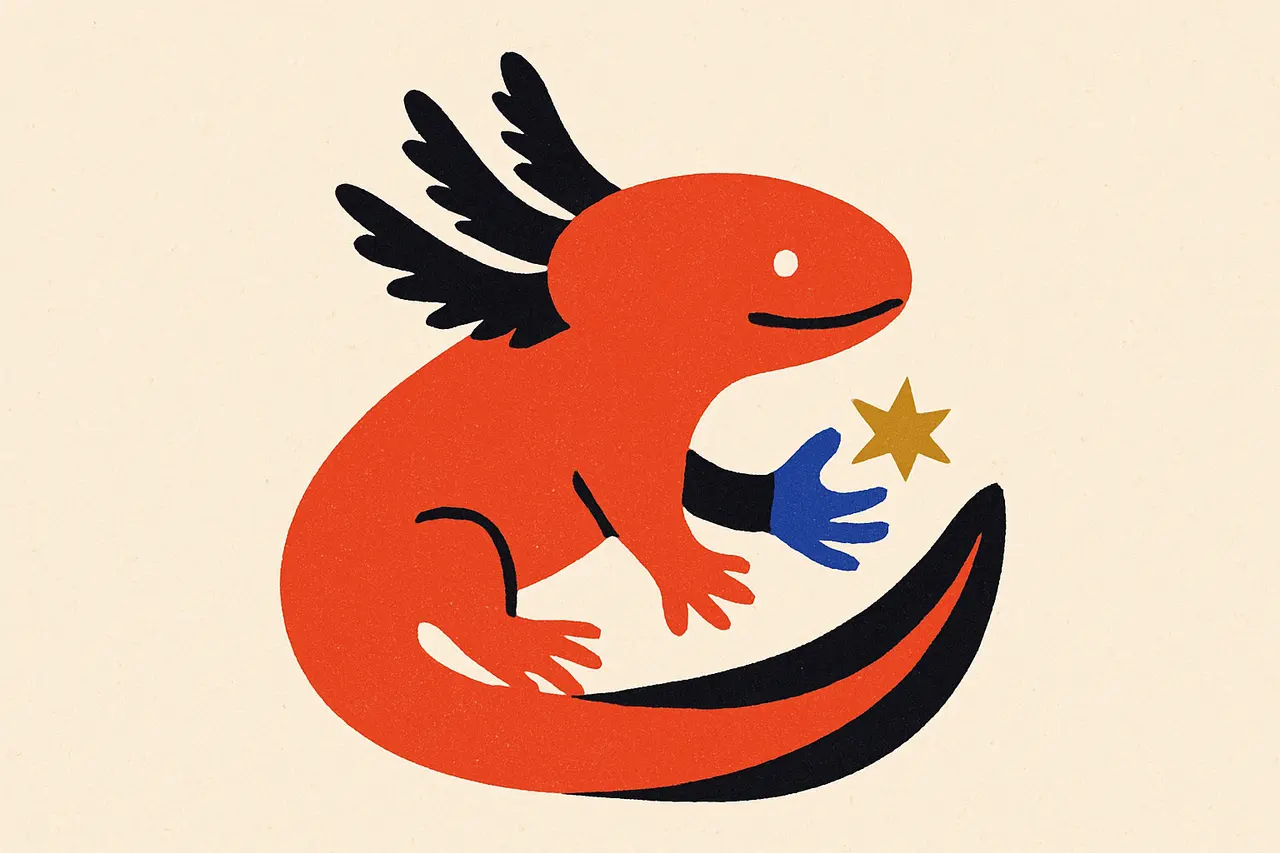
This Mexican salamander can rebuild a severed leg perfectly, five times over, without leaving a scar.
The axolotl is a salamander that never grows up. Through a quirk called neoteny, it keeps its feathery gills and aquatic, larval body for its whole life — and with it, an astonishing power to rebuild itself.
Cut off a leg and the axolotl doesn’t form a scar. Instead, cells at the wound surface dedifferentiate — they shed their adult identity and pile up into a blastema, a mass of progenitor cells that behaves like a tiny embryo. The blastema reads the limb’s positional identity and regrows exactly the missing structure: skin, bone, cartilage, muscle, and nerves, in the right order, no more and no less. The axolotl can repeat the feat five times perfectly, in a matter of weeks, and the same trick extends to its lungs, heart, jaws, spinal cord, and even parts of its brain.
Every tissue is replaced, then wired back exactly as before.
The eternal youth isn’t magic; it’s hormonal. Neoteny is driven by unusually low thyroid-hormone signaling. Dose an axolotl with iodine or thyroxine and you can force it to metamorphose into an air-breathing land salamander — gills resorbed, body remodeled — proving the adult form was latent all along.
Because mammals share many of the same signaling pathways, biologists treat the axolotl as a key model for regenerative medicine. The irony is sharp: the creature that can rebuild almost any body part is itself critically endangered, with perhaps 50 to 1,000 left in the wild. Those survivors cling to the shrinking canals of Mexico City’s Lake Xochimilco, squeezed by urbanization and by introduced tilapia and carp that devour the young — even as millions of axolotls thrive safely in labs and home aquariums worldwide.
Sources & references
2 referencesWell-established. Corroborated by 2 independent sources.