Apollo 17 took the Blue Marble photo five hours after launch
On this day · 7 December 1972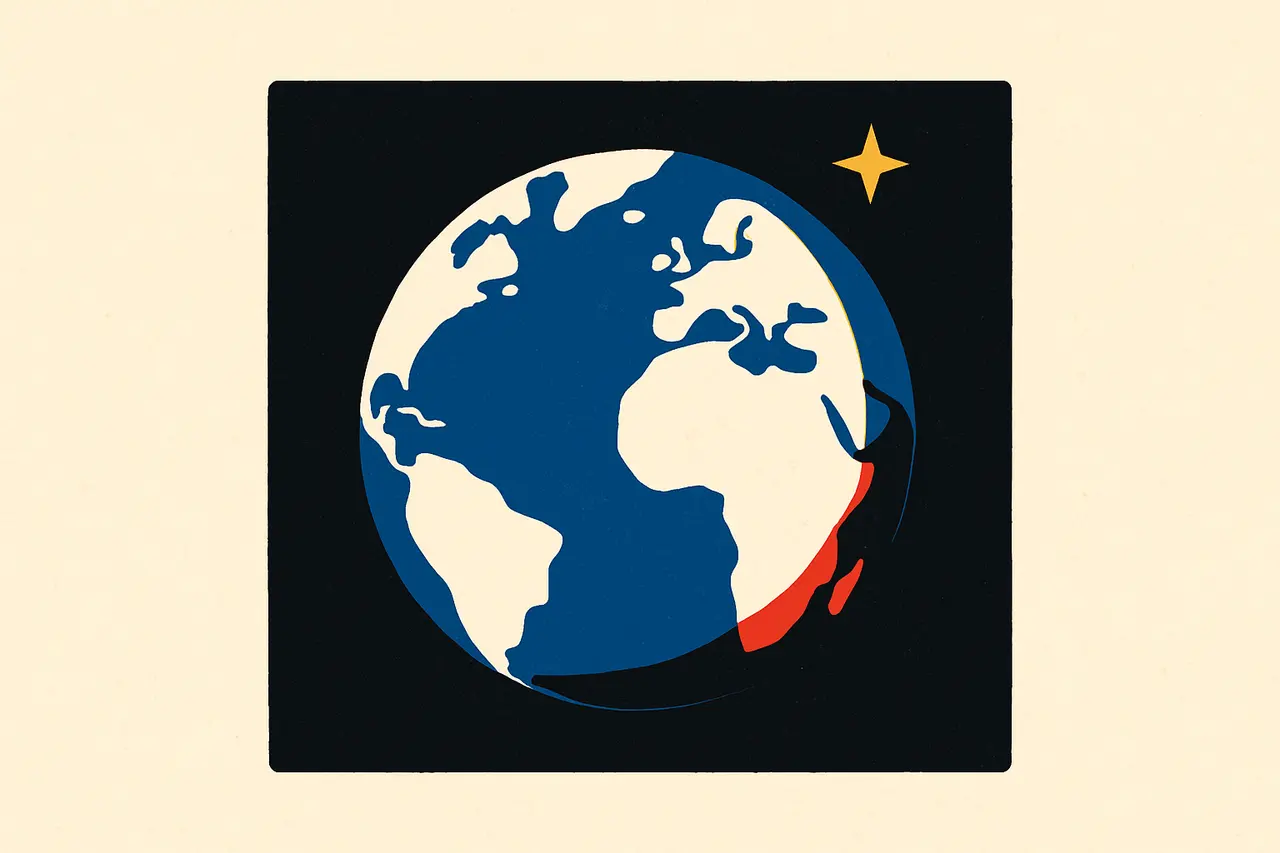
Frame AS17-148-22727 was shot on December 7, 1972, about 29,000 km out — and no one can prove which astronaut pressed the shutter.
The “Blue Marble” photograph, NASA frame AS17-148-22727, was taken by the Apollo 17 crew on December 7, 1972, about five hours after launch, as they coasted toward the Moon with the Sun behind them and the whole of Earth lit up in the window.
It was one of four full-disk frames shot in quick succession on a 70 mm Hasselblad with an 80 mm lens. Apollo 17’s path was the first in the program to bring the south polar ice cap into view, so the picture runs from the Mediterranean past Africa, Arabia and Madagascar down to Antarctica.
The caption still leaves two things unsettled. The first is distance: you will find both “29,000 km” and “45,000 km” quoted. Measured from the size of Earth in the frames, the Blue Marble series was taken about 29,400 km out. The 45,000 km figure fits a later run of frames (22729 to 22732), shot after the spacecraft had travelled farther.
The second is the photographer. Gene Cernan, Ron Evans and Harrison Schmitt all used the Hasselblads. The Smithsonian says later analysis credits Schmitt, but it cannot be proven. The editor of NASA’s Apollo Flight Journal notes that Evans read the magazine’s frame count to Houston moments after the sequence, which hints the camera was in his hands.
Either way, the image answered a question the activist Stewart Brand had been pressing since 1966 with campaign buttons asking, “Why haven’t we seen a photograph of the Whole Earth yet?” He later put it on the cover of his Whole Earth Catalog. Full-Earth views are no longer rare: in 2015 NASA’s EPIC camera on the DSCOVR satellite, about 1.5 million km away, began returning one roughly every two hours. No crew left low Earth orbit again until Artemis II flew four astronauts around the Moon in April 2026, the first crewed lunar flyby in more than 50 years.
Sources & references
6 referencesWell-established. Corroborated by 4 independent sources.