Apollo 15 drove the first Moon car, but not the first rover
On this day · 31 July 1971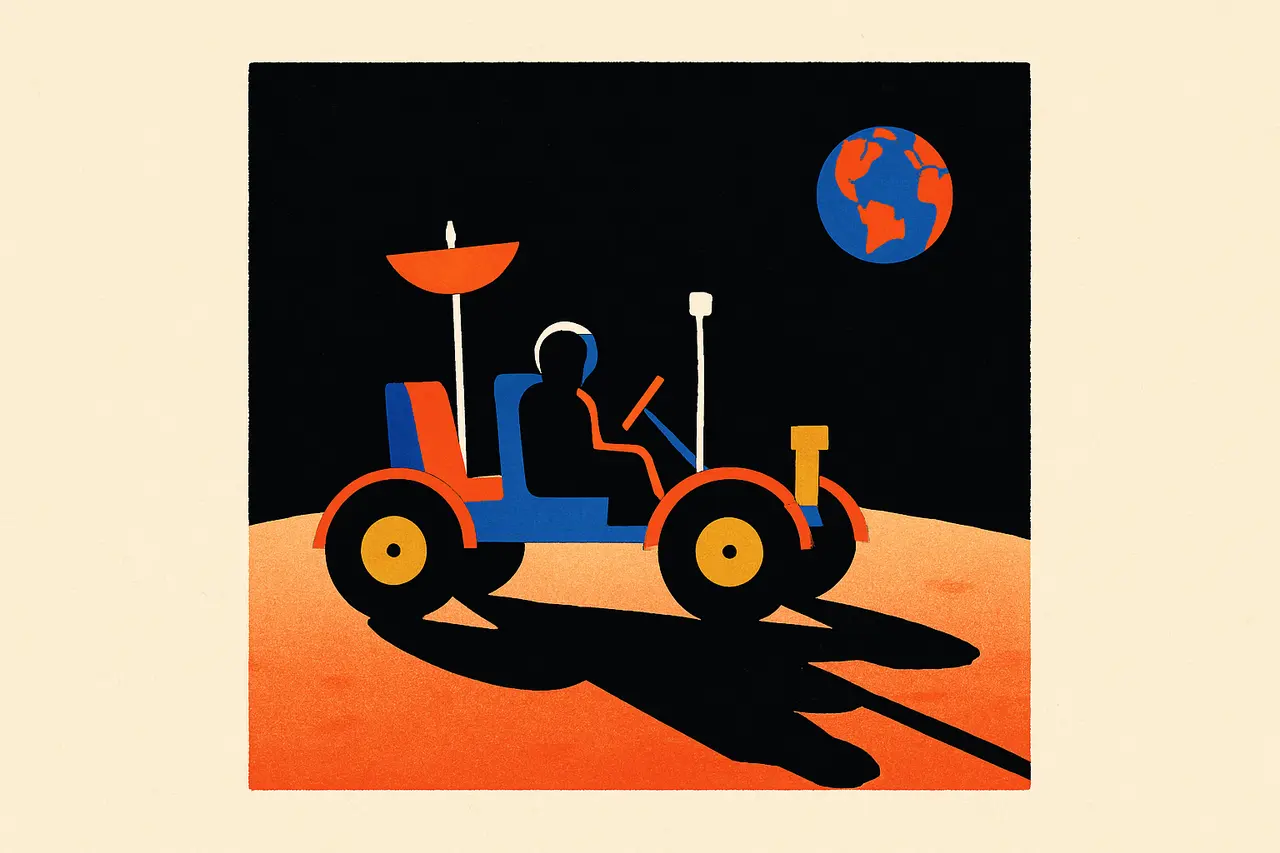
On July 31, 1971, David Scott and James Irwin took humanity's first drive on the Moon — eight months after a Soviet robot got there on wheels.
Apollo 15 astronauts David Scott and James Irwin became the first people to drive on the Moon on July 31, 1971, taking the battery-powered Lunar Roving Vehicle out from their Hadley-Apennine landing site the day after touching down.
Was Apollo 15’s rover the first vehicle on the Moon?
No. The Soviet Lunokhod 1, landed by Luna 17 on November 17, 1970, was the first robotic rover to explore another world, steered by controllers on Earth. What Apollo 15 brought was the first car people drove there, a folding, lightweight buggy with an electric motor in each of its four wheels, built for low gravity and vacuum.
How far from the lander could astronauts go?
Much farther once they had wheels. Before the rover, astronauts in stiff suits stayed close to the lander:
- Apollo 11 (1969): neither moonwalker went more than 55 m from the lander.
- Apollo 14 (February 1971): 1,280 m on foot, the record before the rover.
- Apollo 15 (July 1971): up to 4.8 km away, and 27.9 km driven in total.
- Apollo 17 (1972): 7.5 km, a record that still stands.
The limit was not the rover, which had a range of about 92 km, but safety: crews could not drive farther than they could walk back if it broke down. Over three days on the surface, Scott and Irwin spent a record 18 hours, 37 minutes outside, reaching geology that would have been out of reach on foot. The National Archives credits the rovers with tripling astronauts’ productivity. All three Apollo rovers were left on the Moon, where they remain.
Sources & references
5 referencesWell-established. Corroborated by 4 independent sources.