Apollo 12's rocket triggered the lightning that struck it
On this day · 14 November 1969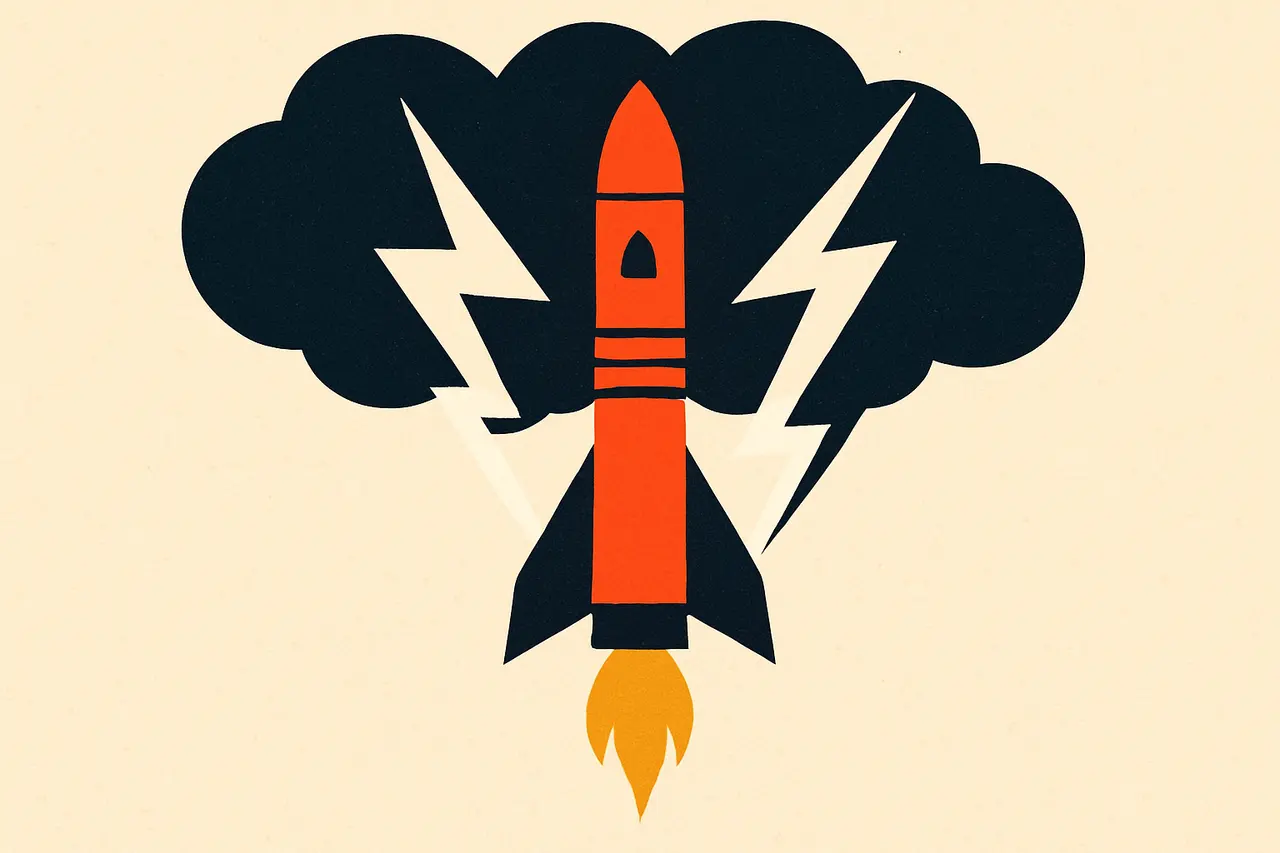
Apollo 12 was hit twice within a minute of liftoff on November 14, 1969 — and experts concluded the rocket itself had triggered both bolts.
Apollo 12 was struck by lightning twice in its first minute of flight on November 14, 1969 — at 36.5 seconds and again at 52 seconds after liftoff from Kennedy Space Center — and the experts who studied it concluded the rocket had triggered both strikes itself.
That is the part most retellings skip. The crew launched into rain under a passing weather front, but there were no other signs of lightning or thunder for six hours before or after liftoff. Scientists discussing the incident at an American Geophysical Union meeting in December 1969 generally agreed that the 110-metre Saturn V, trailing a 500-metre column of ionised exhaust, had distorted the electric field inside a charged cloud and acted as a giant conductor, probably pulling down discharges that the cloud could not have produced on its own.
The rocket kept climbing only because the Saturn V steered itself from its own Instrument Unit, which the strikes left essentially unaffected. The spacecraft was another matter:
- 36.5 seconds: the first bolt knocks all three fuel cells off the line, putting the command module on batteries and scrambling the Signal Conditioning Electronics, so Mission Control sees garbage data.
- 52 seconds: the second strike sends the spacecraft’s guidance platform tumbling.
- About a minute: Pete Conrad radios his bafflement.
- About two and a half minutes: the fuel cells are back on the line.
“I don’t know what happened here; we had everything in the world drop out.” — Pete Conrad, about a minute after liftoff
Flight controller John Aaron recognised the strange readings and his fix, “SCE to Aux”, was relayed up to the crew. Alan Bean flipped the obscure switch and the data returned. The tumbled platform was realigned in orbit before the crew committed to the Moon landing.
NASA’s lightning investigators chose new launch rules over spacecraft changes. From Apollo 13 on, a Saturn V would not launch if its flight path came within 8 kilometres of a thunderstorm, passed through cold-front or squall-line clouds, or crossed cumulus clouds with tops at 3,050 metres or higher.
Sources & references
5 referencesWell-established. Corroborated by 4 independent sources.