Without Cooling Pipes, Hoover Dam Would Still Be Curing
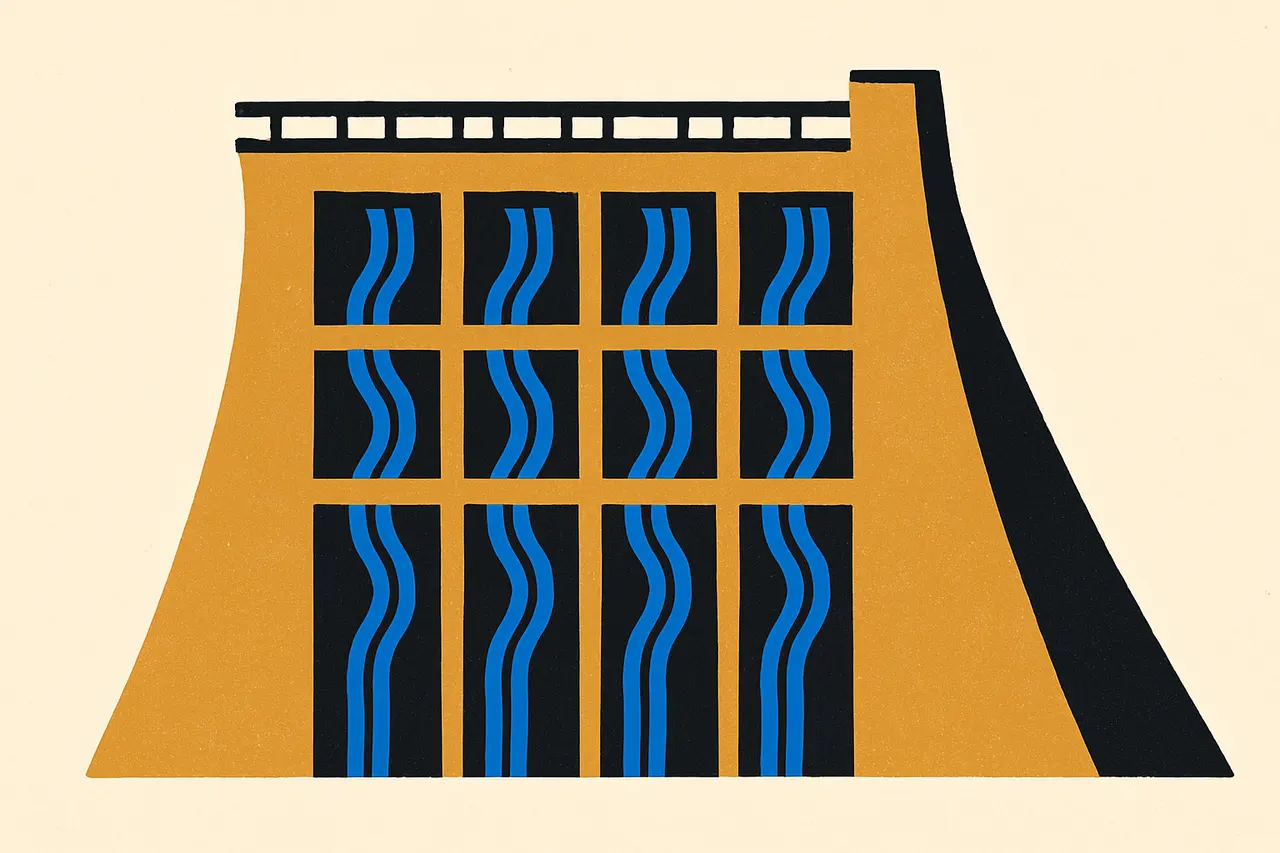
Concrete that big releases so much heat it would have taken over a century to cool, so engineers built a refrigerator inside the dam.
When concrete cures, the cement reacts with water and gives off heat. In a mass as enormous as Hoover Dam — roughly 4.4 million cubic yards of concrete — that heat has nowhere to escape. The U.S. Bureau of Reclamation estimates that if the dam had been poured in one continuous block, the concrete would have taken about 125 years to cool to the temperature of its surroundings.
A slab cooling that slowly would crack as its core shrank against already-hardened outer layers. So engineers built the dam as a grid of interlocking columns and threaded each one with more than 582 miles of one-inch steel pipe.
First river water, then chilled water from an on-site refrigeration plant, ran through the pipes to draw the heat away.
That plant could churn out 1,000 tons of ice a day. Once a block had cooled and shrunk to its final size, workers pumped the pipes full of grout to seal them in place. Pouring ran from June 1933 to May 1935 — and the artificial cooling is why the dam set in a few years instead of more than a century.
Sources & references
3 referencesWell-established. Corroborated by 2 independent sources.