Water boils and freezes at once at 0.01 °C and 611 Pa
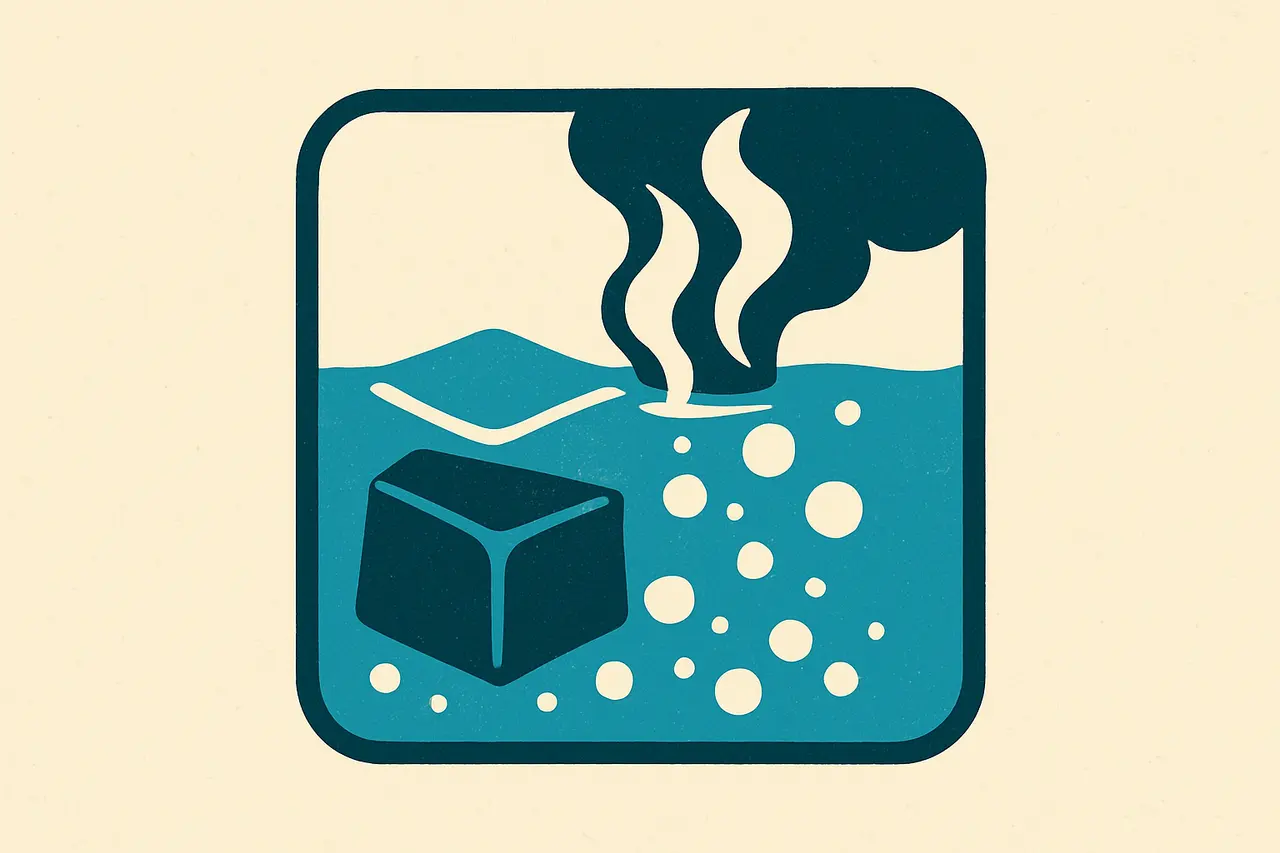
At 273.16 K and a pressure 166 times lower than sea level, ice, liquid and vapour coexist — the point that anchored the kelvin for 65 years.
Water’s triple point is the one combination of temperature and pressure — 273.16 K (0.01 °C) at about 611.7 pascals — at which ice, liquid water and water vapour coexist in stable equilibrium. Under those conditions water melts, freezes, boils and condenses at the same time, with no phase winning.
That pressure is tiny: roughly 1/166th of normal sea-level air pressure. Shift either the temperature or the pressure slightly and the balance tips toward one phase. The figure is not an estimate from a textbook table: in a dedicated 1976 study at the U.S. National Bureau of Standards (now NIST), researchers using a precision mercury manometer measured the vapour pressure at the triple point as 611.657 Pa, with a random uncertainty of just ±0.010 Pa.
Because it is so reproducible, the triple point became the anchor of all temperature measurement. From 1954 until May 2019 the kelvin was defined as exactly 1/273.16 of the triple-point temperature, so every thermometer reading was ultimately a comparison with this one state of water. Celsius follows by subtracting 273.15, which is why the triple point sits a hundredth of a degree above zero.
Even “pure water” was not precise enough. In 2005 the International Committee for Weights and Measures specified that the water must have the isotopic make-up of Vienna Standard Mean Ocean Water, since samples with different mixes of hydrogen and oxygen isotopes need corrections.
Since May 2019 the kelvin has been defined by fixing the Boltzmann constant instead, so the triple point is no longer exact by definition. It is now a measured quantity: the old uncertainty in the Boltzmann constant was transferred to it, giving a standard uncertainty of about 0.1 millikelvin. Its best value is still 273.16 K, and the international thermometry committee says it is unlikely to be revised in the foreseeable future. Sealed triple-point cells therefore still calibrate the world’s most precise thermometers.
Sources & references
5 referencesWell-established. Corroborated by 4 independent sources.