Vantablack absorbs 99.965% of light — but isn't the blackest
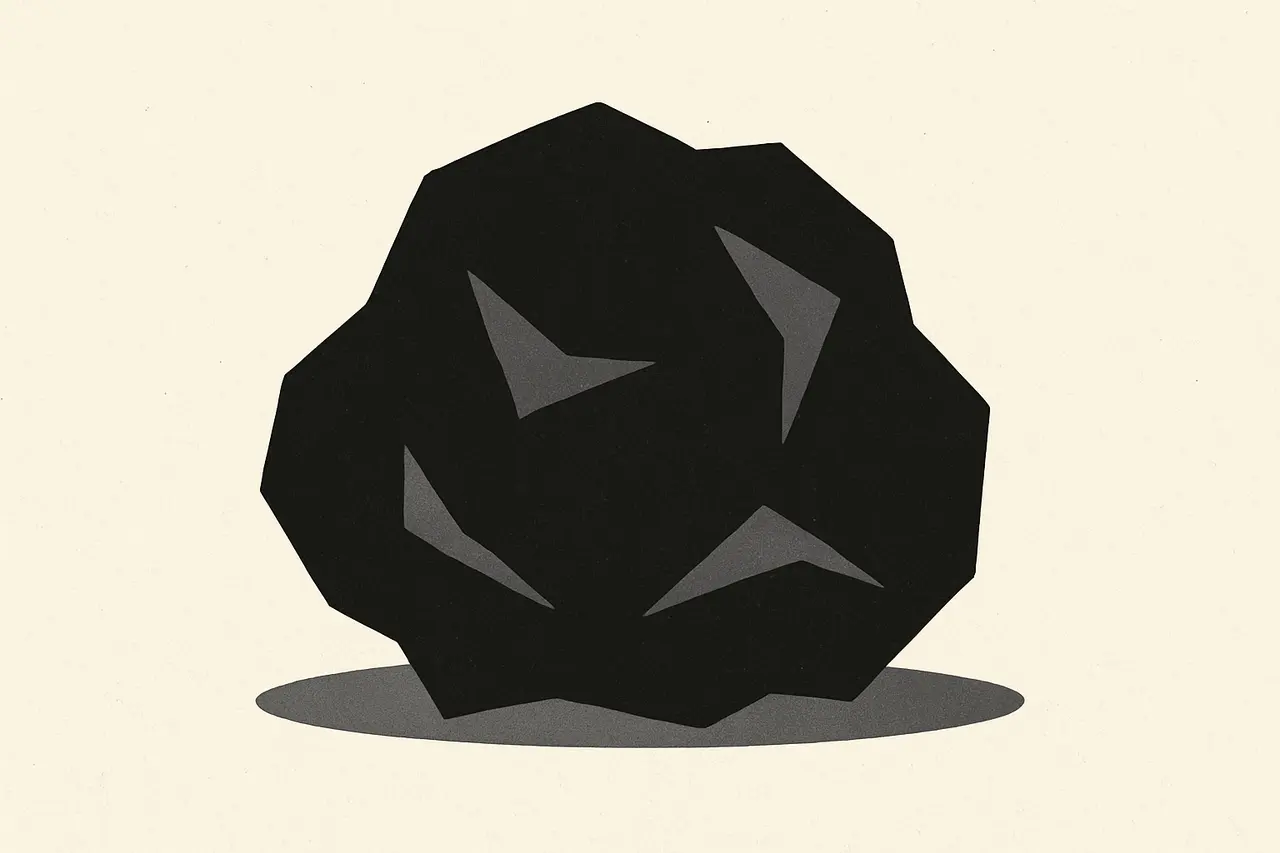
Vantablack swallows 99.965% of light, making 3D shapes look like flat holes. Since 2019 an MIT coating has been blacker still.
Vantablack, the carbon-nanotube coating made by British firm Surrey NanoSystems and first released in 2014, absorbs 99.965% of the ultraviolet-to-infrared light that hits it. But it is no longer the blackest material on record: since 2019 that title has belonged to an MIT coating that captures at least 99.995%.
The name stands for Vertically Aligned NanoTube Array. Carbon nanotubes stand packed together like a dense forest; light that enters bounces from tube to tube and is converted into a trace of heat instead of escaping. Coat a crumpled sheet of foil and its wrinkles vanish, because the eye has almost no reflected light from which to read shape.
The two absorption percentages look almost identical, but what counts is the light that gets back out:
| Vantablack | MIT coating | |
|---|---|---|
| Maker | Surrey NanoSystems | MIT engineers |
| Year | 2014 | 2019 |
| Light absorbed | 99.965% | at least 99.995% |
| Light returned | about 0.035% | at most 0.005% |
MIT says its material reflects 10 times less light than any other superblack, Vantablack included. Engineer Brian Wardle’s group found it by accident while growing nanotubes on chlorine-etched aluminium foil, and artist Diemut Strebe used it to make a 16.78-carat diamond seem to disappear.
Ultra-black coatings exist to kill stray light in cameras and telescopes. Nobel laureate John Mather has explored the MIT material for a star shade to block glare around a space telescope:
“Would you like to see an Earth orbiting another star? We need something very black.” — John Mather
Vantablack has since grown into a family of coatings, used in camera systems, automotive sensors and the art of Anish Kapoor. Its newest job is in orbit. Vantablack 310 will coat one side of Jovian 1, a CubeSat from the universities of Surrey, Portsmouth and Southampton, scheduled in 2025 for launch in 2026, to test whether darkening satellite hulls can stop mega-constellations from spoiling ground-based astronomy.
Sources & references
3 referencesWell-established. Corroborated by 3 independent sources.